
The moment you realize “breathing” isn’t one thing
In IB Biology, gas exchange can feel like one topic until you meet the living world. A bacterium “breathes” by letting oxygen drift across its membrane. A fish runs water past gills like a conveyor belt. An insect basically installs its own internal snorkel network. And you? You carry around millions of tiny sacs that look like bubble wrap.
That variety isn’t random. It’s the quiet logic of physics meeting the messy creativity of evolution. If you can explain why organisms use different gas exchange systems, you can answer almost any exam question on the topic.
IB Biology quick checklist: what decides the gas exchange system?
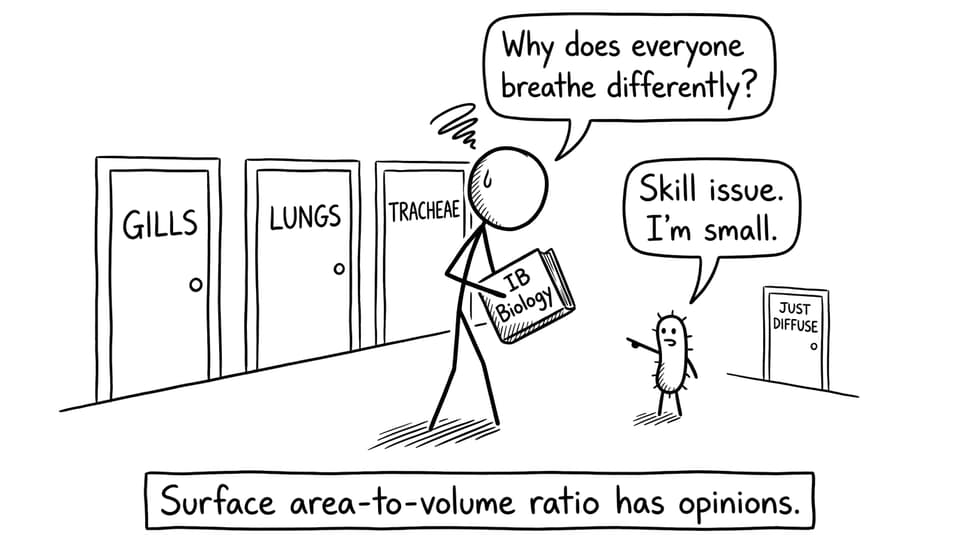
When you see any organism in an IB Biology question, run this checklist:
-
Surface area-to-volume ratio (SA:V): small bodies diffuse; big bodies need structures.
-
Diffusion distance: thin surfaces win.
-
Environment: water vs air changes oxygen availability and dehydration risk.
-
Metabolic rate: higher demand needs faster delivery.
-
Ventilation and transport: moving air/water and moving blood (or not).
-
Evolutionary constraints: organisms modify what they inherited.
For the full syllabus-aligned sequence, anchor your revision to IB Biology Topic B3.1: Gas Exchange Notes.
Surface area-to-volume ratio: the hidden driver in IB Biology
The simplest reason gas exchange systems differ is geometry. As organisms get larger, volume grows faster than surface area. In IB Biology, that means diffusion alone becomes too slow to meet oxygen demand and remove carbon dioxide.
Tiny organisms (like bacteria and many protists) can rely on diffusion across the membrane because:
-
SA:V is high
-
diffusion distances are short
-
metabolic demand per cell is manageable
Once bodies become thicker, something has to change: flattening, folding, branching, or building an internal surface.
If you want a clean SA:V explanation you can borrow in extended responses, use B2.3.6 Surface area-to-volume ratios and constraints on cell size and the supporting blog on how SA:V influences gas exchange efficiency.
Water vs air: why fish need gills and mammals need lungs
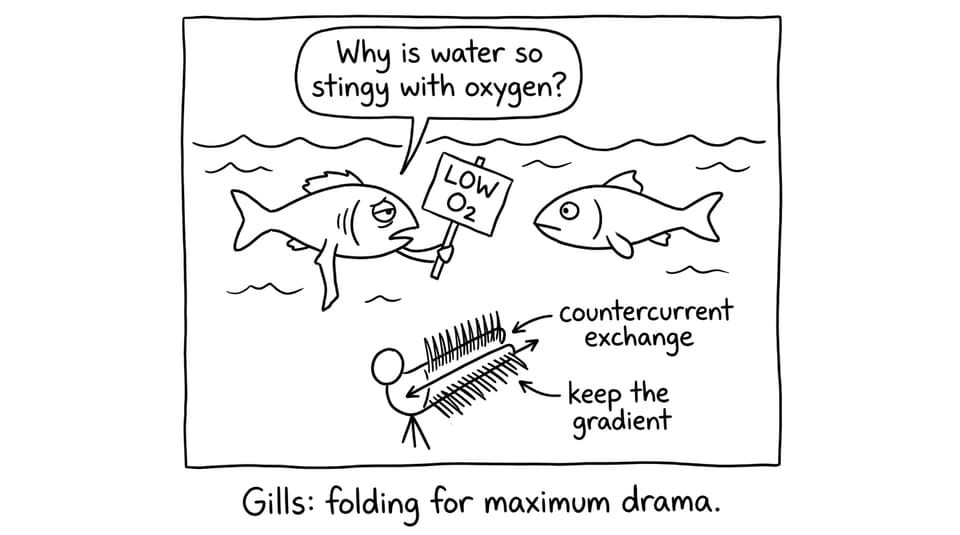
In IB Biology, environment is the second big lever. Water contains much less dissolved oxygen than air, and it’s denser, so ventilating it costs more energy. That’s why aquatic animals tend to have highly efficient, high-surface-area systems.
Gills: high efficiency for low-oxygen water
Fish gills are packed with filaments and lamellae to maximize surface area and keep diffusion distance small. Many fish also use countercurrent exchange, maintaining a steep gradient so oxygen continues to diffuse along the entire gill.
To drill the exact question styles examiners love, practice with the B3.1 Gas exchange Questionbank (SL/HL).
Lungs: protected surfaces for dry land
Air has more oxygen, but it dries things out. Terrestrial animals solve this by putting the exchange surface inside the body, where it stays moist. Mammalian lungs use alveoli to create enormous surface area and a thin diffusion barrier, while ventilation and blood flow maintain gradients.
For exam-ready wording, revise B3.1.4 Adaptations of mammalian lungs for gas exchange Notes and connect it to Notes for 6.4 Gas exchange - IB.
Insects: the “skip the blood” strategy
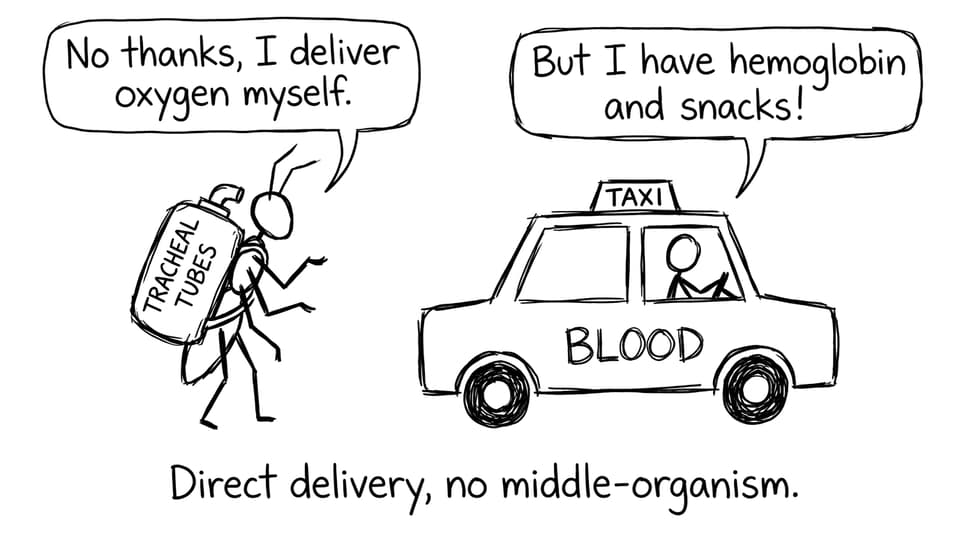
Insects are a favorite curveball in IB Biology because they don’t transport oxygen primarily via blood. Their tracheal system delivers air through tubes directly to tissues, which can be extremely fast for small bodies and high activity.
This works well until size becomes a limit: diffusion through tracheae over long distances becomes too slow, which helps explain why insects don’t scale up indefinitely.
Plants: gas exchange without “breathing”
Plants also show up in IB Biology gas exchange questions because their trade-off is different: they need CO₂ for photosynthesis but risk water loss.
-
Stomata regulate gas exchange and transpiration.
-
Leaf structure helps create diffusion pathways through air spaces.
A quick way to lock this in is daily recall with Flashcards for B3.1.7 Adaptations for gas exchange in leaves.
Bring it home: gas exchange is a story of trade-offs
Gas exchange systems differ because every organism is solving the same problem under different rules. Size changes SA:V ratio. Water changes oxygen availability. Land changes dehydration risk. Metabolic rate changes how fast oxygen must arrive. That’s the core IB Biology logic.
If you want to turn that logic into marks, RevisionDojo is built for it: revise with Study Notes, test yourself with the Questionbank, lock in recall via Flashcards, and use Mock Exams plus Predicted Papers to practice pacing. When you’re stuck, AI Chat helps you rebuild the explanation, and Grading tools show what examiners actually reward. Start with IB Biology Topic B3.1: Gas Exchange and build from there.