

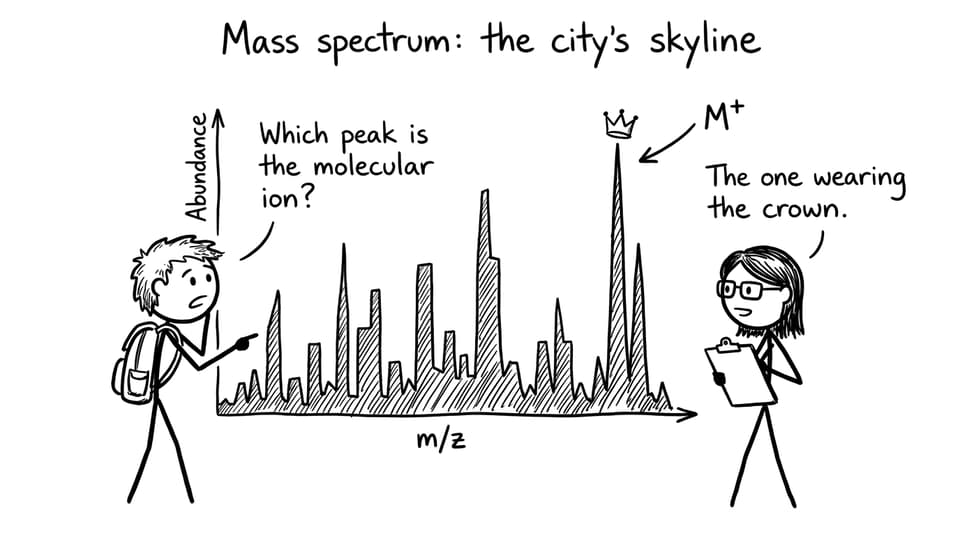
Mass spectra can feel like the exam version of a crowded city skyline. Lots of peaks. Lots of noise. And one quiet detail that changes everything.
In IB Chemistry, the molecular ion peak is that detail. It is the moment a messy unknown compound becomes a number you can trust: its relative molecular mass. Once you learn to find the molecular ion peak quickly, mass spectrometry stops being “guess the tallest peak” and starts being a calm, repeatable method.
Quick checklist for spotting the molecular ion peak (IB Chemistry)
Use this mini-routine whenever you see a spectrum in IB Chemistry:
-
Look near the highest m/z values for a plausible molecular ion peak (ignore tiny noise spikes).
-
Remember most ions are +1, so m/z = Mr for the molecular ion.
-
Check for M+1 and M+2 patterns (isotopes can sit next to the molecular ion peak).
-
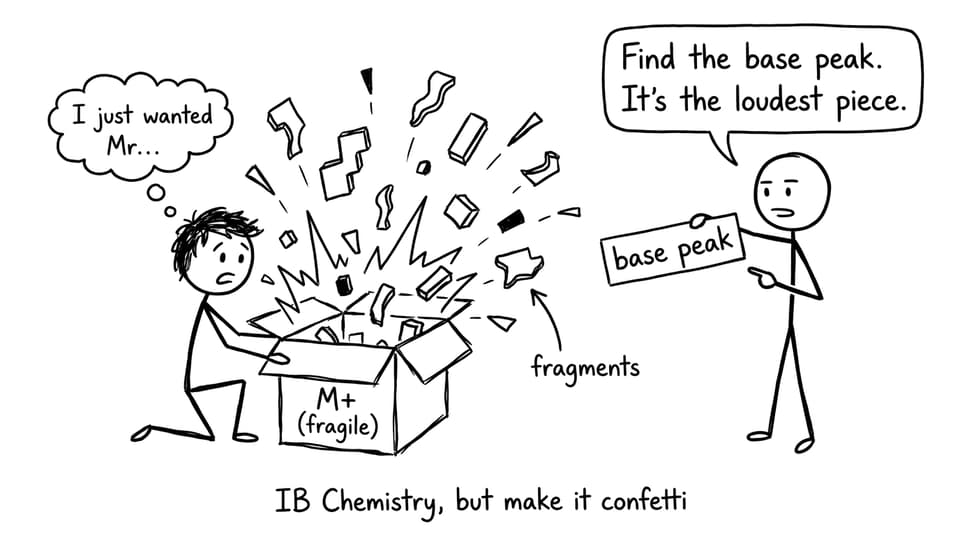
Identify the base peak separately (it is the tallest, not necessarily the molecular ion peak).
-
If M+ looks weak or missing, use isotopes and fragments more heavily.
For the syllabus-aligned foundations, pair this with RevisionDojo’s notes on S3.2.8 Mass spectrometry (HL) and S1.2.3 Mass Spectrometry (HL).
What the molecular ion peak actually is
In mass spectrometry (as taught in IB Chemistry Topic 11/21 style questions), a sample is ionised, and the machine measures ions by their mass-to-charge ratio, m/z.
The molecular ion (also called the parent ion) forms when the molecule loses one electron but does not break apart:
[ M \rightarrow M^{+\cdot} + e^- ]
That radical cation still represents the whole molecule, so its m/z value corresponds to the compound’s relative molecular mass (the electron’s mass loss is negligible at this level).
The molecular ion peak is the peak on the spectrum that corresponds to this intact ion, M+·.
If you want a clean definition you can reuse in explanations, RevisionDojo’s IB Chemistry glossary phrases these key terms in an exam-friendly way.
How the molecular ion peak forms (and why it is often fragile)
A useful way to picture electron-impact ionisation is: the instrument is trying to tag your molecule with a charge so it can be guided and detected. The problem is the tagging process is violent.
The steps you should hold in your head for IB Chemistry:
-
The sample is vaporised.
-
High-energy electrons knock an electron out of the molecule.
-
The molecule becomes a radical cation, M+·.
-
The detector records its m/z, producing the molecular ion peak.
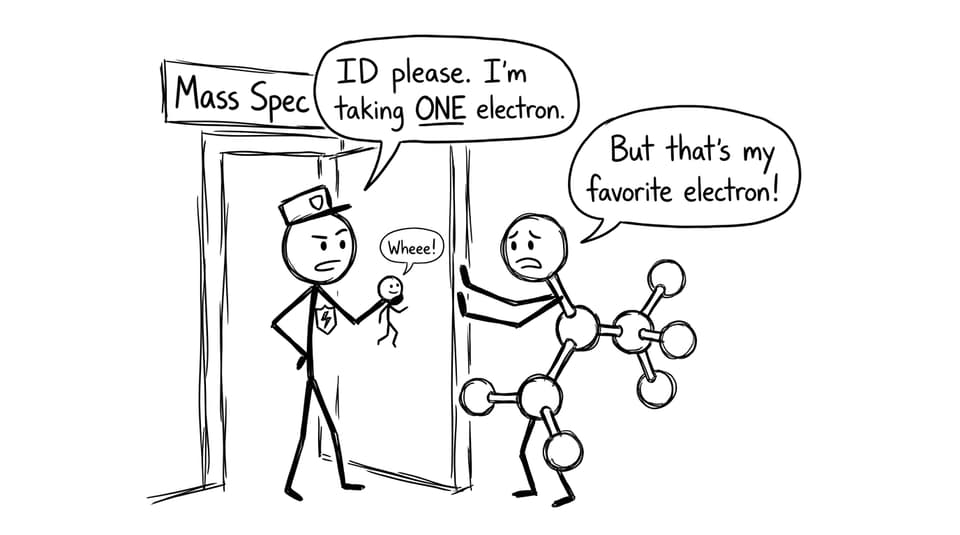
Because M+· is often unstable, it can fragment quickly. That is why, in many spectra, the molecular ion peak exists but is not the tallest. In IB Chemistry, students lose marks by assuming “tallest peak = molecular ion peak” instead of separating molecular ion peak vs base peak.
Molecular ion peak vs base peak vs isotope peaks
Molecular ion peak (M+)
-
Represents the intact molecule.
-
Usually the highest meaningful m/z peak for the compound (apart from isotope peaks).
-
Gives Mr directly when charge is +1.
Base peak
-
The tallest peak.
-
Represents the most abundant ion (often a stable fragment).
-
Helpful structurally, but it is not automatically Mr.
Isotopic peaks (M+1, M+2)
-
Sit near the molecular ion peak.
-
Come from naturally occurring isotopes (notably 13C; and halogens like Cl and Br).
-
Act like “fingerprints” for certain atoms.
RevisionDojo’s S3.2.12 Structural Analysis (HL) notes are a strong next step if you want to connect M+, fragments, and identification in one workflow.
Exam patterns IB Chemistry students should recognise fast
Propanone (acetone)
Propanone has Mr = 58, so a molecular ion peak around m/z 58 is your anchor. After that, fragments help confirm functional groups and common cleavages.
Chlorine-containing compounds
Chlorine shows two common isotopes (35Cl and 37Cl), producing an M and M+2 pattern with a 3:1 ratio in peak heights. In IB Chemistry, this is one of the quickest wins on unknown identification.
If you want the isotope story to feel less magical, revisit S1.2.2 Isotopes notes and then come back to spectra.
Bromine-containing compounds
Bromine’s two common isotopes (79Br and 81Br) give an M and M+2 pattern with a 1:1 ratio. When you see equal twins two units apart near the molecular ion peak, you should immediately think “Br”.
When the molecular ion peak is weak (or looks missing)
This is where IB Chemistry questions try to trip you with confidence.
Some compounds fragment so readily that the intact M+· is low intensity. You will commonly see this with molecules that form especially stable fragments, or with structures that break apart easily under electron impact (for example, many alcohols and highly branched molecules).
Your response strategy:
-
Still scan the highest m/z region for a small but real molecular ion peak.
-
Use M+2 patterns to confirm halogens even if the molecular ion peak is faint.
-
Lean on the base peak and common fragment losses (your Data Booklet helps here).
For targeted practice, RevisionDojo’s Structural Analysis Questionbank (HL) is ideal because it forces you to identify the molecular ion peak under exam-style pressure.
Closing: the calm way to earn marks with the molecular ion peak
The molecular ion peak is the quiet anchor point of mass spectrometry. In IB Chemistry, it turns a spectrum from “lots of peaks” into one clear starting number: Mr. From there, isotope patterns and fragmentation stop feeling random and start feeling like clues that agree with each other.
If you want this to stick under exam timing, use RevisionDojo as your daily practice loop: the Study Notes to learn the method, Flashcards for peak pattern recall, the Questionbank to build speed, and AI Chat to talk through spectra you get wrong. When you are close to exams, layer in Predicted Papers, Mock Exams, and Grading tools to simulate pressure, and use the Tutors and Coursework Library when you need targeted support.
For more skills that connect to spectroscopy questions, you can also explore Infrared Spectroscopy Explained and NMR Spectroscopy Explained Simply alongside this IB Chemistry guide.