


Metal doesn’t look mysterious until you try to explain it under exam pressure.
You know the feeling: you’re halfway through an IB Chemistry question, you’ve written “delocalised electrons,” and suddenly your brain asks, Okay… but why does that make aluminium conduct electricity and bend without snapping? Metallic bonding is one of those topics that feels simple in a diagram and slippery in a 4-mark explanation.
This guide makes the model feel real, then shows you how to write it in the tight, mark-friendly language IB Chemistry rewards.
Quick checklist: what you must say in IB Chemistry
If you can recall these points quickly, you can answer most IB Chemistry metallic bonding questions cleanly:
-
Metallic bonding happens in a lattice of metal cations.
-
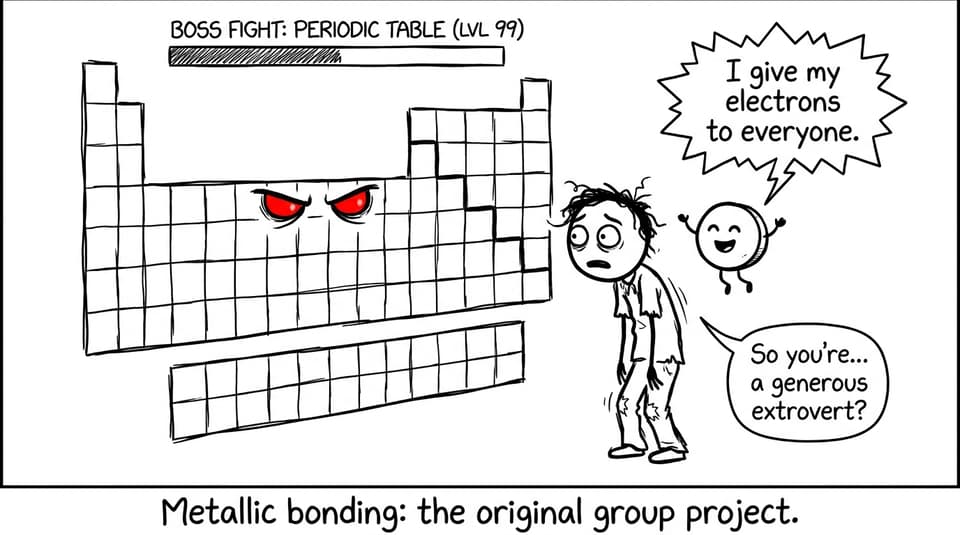
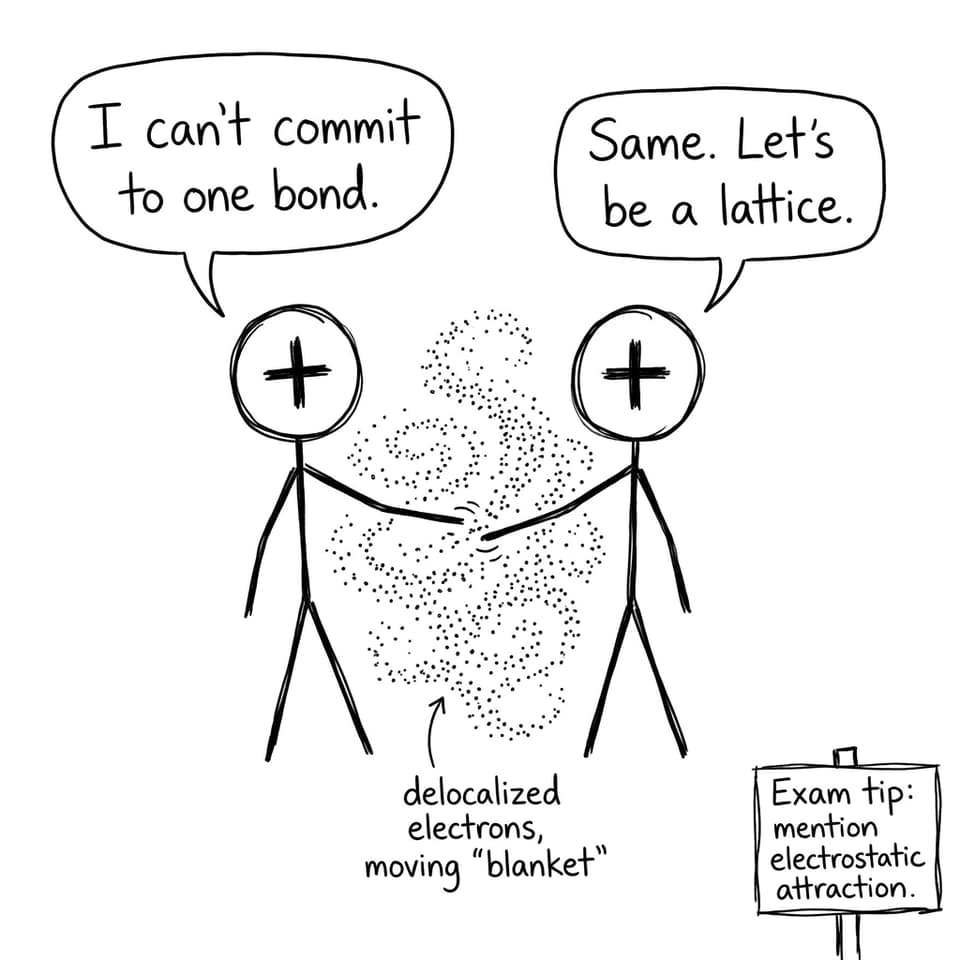
Outer electrons become delocalised (shared across the whole structure).
-
The bond is electrostatic attraction between cations and delocalised electrons.
-
The structure is giant (extended lattice, not molecules).
-
Delocalised electrons explain electrical conductivity and thermal conductivity.
-
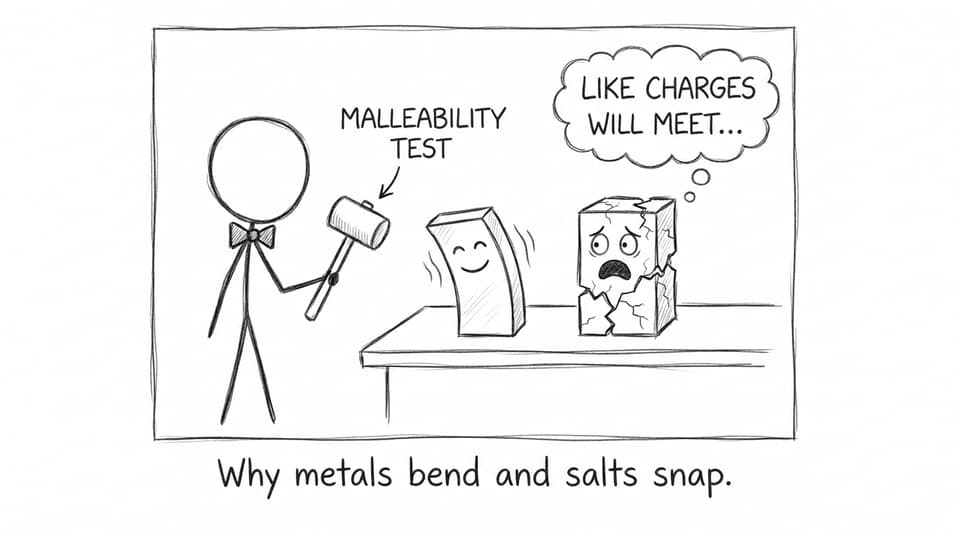
Non-directional bonding explains malleability and ductility.
For a syllabus-aligned home base, keep the IB Chemistry topic hub open while you revise: IB Chemistry Resources.
What metallic bonding actually is (in exam language)
In IB Chemistry, metallic bonding is defined as the electrostatic attraction between:
-
a lattice of positive metal ions (cations), and
-
a sea of delocalised electrons.
When metal atoms pack together, their outer-shell electrons are no longer held tightly to a single nucleus. Those electrons become mobile across the entire lattice. The metal atoms effectively become cations, and the shared electrons act like a glue that holds the structure together.
If you want to see this placed precisely in the syllabus sequence, these are useful for quick reference:
The “sea of electrons” model (and why IB Chemistry loves it)
The sea model matters because it links structure to properties. That’s a recurring pattern in IB Chemistry: if you can describe the particles, you can justify what we observe.
Electrical conductivity
Metals conduct electricity in the solid state because delocalised electrons can move through the lattice. When you apply a potential difference, electrons drift and carry charge.
A focused explanation you can copy into your head is here: IB Chemistry: Why Metallic Bonds Conduct Electricity.
Thermal conductivity
Those same delocalised electrons transfer kinetic energy quickly across the structure. Energy moves efficiently because the charge carriers are mobile and the lattice is closely packed.
Malleability and ductility
Metallic bonding is non-directional. If layers of ions slide, the sea of electrons shifts too, so attraction is maintained. That’s why metals bend, roll, and draw into wires instead of shattering.
Lustre (shiny appearance)
Metals look shiny because electrons can absorb and re-emit light (photons). In IB Chemistry terms: the delocalised electrons interact with electromagnetic radiation, producing reflectivity.
What changes metallic bond strength?
Bond strength in IB Chemistry metallic bonding questions usually comes down to three ideas:
-
More delocalised electrons per atom: stronger attraction.
-
Higher ionic charge (e.g., 2+ vs 1+): stronger attraction.
-
Smaller ionic radius: electrons are closer to the positive charge, strengthening attraction.
That’s why aluminium tends to have stronger metallic bonding than sodium: Al forms Al3+ and contributes more delocalised electrons, creating a stronger electrostatic pull.
For a clean, mark-ready set of notes on trends, use: S2.3.2 Strength of metallic bonds notes.
HL students can also connect this to transition metals, where delocalised d-electrons can contribute to bonding strength: S2.3.3 Transition elements and delocalized d-electrons (HL).
Alloys: metallic bonding with a twist
An alloy is a mixture of a metal with one or more other elements (often another metal). In IB Chemistry, the key story is structural:
-
Pure metals have regular layers that slide easily.
-
Alloys introduce different-sized atoms that distort the lattice.
-
Distortion makes it harder for layers to slide, so alloys are often stronger.
This idea is common in data-response questions where you compare hardness, tensile strength, or corrosion resistance.
When you want to practise questions that test structure-property links under time pressure, use RevisionDojo’s targeted practice:
How to write a high-mark metallic bonding answer
A quiet truth of IB Chemistry is that most lost marks come from missing link words, not missing knowledge. Aim for this shape:
-
Structure: “giant lattice of positive ions + delocalised electrons”
-
Cause: “electrostatic attraction”
-
Property: “therefore conducts / therefore malleable / therefore high melting point”
If you want a reliable template for building explanations that match markschemes, read: Structure IB Answers to Maximize Marks.
Closing: make metallic bonding easy to recall under pressure
Metallic bonding in IB Chemistry is simple, but not shallow: a lattice of positive ions, a sea of delocalised electrons, and electrostatic attraction that explains conductivity, strength, and malleability. Once you can say that in one calm paragraph, you stop guessing and start earning predictable marks.
If you want to turn that calm understanding into exam performance, RevisionDojo is built for the full loop: Study Notes for clarity, Flashcards for recall, Questionbank for targeted drills, AI Chat for instant explanations, Grading tools to tighten your wording, plus Mock Exams, Predicted Papers, the Coursework Library, and Tutors when you want human feedback.
For a broader view of how Chemistry fits your overall IB science pathway, you might also like: Which Science Should I Take in IB? Bio vs Chem vs Physics.


