When you first meet limiting reagent questions in IB Chemistry, they feel unfair in a very specific way: you do everything “right,” and the reaction still refuses to give you the amount of product you expected.
It’s like packing for a trip and realizing your charger is missing. You can have the suitcase, the passport, and the enthusiasm. But without that one item, the whole plan shrinks.
That’s the core idea: in IB Chemistry, reactions don’t care how much of some reactants you brought. They care whether you brought the right ratio.
What “limiting reagent” means in IB Chemistry
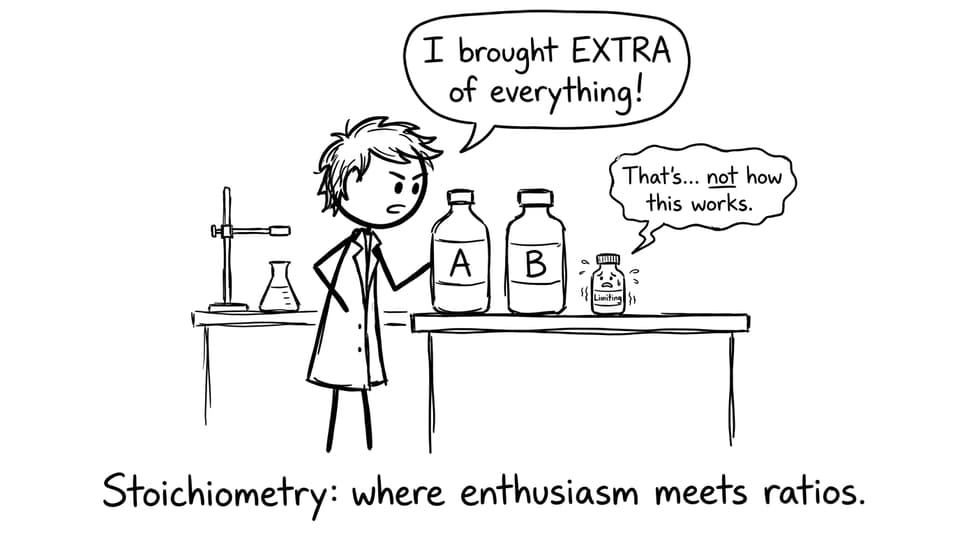
A limiting reagent (limiting reactant) is the reactant that gets completely used up first, which forces the reaction to stop. Because the reaction stops when the limiting reagent runs out, it determines the maximum amount of product you can form (your theoretical yield).
If you want the exact syllabus framing, it sits neatly inside reacting masses and stoichiometry (see 1.3 Reacting masses and volumes and the linked notes).
A quick limiting reagent checklist (exam-proof)
Use this every time a limiting reagent problem appears in IB Chemistry:
-
Balance the chemical equation first
-
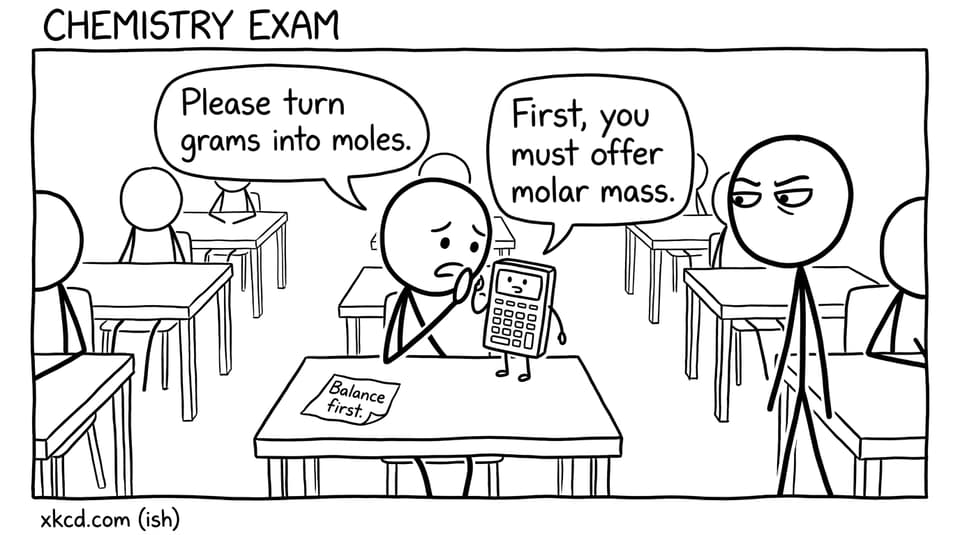
Convert every reactant to moles (mass to moles, or solution moles using concentration × volume)
-
Compare using the mole ratio from the balanced equation
-
The reactant that can make the least product is the limiting reagent
-
Use the limiting reagent to calculate theoretical yield, then any excess remaining
If your mole skills feel shaky, revisit the foundations with The Mole Explained Clearly for IB Chemistry.
The method that actually works (without guessing)
Balance the equation first (always)
In IB Chemistry, the balanced equation is not decoration. It’s the rulebook.
Example:
N₂ + 3H₂ → 2NH₃
That “1 to 3” ratio is the entire story.
Convert everything to moles
Common conversions:
-
Mass: moles = mass ÷ molar mass
-
Solutions: moles = concentration × volume
If you’re working with solutions and units confuse you, bookmark What is the unit for concentration in chemistry? (IB Chemistry).
Compare how much product each reactant could form
A reliable rule for IB Chemistry: calculate the moles of product from each reactant separately (using the mole ratio). The smaller answer comes from the limiting reagent.
This avoids ratio mistakes and keeps your logic visible for method marks.
Worked example (IB-style) with clean reasoning
Reaction:
2Al + 3Cl₂ → 2AlCl₃
Given:
-
5.0 g Al
-
10.0 g Cl₂
Step 1: Convert to moles
-
Al: 5.0 ÷ 27.0 = 0.185 mol
-
Cl₂: 10.0 ÷ 71.0 = 0.141 mol
Step 2: Find moles of product possible from each reactant
From the equation:
-
2 mol Al makes 2 mol AlCl₃ (so 1:1 between Al and AlCl₃)
-
3 mol Cl₂ makes 2 mol AlCl₃
So:
-
From Al: 0.185 mol Al → 0.185 mol AlCl₃
-
From Cl₂: 0.141 mol Cl₂ × (2/3) = 0.0940 mol AlCl₃
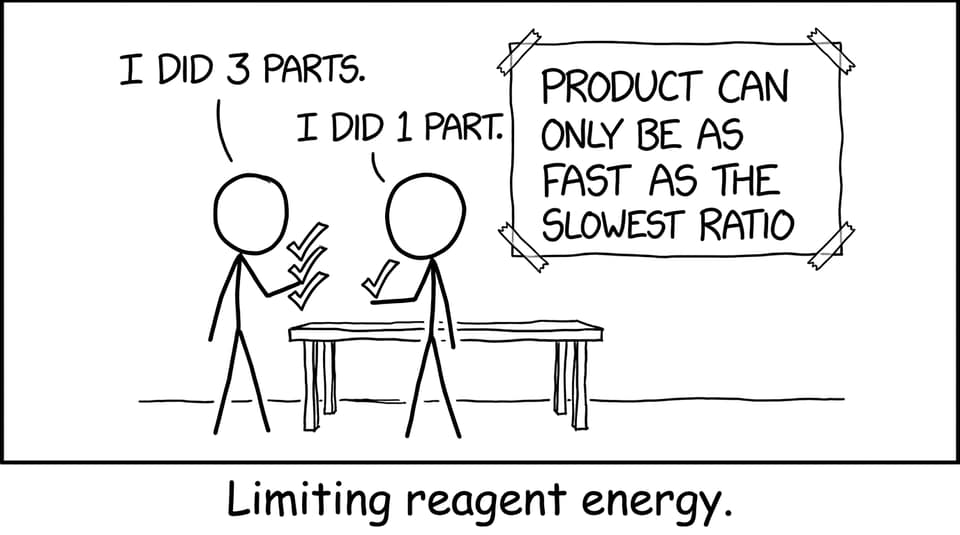
Because chlorine produces less product, Cl₂ is the limiting reagent.
That’s the reaction’s bottleneck. Everything else is extra.
Limiting vs excess reactant (how IB Chemistry words it)
Limiting reagent
-
Gets completely consumed
-
Caps the theoretical yield
-
Drives every later calculation (yield, leftover mass, percentage yield)
Excess reagent
-
Remains after the reaction stops
-
Can be calculated once the limiting reagent is known
This becomes especially important when the question pivots to efficiency. For that next step, see IB Chemistry: How to Calculate Percent Yield Fast.
Common mistakes IB students make (and how to dodge them)
Forgetting the equation is a ratio statement
Many students treat coefficients like “multipliers” rather than a recipe. In IB Chemistry, coefficients say: these amounts must react together.
Comparing masses instead of moles
A bigger mass does not mean more particles. Always convert.
Not showing the “product from each reactant” comparison
Even if you can do it mentally, writing it out reduces silly errors and increases method marks.
If you want targeted practice on exactly these traps, use RevisionDojo’s Questionbank or jump straight into the syllabus-aligned R2.1 How much? The amount of chemical change plus the matching R2.1 Questionbank.
Bringing it home (and turning it into marks)
Limiting reagent questions are really questions about restraint. In IB Chemistry, the reaction can only move as far as the scarcest required ingredient allows. Once you train yourself to balance, convert to moles, and compare product amounts, the “mystery” disappears.
To lock this in before exams, build a short routine: read the core theory in the IB Chemistry glossary, practise mixed stoichiometry sets in the R2.1 Questionbank, then simulate pressure with RevisionDojo’s IB Chemistry Predicted Papers. Add Flashcards, Study Notes, AI Chat for quick checks, and Grading tools for honest feedback, and this topic stops being a stumbling block and becomes easy marks.


