


When two people read the same paragraph and disagree on what it’s worth, you feel it in your stomach.
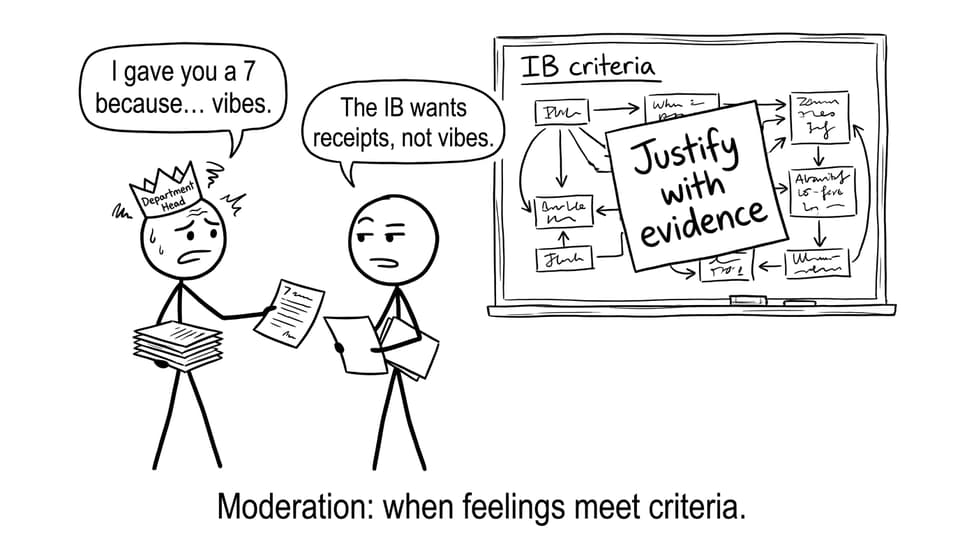
In the IB, that moment matters because marks aren’t supposed to depend on who happened to be holding the pen. They’re supposed to depend on evidence: what you actually did, and how it matches the criteria. That’s the quiet purpose of departmental moderation, making sure assessment is consistent, fair, and defensible.
For students preparing for IB exams, moderation can sound like a teacher-only process happening behind closed doors. But it directly shapes your reality: the feedback you receive, the markbands you’re trained toward, and how confidently you can trust your grades. When moderation is done well, it doesn’t just protect fairness. It trains a department to speak the same assessment language, so you can learn what the IB is truly rewarding.
Quick checklist: what strong IB moderation looks like
If you’re curious what your school should be doing (and what you can ask for), this is the simplest checklist:
-
Shared understanding of IB criteria and markbands (not “gut feel” marking)
-
Regular moderation meetings after major assessments
-
Anonymised samples to reduce bias
-
Clear notes on what the department agreed the criteria mean
-
Action steps that change teaching (not just numbers)
This is also why student-facing clarity matters: the more your teachers agree on what the IB wants, the more predictable your path to higher marks becomes.
What “departmental moderation” means in IB (in plain language)
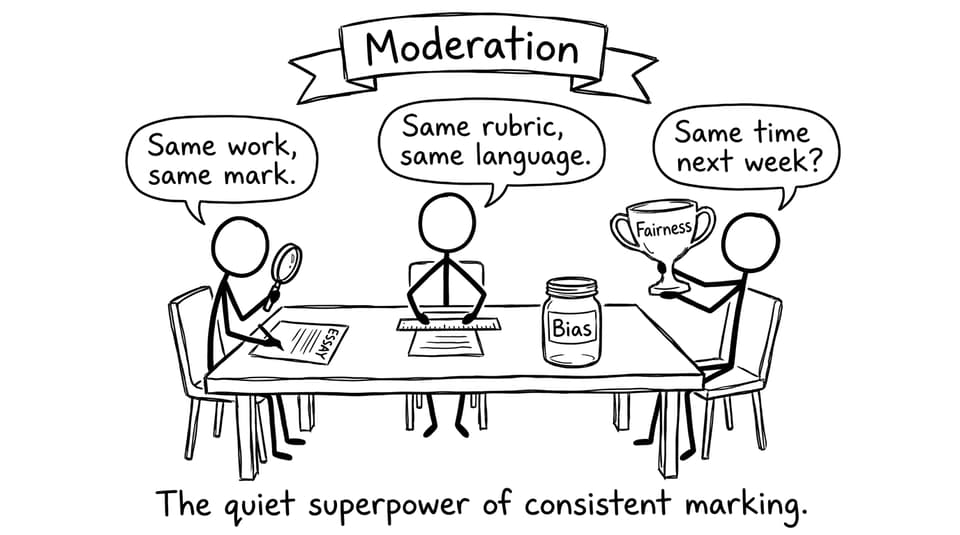
Departmental moderation is a structured process where teachers compare marking decisions and calibrate to the same standard. In the IB, that standard is the published criteria, markbands, and exemplar interpretations.
Think of it like tuning instruments before a concert. Everyone might be playing the same piece, but if one person is slightly sharp and another slightly flat, the audience hears chaos. Moderation is how departments reduce that chaos.
For students, the benefit is simple: two equally strong essays should earn similar marks, even if they’re marked by different teachers. And your feedback should be aligned to the same expectations you’ll face in the IB exams and internally assessed components.
If you want to understand the criteria language teachers are calibrating to, keep this guide open while you revise: IB Grading Criteria Breakdown.
Why IB moderation matters for your exam prep (even if you never see it)
Moderation is not only about protecting fairness. It also creates consistency in training.
When a department moderates well, three things happen for IB students:
You stop chasing “teacher preferences”
A lot of exam stress comes from invisible rules: “Mr. X likes introductions,” “Ms. Y hates long paragraphs,” “This teacher marks harshly.” Good IB moderation reduces that noise. You can focus on what the criteria actually reward.
Feedback becomes more usable
Feedback isn’t helpful when it’s vague or inconsistent. Moderation pushes departments toward criterion-referenced comments: what you did, which strand it belongs to, and what to do next.
If your feedback feels confusing, it’s often because criteria language isn’t being used consistently. This is also where student tools can help you translate feedback into action: RevisionDojo’s IB Coursework Grader gives rubric-aligned breakdowns so you can revise with precision.
Your confidence becomes evidence-based
Students don’t need constant reassurance. They need repeatable proof. A moderated department creates predictable marking patterns, which lets you build strategy: timed practice, targeted improvements, and realistic self-assessment.
For exam-shaped practice that mirrors how the IB rewards marks, use RevisionDojo’s Questionbank alongside the criteria guides.
From compliance to collaboration: the moderation shift that helps students
Some schools treat moderation like paperwork: adjust a few marks, tick a box, move on. That version rarely changes student outcomes.
The departments that help students most treat IB moderation as collaborative inquiry. They don’t just ask “Do we agree on the score?” They ask:
-
“What evidence shows this meets the descriptor?”
-
“Which criterion language are we interpreting differently?”
-
“What misconceptions does this reveal about our teaching?”
That mindset matters because the IB doesn’t reward effort. It rewards demonstrated achievement against criteria. When teachers discuss evidence carefully, they build a shared mental model of what strong work looks like.
If you’re interested in how schools systematise this kind of consistency, this article connects the dots: How RevisionDojo Strengthens IB Department Collaboration and Consistency.
A simple structure for effective IB moderation meetings
You don’t need to be in the meeting to benefit from it. But it helps to know what “good” looks like.
Preparation: choose samples that represent reality
Teachers collect student work across the mark range. The goal isn’t to cherry-pick brilliance. It’s to see the full spread: what low, mid, and high performance actually looks like in this cohort.
Anonymising samples reduces bias. It’s harder to “see the student” and easier to see the evidence.
Independent marking: commit before you compare
Each teacher marks the same pieces using IB criteria first, independently. This matters because it reveals genuine differences in interpretation.
Discussion: focus on reasoning, not authority
In strong departments, the conversation sounds like:
-
“Where is the analysis?”
-
“Does this actually evaluate, or is it descriptive?”
-
“Which descriptor phrase is the best match?”
Not: “I’ve been teaching longer, so trust me.”
Documentation: write down what you agreed
The biggest waste in moderation is repeating the same debate every term. Departments should record:
-
The agreed interpretation of tricky criteria phrases
-
Examples of what “top band” evidence looked like
-
Common student mistakes to address in teaching
Students benefit when these decisions turn into clearer task sheets, clearer feedback, and more predictable marking.
IB criteria as a shared language (and how you can use it)
The fastest way to feel in control of IB assessment is to speak the same language as the rubric.
Even if your school doesn’t show you moderation notes, you can still train yourself to write in “criteria sentences,” like:
-
“This claim is supported by specific evidence from…”
-
“This comparison shows similarity in X, but difference in Y, which suggests…”
-
“A limitation of this approach is…, which affects…”
That’s not robotic. It’s strategic. It makes your work easier to justify, which is exactly what moderation rewards.
For deeper rubric interpretation (especially where judgment is involved), this is worth reading: Balancing Teacher Judgment with IB Rubrics.
Digital tools that make IB moderation faster (and student feedback clearer)
Modern departments often use shared folders and spreadsheets. That’s a start. But the IB workload is heavy, and “start” isn’t always enough.
This is where platforms like RevisionDojo matter, because they connect the teacher process to the student experience. For example:
-
Grading tools help teachers anchor feedback to criteria (and help you see what to fix)
-
A Coursework Library helps you understand what strong work looks like before you submit
-
AI Chat can clarify what a command term demands when feedback feels vague
-
Tutors add a human layer when you want high-stakes, detailed correction
And for exam prep, the same ecosystem matters: Study Notes for clarity, Flashcards for recall, Mock Exams and Predicted Papers for realism.
If you want a simple study loop that matches how the IB actually tests you, use: RevisionDojo App: The Smarter Way to Prep for IB Exams.
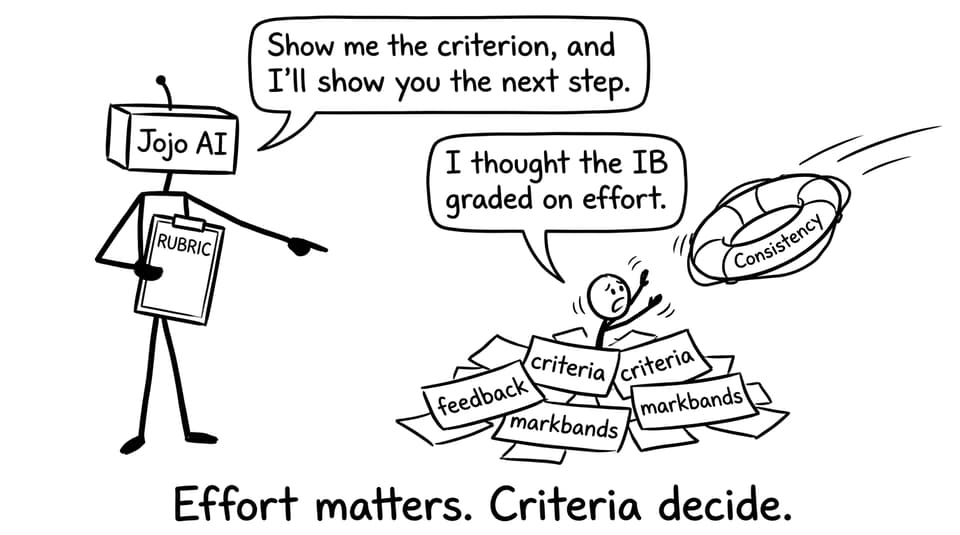
The student takeaway: consistency is a strategy, not a slogan
The fairest version of the IB is the version where your grade depends on your evidence, not your marker. Departmental moderation is how schools try to make that promise real.
And you can benefit from it even more when your own revision is consistent too: daily recall, frequent exam-style practice, fast feedback, and clear fixes. That’s the point of RevisionDojo as an IB home base: Study Notes, Flashcards, AI Chat, Questionbank, Grading tools, Predicted Papers, Mock Exams, a Coursework Library, and Tutors when you want a human to tighten the standard.
If you want your next assessment to feel less like a mystery and more like a method, start building your loop on RevisionDojo: RevisionDojo | IB & MYP Resources.