
Balancing teacher judgment with IB rubrics can feel like watching two different worlds collide.
One world is tidy: descriptors, bands, and criteria that promise fairness. The other world is human: a teacher noticing the quality of your insight, the awkward sentence that still contains a great idea, the method that’s almost right but not quite replicable.
If you’re an IB student preparing for exams, this matters more than you think. Because your best revision isn’t just “learn more content.” It’s learning to show evidence the way the rubric rewards it, and understanding how teacher judgment fills in the gaps when your work lives between boxes.
Quick checklist: make teacher judgment work for you (not against you)
Use this mini routine any time you get feedback, a score, or a confusing comment:
-
Translate feedback into IB rubric language (which criterion is it really about?).
-
Ask for one concrete example of “what would move me up one level?”
-
Highlight “borderline” moments in your work where judgment mattered.
-
Build a tiny evidence map: claim, then evidence, then explanation, then criterion.
-
Rehearse the fix using timed practice, not endless rewriting.
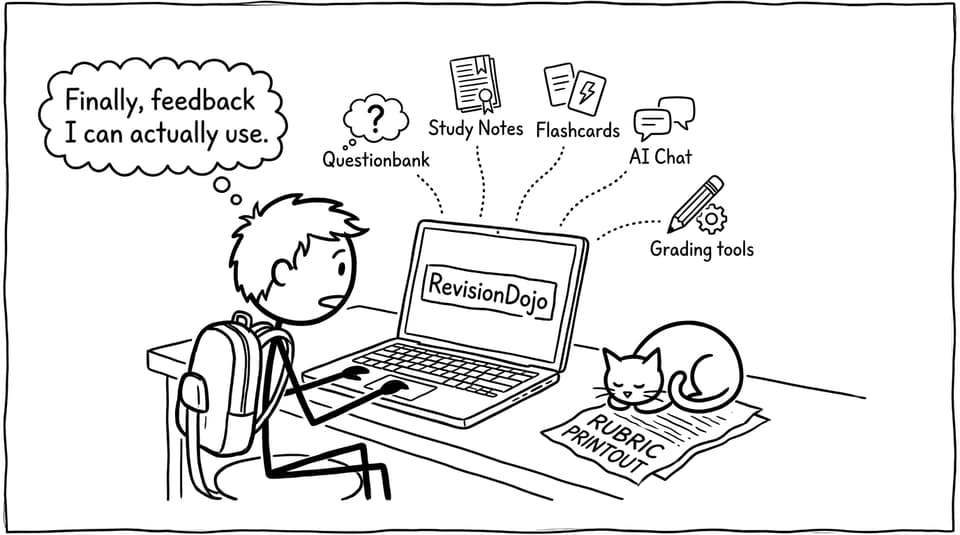
If you want a structure to run this weekly, RevisionDojo’s core loop (Study Notes, then Flashcards, then Questionbank) is built around that same IB idea: evidence first, then accuracy, then clarity. Start at the main RevisionDojo IB hub.
Why IB rubrics matter (and why they’re not just checklists)
IB rubrics exist for a simple reason: schools across the world need a shared definition of quality. In theory, your work should be judged by the same standard whether you’re in Singapore, Nairobi, or Madrid.
But rubrics don’t grade work by themselves. People do.
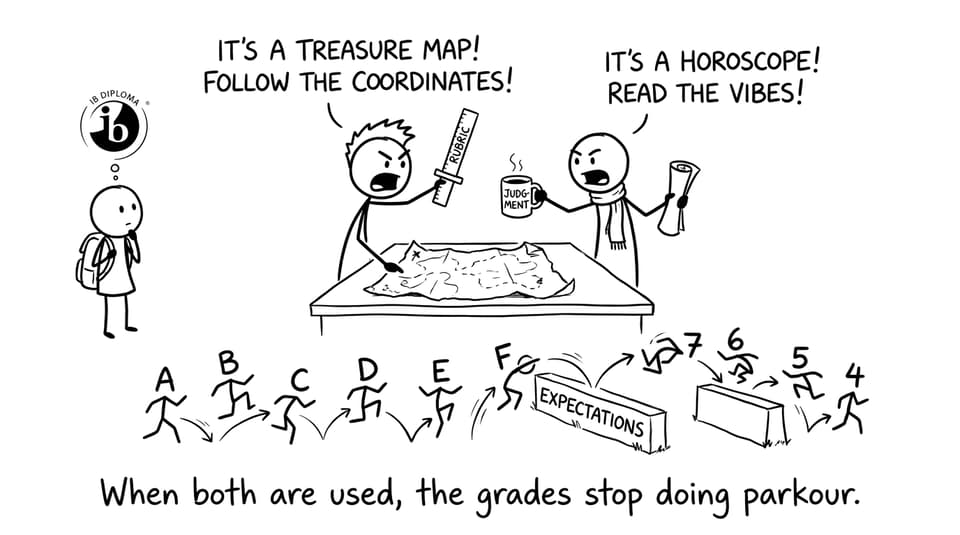
A rubric is less like a vending machine (“insert paragraph, receive marks”) and more like a map. It tells your teacher what to look for: analysis vs description, evaluation vs narrative, justification vs vibes. Yet your teacher still has to interpret what your evidence actually shows.
That interpretation is where teacher judgment becomes powerful, and where students can get confused.
If you’ve ever thought, “I did what the criterion said, why didn’t I get the top band?” you’re not alone. Often, the missing piece is not effort. It’s specificity: you gave an answer, but not enough evidence of meeting the descriptor.
To practice turning “good ideas” into “rubric-visible evidence,” use targeted exam-style drills in the RevisionDojo Questionbank and then compare your reasoning to what the markscheme rewards.
Where teacher judgment shows up in IB marking
Teacher judgment tends to appear in three common places in IB assessment:
Borderline work
Your response might sit between two bands. You included some analysis, but not consistently. Your evaluation is present, but thin. This is where teachers weigh the overall pattern: does the work mostly behave like a higher band, or does it occasionally visit it?
Creative or unusual approaches
Sometimes you answer in a way that’s clever but unexpected. Rubrics can’t predict every strong path. A good teacher recognizes when you’ve met the intent of the criteria, even if the route looks different.
Quality signals the rubric implies, but doesn’t spell out
Rubrics often compress complex ideas into a few lines. “Clear,” “coherent,” “effective,” “relevant,” these are human words. Your teacher’s judgment decides what counts as clear enough, coherent enough, and relevant enough.
This is also why consistency is a real skill for departments. If you want to understand how schools try to make marking more consistent, read How IB Teachers Can Maintain Consistency in Grading and Assessment.
The boundary line: judgment within the rubric (not outside it)
Here’s the quiet truth: teacher judgment is not permission to ignore the IB rubric. It’s a way to apply it honestly.
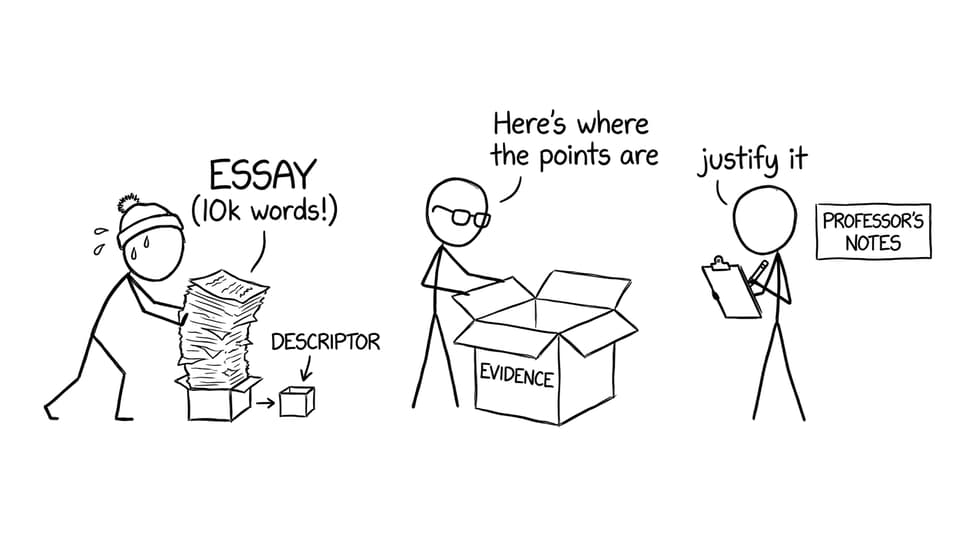
A useful mental model is this:
-
The rubric tells your teacher what to reward.
-
Your work provides the evidence.
-
Judgment decides how strongly that evidence matches the descriptor.
So when you want a mark increase, don’t ask, “Can you be nicer?” Ask, “What evidence would make this descriptor undeniably true?”
Try these student-friendly questions:
-
“Which criterion pulled me down the most, and what would a higher-band version look like?”
-
“Where did you see me doing analysis, and where did it slip into description?”
-
“If you had to point to one paragraph that lost the marks, which one is it and why?”
If you’re working on coursework, this gets even more direct. Use the IB Coursework Grader to see criterion-by-criterion feedback, then bring the specific strands to your teacher. You’ll have a shared language, which is exactly what IB assessment is designed to create.
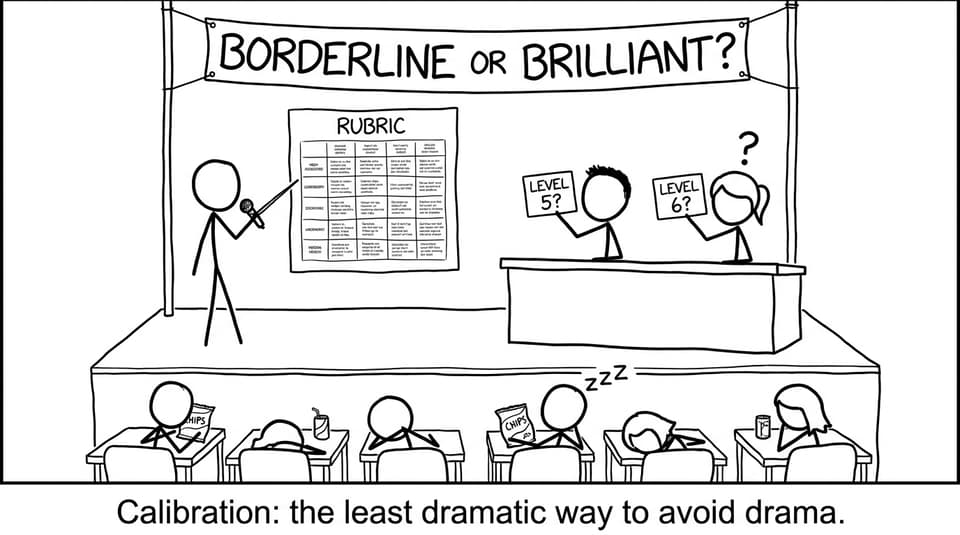
How to use calibration logic as a student
Calibration sounds like a teacher-only word. But you can borrow the idea.
Calibration means: “Let’s compare this work to a standard example so our interpretation matches.” Teachers do that in moderation meetings. You can do it with exemplars and timed practice.
Three practical ways to self-calibrate for IB:
Compare to an exemplar, not to a feeling
When you read a high-scoring model, don’t just think “wow.” Extract the pattern.
-
What counts as “evaluation” in this subject?
-
How often do they justify choices?
-
How do they handle counterclaims or limitations?
If you’re unsure how teacher marking and moderation fit together for IAs, this article adds clarity: Do Teachers Know Your Final IA Mark? (IB Explained).
Use “borderline drills” in exam prep
Pick two responses you wrote that feel close in quality. Then try to explain why one deserves a higher band using IB criterion wording.
This is easier if you’re practicing at scale. A structured approach like the RevisionDojo app workflow for IB exam prep helps you run repeatable loops: learn the concept, recall it, apply it, then review what the criteria rewarded.
Turn vague feedback into a measurable edit
“Be clearer” becomes “define my terms in the first sentence and use one labeled example.”
“More analysis” becomes “explain why the result happens and link back to the question.”
That is the student version of calibration: making quality concrete.
The exam-season connection: rubrics train your writing habits
Even when you’re not writing coursework, IB rubrics are training your exam instincts.
Rubrics reward habits like:
-
answering the command term directly,
-
selecting relevant evidence,
-
explaining the significance of that evidence,
-
and structuring responses so the examiner can find the marks.
If you freeze in papers because questions feel unfamiliar, you don’t need motivation. You need repetition with feedback. This guide is worth keeping open during revision blocks: IB Exam Panic: What to Do If You Don't Understand.
To keep your momentum realistic, it also helps to set expectations about what exam difficulty feels like: How Hard Are IB Exams? A Realistic Guide.
Conclusion: the calm middle ground that improves your marks
The best IB grading isn’t robotic, and it isn’t random. Rubrics provide the structure; teacher judgment applies that structure to real student work.
As a student, your advantage is learning to speak both languages: write with the rubric in mind, and ask for feedback in a way that turns judgment into evidence.
If you want that process to feel simpler, build your revision around tools that mirror IB expectations: RevisionDojo’s Study Notes, Flashcards, Questionbank, AI Chat, Grading tools, Predicted Papers, Mock Exams, Coursework Library, and Tutors. Start with the Questionbank feature and the IB Coursework Grader, then turn every piece of feedback into one small, repeatable upgrade.