
Le Chatelier’s Principle is one of those IB Chemistry ideas that feels obvious after you understand it, and weirdly slippery right before an exam. You read the rule, you nod, and then a question adds “temperature increases” and your brain suddenly forgets which side heat lives on.
The comforting part is this: equilibrium questions are predictable. If you learn a few patterns, you can answer quickly and explain clearly, which is exactly what IB Chemistry markschemes reward.
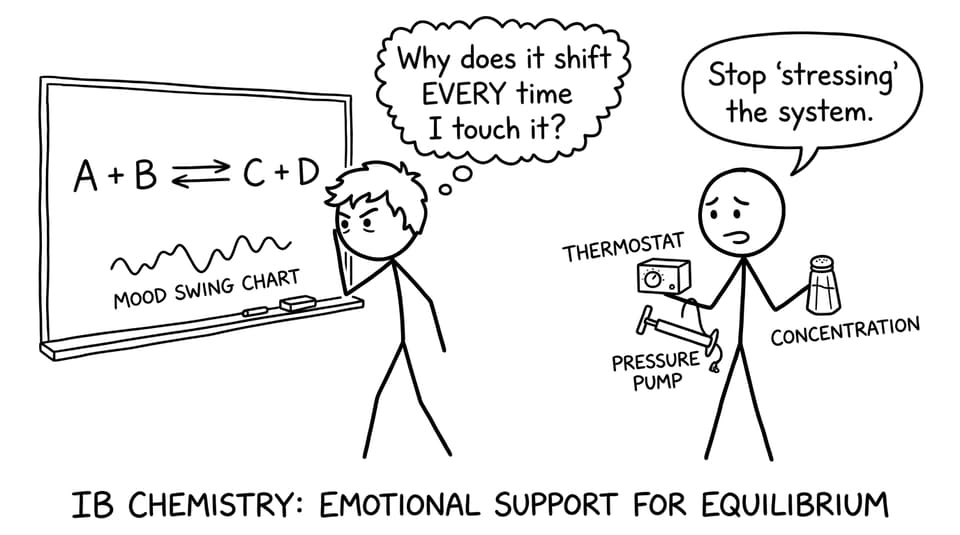
Le Chatelier’s Principle in one sentence (IB Chemistry)
If a system at equilibrium is disturbed, it shifts in the direction that reduces the disturbance.
Two important clarifications for IB Chemistry:
-
It predicts the direction of the shift (left or right), not how much it shifts.
-
The system is dynamic: forward and reverse reactions keep happening; they’re just balanced.
If you want the equilibrium foundation to feel solid, pair this with Dynamic Equilibrium Explained for IB Chemistry.
Quick exam checklist (save this for IB Chemistry revision)
When you see a Le Chatelier question in IB Chemistry, do this in order:
-
Identify the stress: concentration, pressure/volume, temperature
-
For pressure: count moles of gas only
-
For temperature: decide if forward reaction is exothermic or endothermic
-
State the shift direction, then say what increases/decreases
-
Remember: a catalyst changes rate, not position
For extra targeted practice, the 7.1 Equilibrium Questionbank is ideal for drilling these patterns under timed pressure.
Concentration changes: the most reliable pattern in IB Chemistry
Think of concentration like the system “cleaning up” whatever you added too much of.
If you increase a reactant
The system uses up reactant by forming more products; equilibrium shifts right.
If you decrease a reactant
The system replaces reactant; equilibrium shifts left.
If you increase a product
The system removes product by forming more reactants; equilibrium shifts left.
If you decrease a product
The system makes more product; equilibrium shifts right.
If you want the why (not just the rule), read Why Does Changing Concentration Shift the Equilibrium Position?.
Pressure and volume: only for gases (IB Chemistry classic)
Pressure questions in IB Chemistry are basically counting exercises.
Increasing pressure (decreasing volume)
Equilibrium shifts to the side with fewer moles of gas.
Decreasing pressure (increasing volume)
Equilibrium shifts to the side with more moles of gas.
Example you’ll see everywhere:
Left side has 4 moles of gas; right side has 2. Increase pressure, and the system “chooses” the smaller side; it shifts right.
To connect this to K and equilibrium expressions (which often appears right after Le Chatelier in IB Chemistry), use R2.3.2 The equilibrium law and constant.
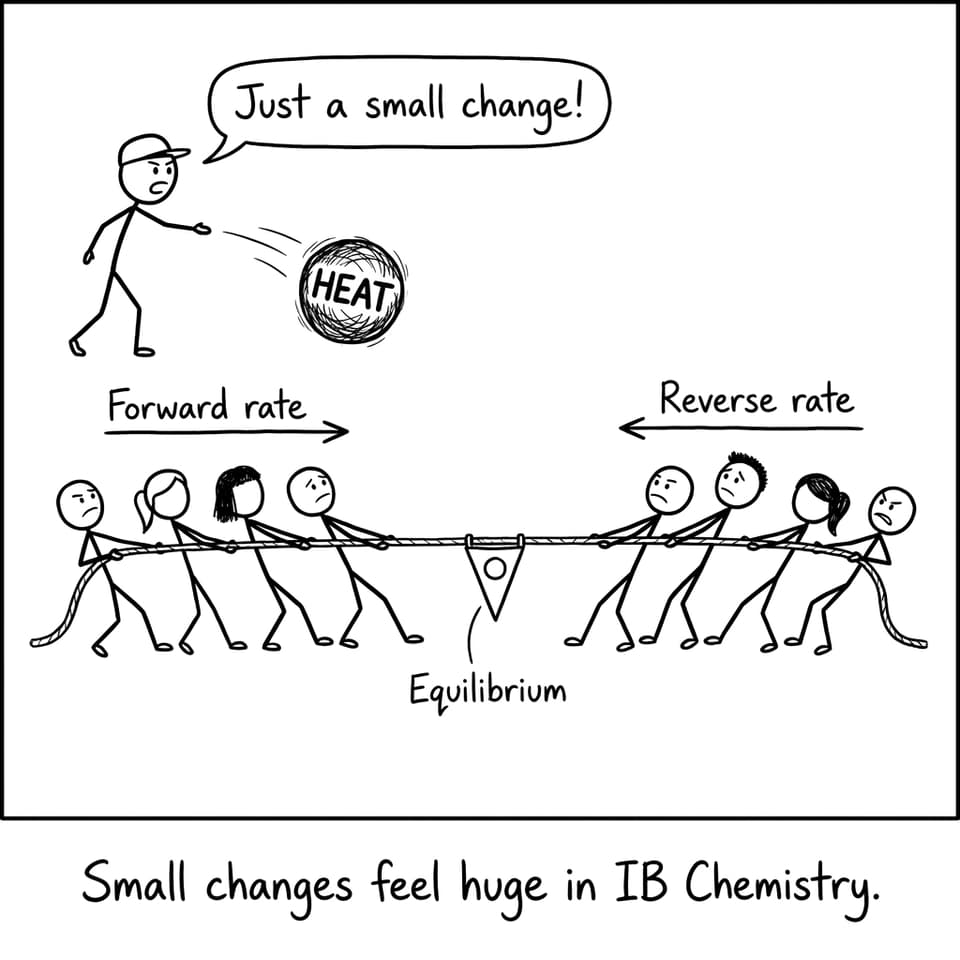
Temperature: treat heat like a reactant or product (IB Chemistry must-know)
This is where IB Chemistry students lose marks, not because it’s hard, but because they rush.
Exothermic forward reaction (ΔH < 0)
Heat is a product.
-
Increase temperature (add heat); shift left
-
Decrease temperature (remove heat); shift right
Endothermic forward reaction (ΔH > 0)
Heat is a reactant.
-
Increase temperature; shift right
-
Decrease temperature; shift left
A good habit: rewrite the equation with “heat” on the correct side before deciding.
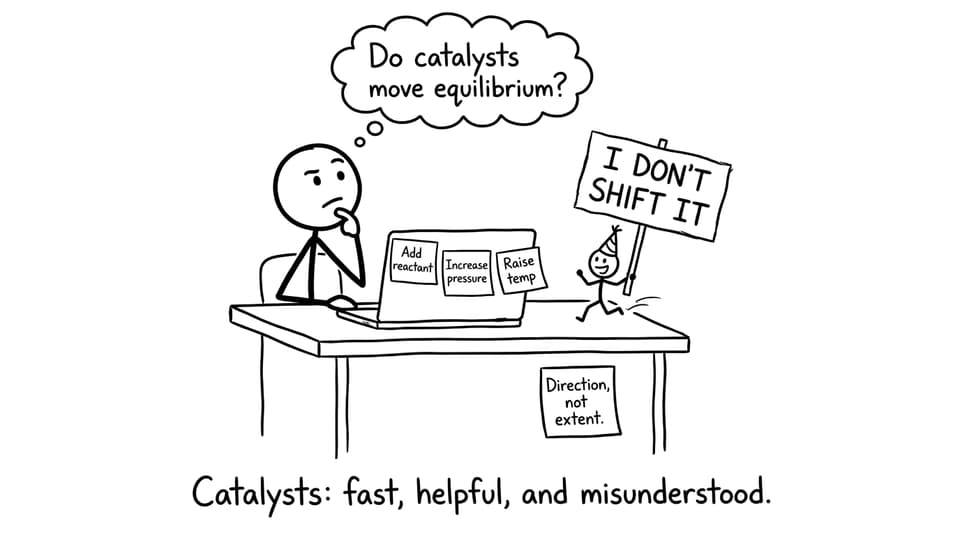
Catalysts: faster equilibrium, same position (IB Chemistry trap)
A catalyst:
-
speeds up both forward and reverse reactions
-
helps the system reach equilibrium sooner
-
does not change the equilibrium position
That’s why Le Chatelier’s Principle doesn’t “apply” to catalysts as a stress that causes a shift.
One IB Chemistry-style example (with reasoning)
Given:
Stress: temperature increases.
Because (\Delta H < 0), the forward reaction is exothermic, so heat is on the product side. Adding heat pushes the system away from products and toward reactants; equilibrium shifts left.
For broader exam strategy, IB Chemistry HL: Complete Guide for Success is a solid roadmap.
Bring it home: use IB Chemistry practice to make it automatic
Le Chatelier’s Principle is simple because it’s consistent: the system shifts to reduce whatever you changed. In IB Chemistry, the marks come from doing that consistently under pressure, spotting the stress, applying the right rule, and explaining it in a sentence that sounds like a markscheme.
If you want this to feel automatic, RevisionDojo is built for that loop: learn fast with Study Notes and Flashcards, test with the Questionbank, refine explanations with AI Chat and Grading tools, then consolidate with Predicted Papers and Mock Exams. Start with the IB Chemistry Resources hub and make equilibrium one of the easiest topics you answer in IB Chemistry.