
Isomerism is one of those IB Chemistry ideas that feels small until it quietly reshapes your whole view of organic molecules. Two compounds can share the same molecular formula, look identical in a data table, and still behave like completely different characters in a story. The twist is simple: arrangement matters. In IB Chemistry, isomerism is where you stop memorizing molecules and start seeing them.
Isomerism in IB Chemistry: the one-sentence definition
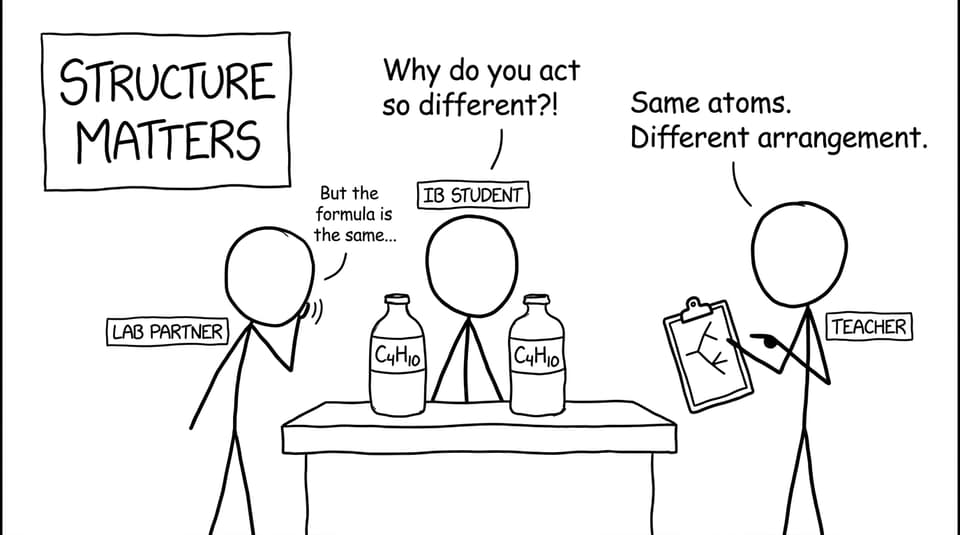
Isomerism happens when two or more compounds have the same molecular formula but different structures or different 3D arrangements.
That one line explains a lot of exam questions, because structure changes real properties:
-
boiling point and melting point
-
solubility and polarity
-
reactivity and reaction pathways
-
biological activity (especially for optical isomers)
If you want a syllabus-aligned anchor, RevisionDojo’s Organic Chemistry hub keeps the topic map clear: IB Chemistry Organic Chemistry.
A quick isomerism checklist (what examiners really test)
When an IB Chemistry question says “isomers,” run this mental checklist:
-
Do they have different connectivity? means structural isomers
-
Same connectivity but different spatial arrangement? means stereoisomers
-
Double bond or ring with restricted rotation? means cis-trans (geometric)
-
Carbon with four different groups? means optical isomers (enantiomers)
Then practise the classification under time pressure using RevisionDojo’s Questionbank and the dedicated topic practice at IB Chemistry 20.3 Stereoisomerism Questionbank.
Structural isomerism (same formula, different wiring)
Structural (constitutional) isomers differ in which atoms are connected to which. In IB Chemistry, you’ll most often see three types.
Chain isomers in IB Chemistry
Same functional group, different carbon skeleton (straight vs branched).
Classic example: C_4H_10 can be a straight chain (butane) or branched (methylpropane). Branching usually lowers surface area and reduces intermolecular forces, so branched isomers tend to have lower boiling points.
For a deeper breakdown with worked thinking, use Structural Isomers Notes (S3.2.6).
Position isomers
Same carbon skeleton and functional group, but the functional group is in a different place.
Example idea: C_3H_7Cl can be 1-chloropropane or 2-chloropropane. Same parts, different placement, different properties and sometimes different reactivity.
Functional group isomers
Same molecular formula, different functional group entirely.
Example: C_2H_6O can be an alcohol (ethanol) or an ether (methoxymethane). In IB Chemistry, this is where students lose marks by assuming “same formula means similar chemistry.” It doesn’t.
If functional groups still feel slippery, pair this with: Functional Groups Made Simple for IB Chemistry.
Stereoisomerism in IB Chemistry (same wiring, different 3D reality)
Stereoisomers have the same connectivity but differ in three-dimensional arrangement. HL students meet this often, and SL students still see pieces of the logic.
For a complete syllabus explanation, keep this open while you practise: Stereoisomers (HL) Notes S3.2.7 and the companion overview post Stereoisomers Explained Simply.
Geometric (cis-trans) isomerism
Geometric isomers appear when rotation is restricted, usually due to:
-
a C=C double bond
-
a ring structure
To have cis-trans isomerism in an alkene, each carbon of the double bond must have two different substituents.
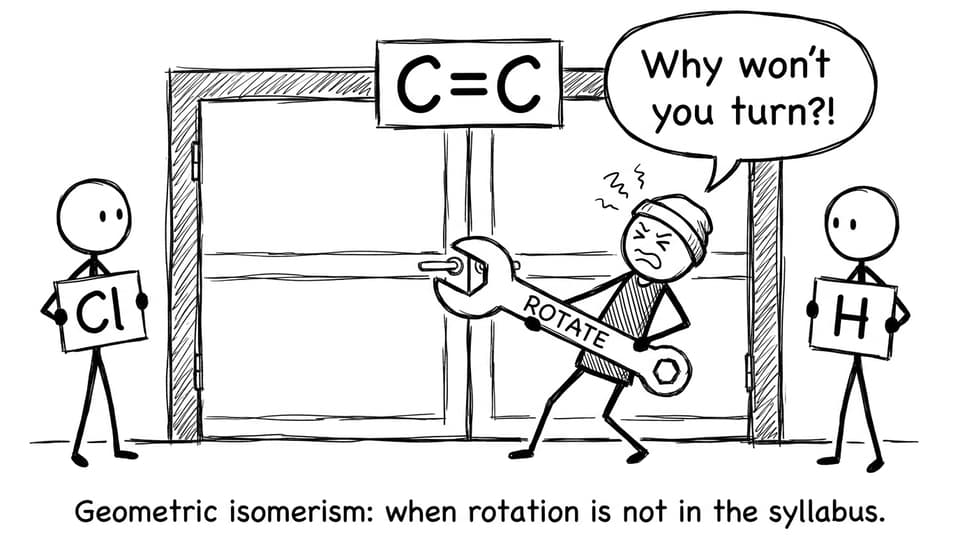
A useful memory hook for IB Chemistry exams: cis often ends up more polar (dipoles don’t cancel as neatly), while trans is often more symmetrical and may have lower polarity.
If you want the bond logic behind restricted rotation, revise: Sigma and Pi Bonds Explained.
Optical isomerism (enantiomers)
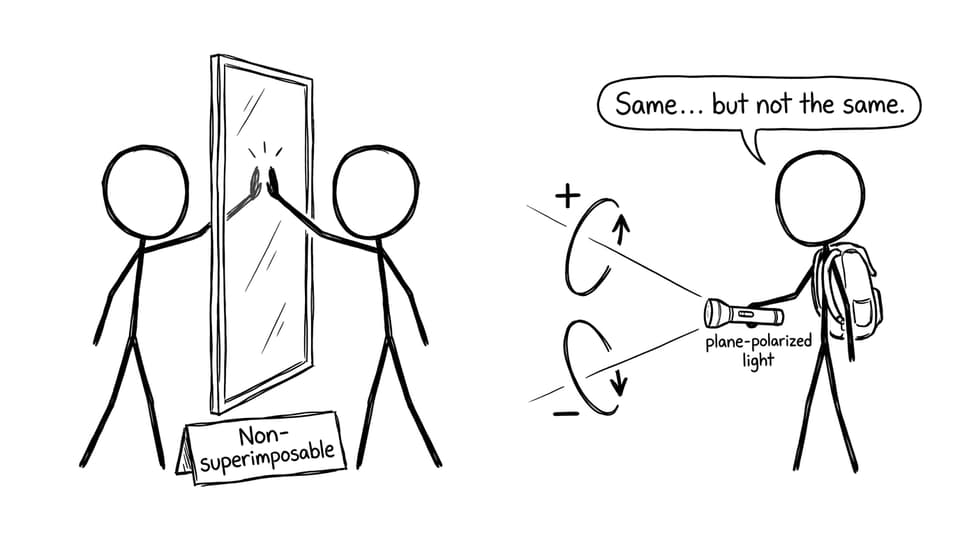
Optical isomerism appears when a molecule is chiral, usually because it has a carbon attached to four different groups (a chiral center).
Enantiomers:
-
are non-superimposable mirror images
-
rotate plane-polarized light in opposite directions
-
often share many physical properties, but can behave differently in biological systems
Common IB Chemistry mistakes (and how to avoid them)
-
“Isomers have different formulas.” No. Same molecular formula, different structure/space.
-
“Cis and trans can rotate into each other.” Not across a C=C bond without breaking it.
-
“Enantiomers are interchangeable in the body.” Biology often distinguishes mirror images.
To train accuracy, use timed practice and instant feedback in IB Chemistry Resources and then build exam stamina with Chemistry Predicted Papers or the broader set at IB Predicted Papers.
Bringing it together (and using RevisionDojo to lock it in)
Isomerism is IB Chemistry’s quiet lesson that formulas are only the beginning. Structural isomerism changes the wiring; stereoisomerism changes the shape. Those changes ripple into polarity, boiling point, reactivity, and even biological effects.
If you want this to stick before exams, combine three RevisionDojo moves: read the notes, drill with the Questionbank, and simulate pressure with Predicted Papers and Mock Exams. Add Flashcards for definitions, use AI Chat when a diagram confuses you, and lean on Grading tools to see how examiners reward clear classification. That’s how IB Chemistry stops being a topic you “cover” and becomes a skill you can trust on exam day.