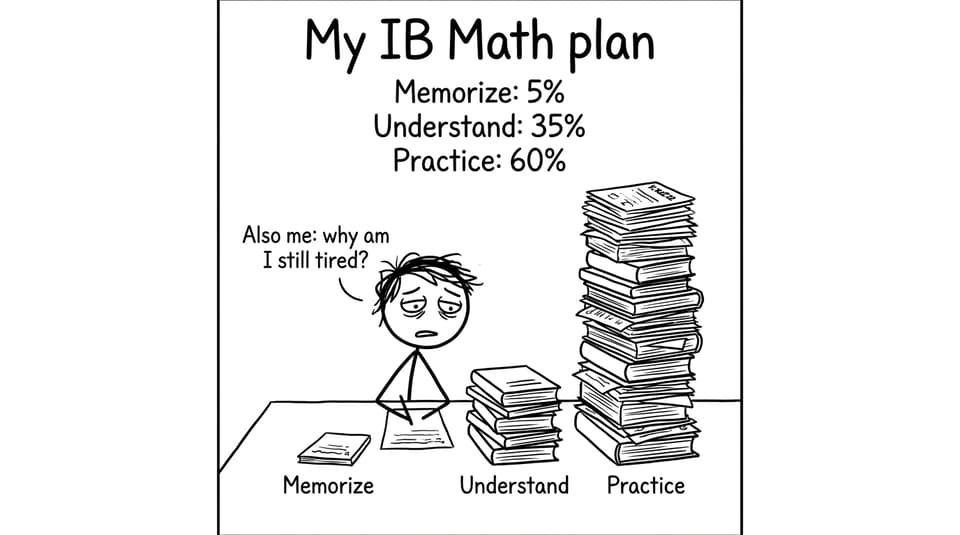

If you’ve ever stared at a formula list the night before an exam and thought, there’s no way this is all fitting in my head, you’re not alone. The good news is that IB Math isn’t a memory contest. It’s a thinking contest. And once you treat it that way, something surprising happens: not memorizing every formula can actually make you faster, calmer, and more accurate.
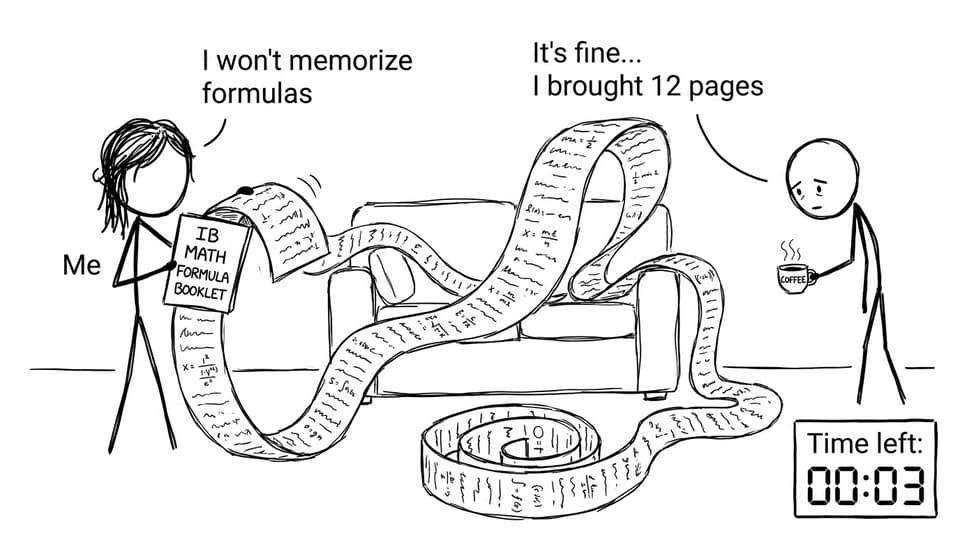
Can you really ace IB Math without memorizing formulas?
Yes--with a caveat. In IB Math, you can avoid memorizing most formulas because the exam provides a data/formula booklet, and because many results can be rebuilt from core ideas (rate of change, area accumulation, similarity, probability rules). The caveat is that you still need fluency: knowing what to use, where to find it, and how to justify it with clear working.
If you want the exam reality check, start by getting comfortable with the booklet itself: What Is the IB Math Data Booklet?
A quick checklist for “no-memorization” IB Math prep
-
Learn the story behind the big ideas (derivatives, integrals, trig, distributions)
-
Practice locating formulas quickly in the booklet
-
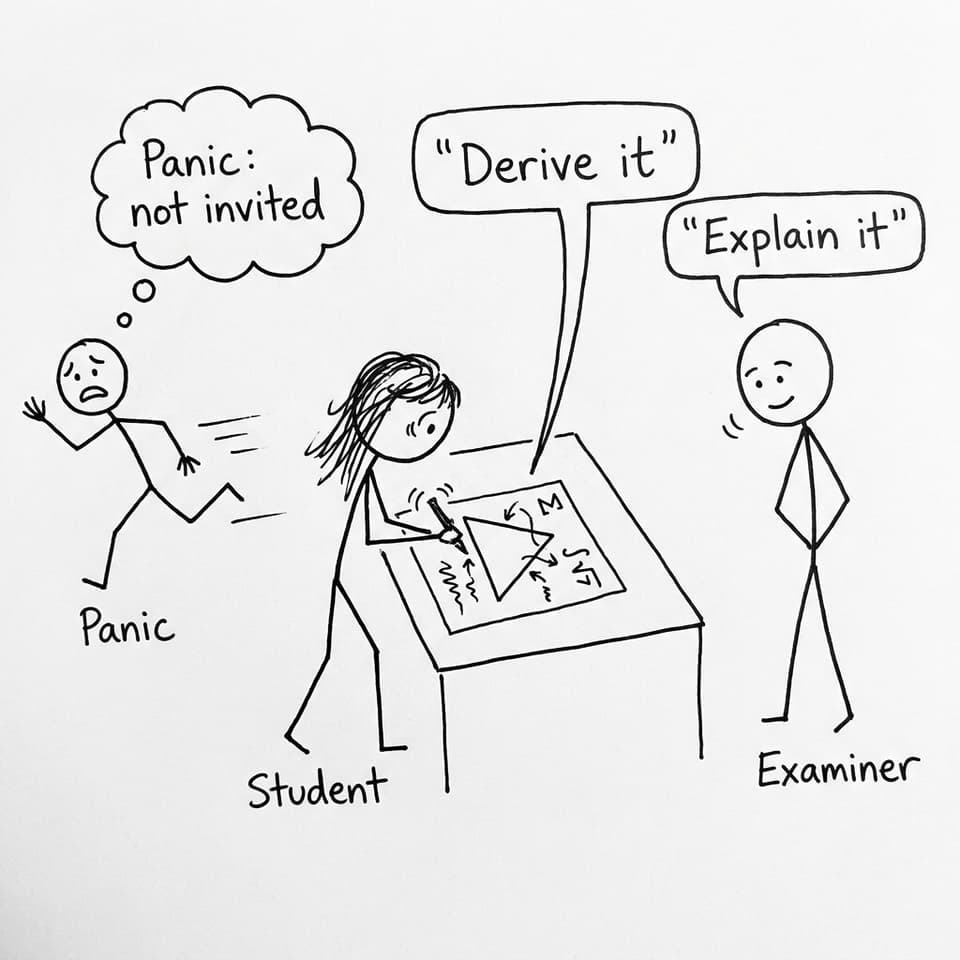
Train “derive when stuck” habits (from graphs, definitions, or first principles)
-
Do timed exam-style practice so the method becomes automatic
-
Review errors like a detective, not like a judge
RevisionDojo makes this loop easier because you can pair practice with instant feedback through the Questionbank, AI Chat, Study Notes, Flashcards, Grading tools, Predicted Papers, Mock Exams, the Coursework Library, and (when you want a human safety net) Tutors.
The skill that beats memorization: understanding what a formula means
Most formulas in IB Math are shortcuts for a relationship you can see.
-
Differentiation is “how steep is it right now?”
-
Integration is “how much has accumulated?”
-
Trig identities are “the same triangle seen from a different angle”
When you understand the meaning, you can often reconstruct what you need, or at least check if your answer is reasonable.
A strong place to build this is your course hub: IB Mathematics: Analysis and Approaches (AA) Resources

Use the data booklet like a tool, not a crutch
The data booklet is available in the exam, but most students treat it like a last-second search engine. The top scorers treat it like a map.
Train with it early using:
Once you know where things live, “not memorizing” stops being scary. It becomes strategy.
Practice is where IB Math marks are made
In IB Math, marks are usually sitting inside method steps: setup, substitution, correct interpretation, clear reasoning. That means your biggest score jump rarely comes from learning more formulas. It comes from doing more questions and learning what examiners reward.
A practical route:
-
Read the method once (Study Notes)
-
Drill variations (Questionbank)
-
Reflect on mistakes (AI Chat + Grading tools)
-
Retest under time pressure (Predicted Papers / Mock Exams)
Start here: How to Use the Questionbank for Targeted Math Revision
If calculus is a pain point (it is for many), practice it directly: Math AA Calculus Questionbank

Build a tiny personal formula sheet (for learning, not for the exam)
Even though you won’t bring it in, building your own “micro sheet” forces you to decide what’s truly high-frequency. It also reveals what you don’t understand yet.
Use this as a guide: Math Formula Sheet for IB HL and SL Students
Conclusion: the real way to ace IB Math
Acing IB Math without memorizing formulas is possible because the exam rewards understanding, method, and communication. The goal isn’t to carry a library in your head--it’s to build a small set of core ideas you can apply anywhere, then practice until those ideas become automatic.
If you want a structured way to do that, use RevisionDojo to combine Study Notes and Flashcards for clarity, the Questionbank and AI Chat for feedback, and Predicted Papers plus Mock Exams for timing and confidence. That’s how IB Math starts to feel less like panic and more like control.