

The moment your brain switches universes (and doesn’t tell you)
You’re deep into an IB Math probability question, feeling fine, doing the usual “favorable over total.” Then you see two quiet words: given that.
Nothing else changes on the page. But everything changes in the logic.
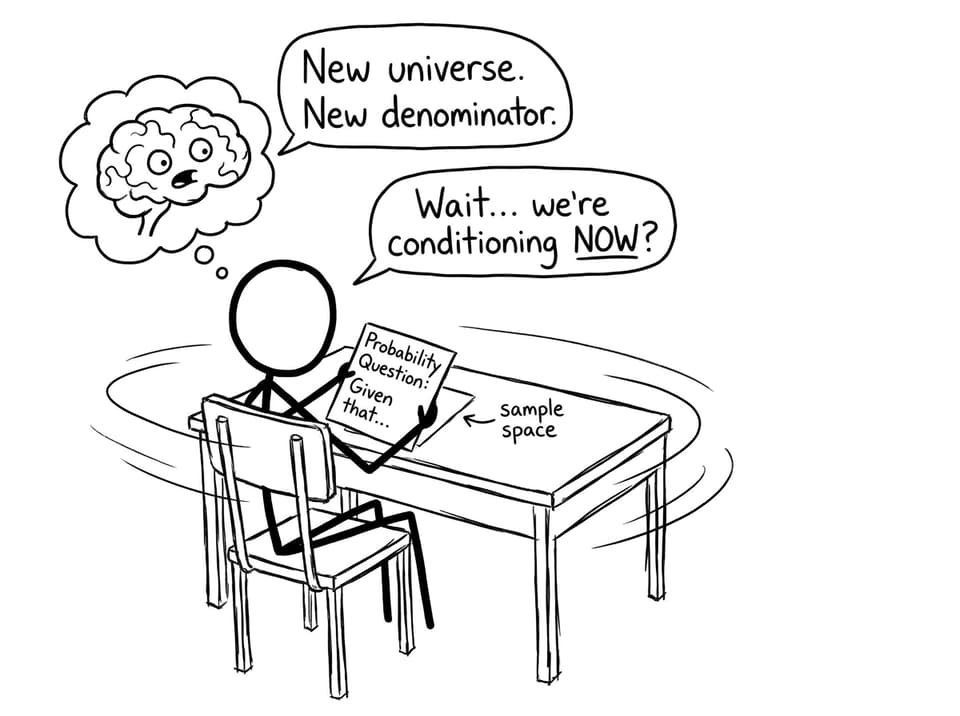
Conditional probability feels counterintuitive because it asks you to change viewpoint mid-question. Most of school math rewards consistency: keep the same totals, keep the same system, just compute carefully. Conditional probability does the opposite. It whispers, “Forget the old total. We live in a smaller world now.”
If you’re preparing for exams, this is good news: your confusion isn’t a sign you’re bad at IB Math. It’s a sign your intuition is doing what human intuition always does.
Quick checklist: the 15-second conditional probability reset
Before you touch your calculator, do this:
-
Circle the condition: given that / knowing that / it is known
-
Rewrite the condition in plain English
-
Shrink the sample space to only outcomes where the condition is true
-
Only then compute: (P(A|B)=\frac{P(A\cap B)}{P(B)})
-
If you can, draw a tree diagram, table, or Venn diagram
For structured practice, use RevisionDojo’s Questionbank to drill conditional setups until the “new denominator” instinct becomes automatic: Conditional and independent probabilities Questionbank.
Why it feels wrong: the sample space shrinks, but your mind keeps the old total
The core trick is not a trick at all: conditional probability changes the denominator.
Students often understand the formula but still apply it as if the original total is still valid. Under pressure, the brain clings to the first sample space it saw. In IB Math, that’s the difference between a clean method mark and a perfectly-executed wrong answer.
A helpful way to think about it: the condition is information, and information has consequences. Conditional probability is probability after information.
If you want the broader framework, this guide breaks the whole topic into predictable steps: How to Solve IB Math Probability Problems Step-by-Step.
Why language trips you up: “given that” is small, but it changes everything
In exams, conditional probability errors are often reading errors.
“Given that it is red” is not decoration. It’s the instruction to delete every non-red outcome from your mental picture. Many students skim it, keep the original totals, and then wonder why the markscheme feels like it came from another planet.
RevisionDojo’s Study Notes and Flashcards are useful here because they train the signals your eyes should catch instantly in IB Math wording: Statistics & Probability hub and Conditional probability Flashcards.
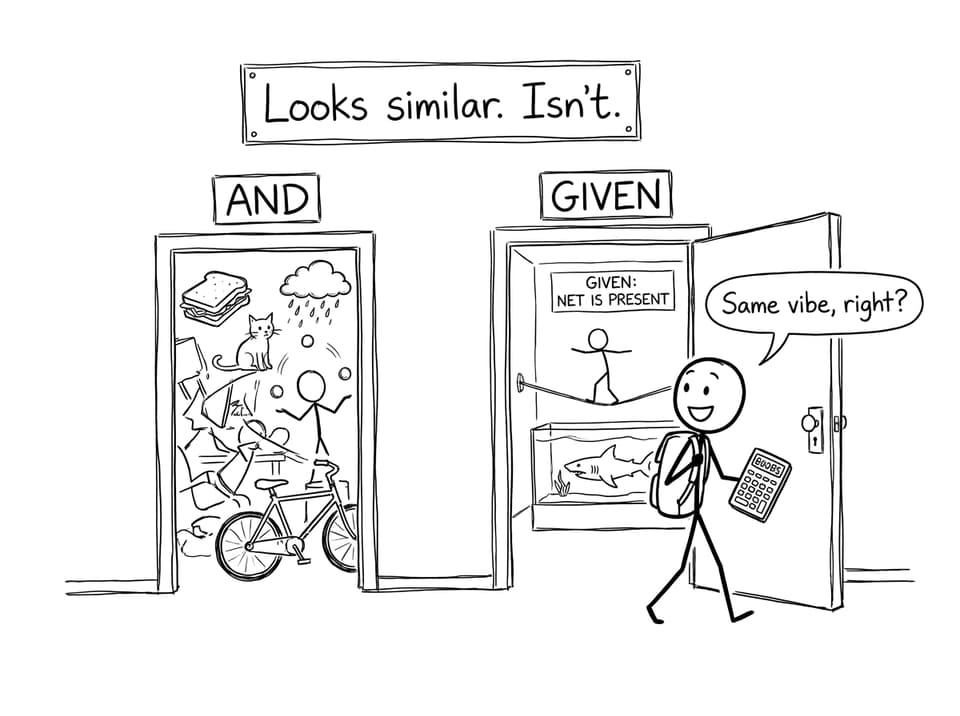
“And” vs “given”: they sound similar, but they’re different rooms
A classic intuition trap is mixing up:
-
(P(A\cap B)): A and B
-
(P(A|B)): A given B
In real life, we often talk as if these are interchangeable. In IB Math, they’re not.
“King and red” asks about the overlap.
“King given red” asks you to stand inside the red outcomes and look around from there.
Why diagrams suddenly make it click
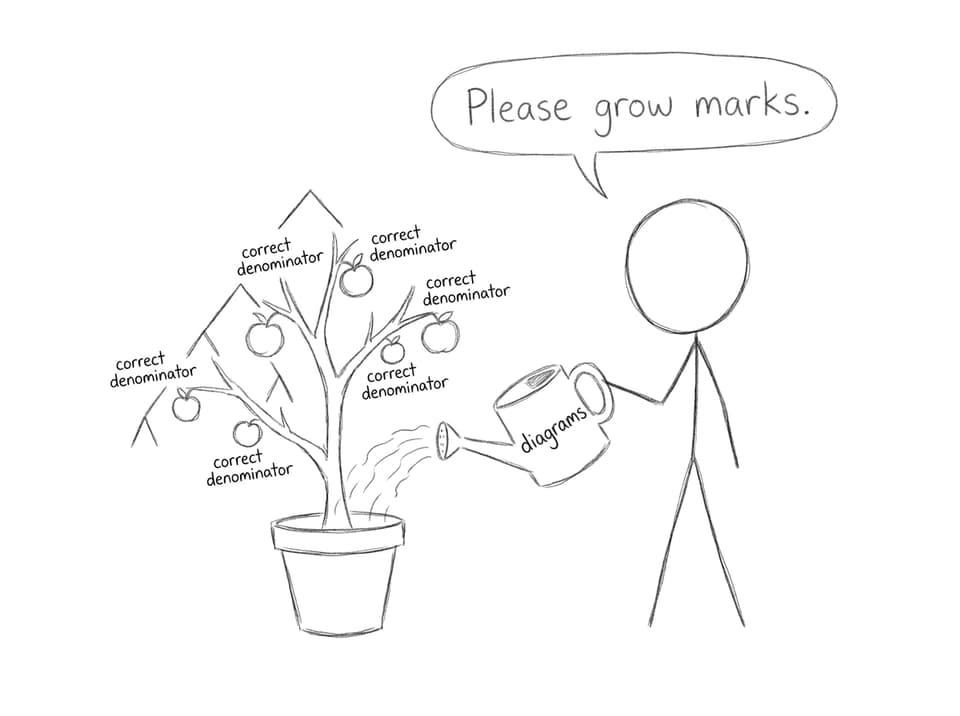
Diagrams don’t just “help.” They force honesty.
A tree diagram makes you condition step-by-step. A table makes you see which row or column you’re living in. A Venn diagram makes overlap and totals visible. That’s why IB examiners often reward clear structure even when the question doesn’t explicitly demand it.
If tables feel especially harsh, you’re not alone: Why Probability Tables Feel Harder Than Tree Diagrams.
Conditional probability also exposes dependence (and removes your favorite shortcut)
Another reason conditional probability feels uncomfortable: it reveals when events are dependent.
Many students assume independence unless told otherwise. Conditional probability removes that safety net. If learning B changes the chance of A, you must update the probability. That update is the whole point.
For a clean explanation that connects directly to exam habits, read: Why Independence Matters So Much in IB Probability.
A calmer way to get good at conditional probability
Conditional probability isn’t there to trick you. It’s there because IB Math is testing whether you understand probability as a relationship between information and outcomes, not just a formula you can recite.
If you want that skill to stick, build a loop: learn the idea with RevisionDojo Study Notes, lock in definitions with Flashcards, pressure-test your understanding in the Questionbank, and then simulate timing with Mock Exams and Predicted Papers. Start here for a structured path: How to Master Probability and Statistics in IB Math and How to Score 7 in IB Math AI SL.
The goal is simple: when you see “given that,” your brain should feel the sample space shrink automatically. That’s when conditional probability stops feeling counterintuitive and starts feeling like control.