
A friend once described opening IB results like checking the weather before a flight: you already packed, you already planned, and yet a single number can change how you feel about the whole journey.
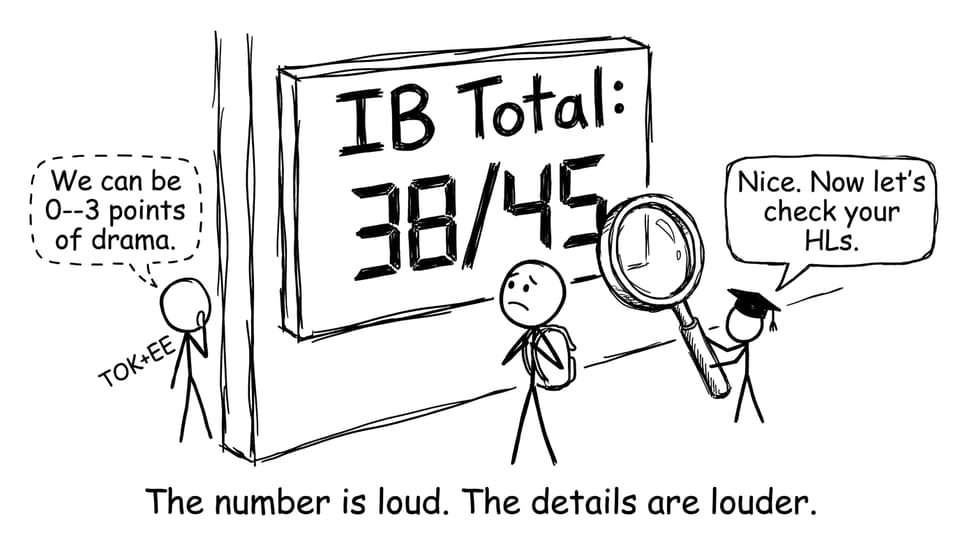
So if you’re staring at 38/45 and wondering, is that actually good for IB university admissions? Yes, it’s strong. But the calmer truth is that universities rarely read an IB score like students do. They treat it less like a trophy and more like a signal: How consistent are you? How relevant are your Higher Level subjects? How reliable is this performance under pressure?
This guide breaks down what 38 in IB really means, why it’s widely considered excellent, and how to position it so it helps you most.
Quick checklist: what a 38 in IB usually tells admissions
Before we go deeper, here’s the simple read universities often take from a 38 IB score:
-
You’re well above typical IB averages (commonly around the low 30s).
-
You likely have a mix of 6s and 7s, with few weak links.
-
Your academic profile looks consistent across subjects, not spiky.
-
Your HL subjects probably carry real weight (and will be checked closely).
-
Your TOK and EE core points may be the quiet difference between “strong” and “standout.”
If you need a broader benchmark picture, this pairs well with What Is a Good Score in the IB Diploma?.
How IB scoring works (and why 38 feels “different”)
The IB Diploma is scored out of 45:
-
Six subjects (each graded 1 to 7) = up to 42 points
-
Up to 3 bonus points from TOK + EE (combined via a matrix)
A 38 matters because it’s not built from one lucky exam. In IB, you can’t hide. Breadth is forced. Weakness shows. That’s also why a 38 is persuasive: it implies you handled a wide workload and still produced a high, stable total.
For a cleaner breakdown of the mechanics, see How Do IB Points Work? and, if you’re thinking about core points specifically, EE in 2027: How It Adds Points to Your IB Diploma.
How rare is a 38 in IB?
Exact percentiles vary each session, but the lived reality is consistent: a 38 in IB sits comfortably in the upper tier of candidates worldwide.
A practical way to think about it:
-
The global “middle” of IB clusters around the high 20s to low 30s.
-
Scores above the mid-30s usually indicate a student who is consistently meeting high markbands across multiple subjects.
-
Scores in the high 30s become meaningfully competitive in selective admissions contexts, especially when paired with the right HL profile.
If you want the university-facing context for why the IB is treated as strong evidence, Why Is an IB Score Needed for Top Universities? is a helpful framing.
What a 38 in IB means for university admissions (by region)
United States
In the US, admissions is holistic, so your IB score is one pillar among grades, course rigor, essays, recommendations, and activities. Still, a 38 IB score tends to read like an academically serious profile, often comparable to a very high GPA depending on conversion.
Two extra US-specific realities:
-
Strong HL results can support placement or credit at some universities.
-
Predicted performance and consistency can matter a lot for early rounds.
If you’re navigating that system, Can You Get Into a Top University in the US Only Doing IB? and How Do Predicted Grades Affect Early Admissions? are worth reading alongside your plan.
United Kingdom
The UK often works through conditional offers, which makes your IB total feel more literal. A 38 is frequently within range for strong universities and many Russell Group courses, but the key is that offers often specify:
-
a total points target, and
-
minimum HL subject grades (for example, a 6 in a required HL).
So a 38 can be “perfect” for one course and “not quite” for another purely because of HL conditions. For an example of how specific courses can get, see Average IB Score for Imperial College Admission.
Canada, Europe, and Australia
Across Canada, Europe, and Australia, a 38 in IB is generally a strong direct-entry level score, often placing you in competitive territory for selective programs and merit-based awards (depending on institution and policy).
In many of these systems, your subject choices and relevant HL strength can still matter, but the total score is often interpreted more straightforwardly than in fully holistic systems.
The part students miss: your HL subjects can matter more than your total
Universities are not only asking “How smart are you?” They’re asking “Are you ready for this specific degree?” In IB, the fastest signal for readiness is usually the Higher Level set.
A 38 with:
-
HL Mathematics + HL Physics (strong grades) tells a clean story for engineering.
-
HL English + HL History (strong grades) tells a clean story for humanities.
And that alignment can outperform a slightly higher total that’s mismatched. If you want a broader admissions perspective on how IB is viewed, What Do Universities Think of the IB Diploma? adds useful context.
How to turn a 38 in IB into momentum (not just relief)
A good score helps most when it changes what you do next. Here’s a simple, repeatable approach for IB students preparing for exams or trying to protect predicted grades.
Use a “proof loop,” not a panic loop
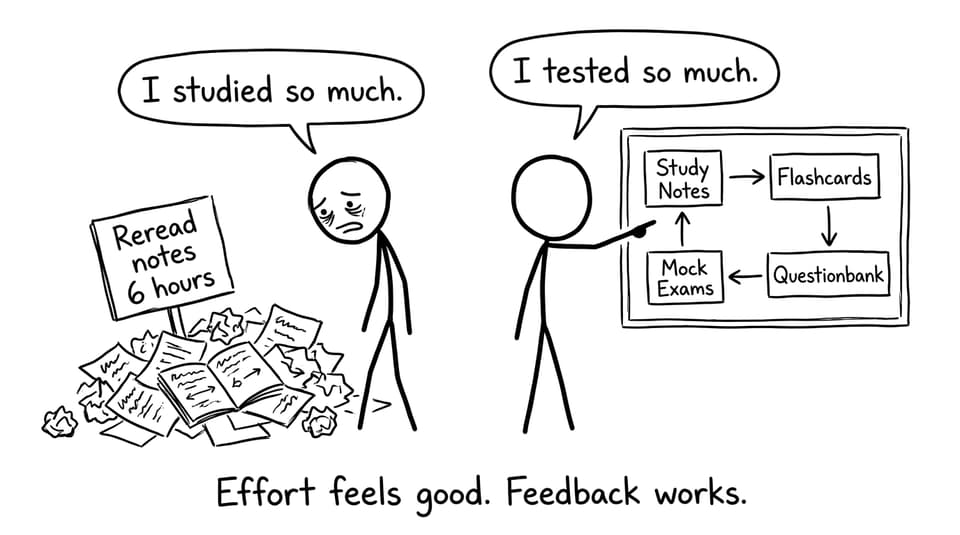
Most students respond to pressure by rereading. It feels responsible. It’s also hard to measure.
A stronger loop is:
-
Clarify a weak point with targeted notes
-
Retrieve it with spaced repetition
-
Apply it under exam-style conditions
-
Get feedback and fix one pattern
RevisionDojo is built around that loop: Study Notes, Flashcards, Questionbank, AI Chat, Grading tools, Predicted Papers, Mock Exams, Coursework Library, and Tutors when you need a human diagnostic.
You can start here:
-
Questionbank for exam-style practice and fast marking feedback
-
Flashcards for daily recall that actually sticks
-
IB Coursework Grader if TOK/EE/IA work is dragging down your confidence
And for a bigger routine blueprint, RevisionDojo App: The Smarter Way to Prep for IB Exams ties the tools together.
Train like your score is built from habits (because it is)
If you’re aiming to hold or improve a high 30s IB result, your biggest wins are usually:
-
turning weak topics into repeated, timed question sets
-
learning markscheme patterns (especially for structured responses)
-
fixing “command term” mistakes (explain vs evaluate vs discuss)
-
building stamina through timed papers
For the timing side of preparation, Custom IB Mock Exams: Build Practice Tests by Topic is a practical guide you can implement in a weekend.
Conclusion: is 38 a good IB mark?
A 38 in IB is more than “good.” It’s the kind of score that tells universities you can handle rigor across the full IB spectrum, not just in your favorite class. Still, admissions decisions live in the details: HL alignment, course requirements, and whether your application uses the score as a threshold or a signal.
If you want to turn that score into certainty, build a routine that creates proof. Use RevisionDojo to run the loop that actually lifts IB performance: Study Notes to get clear, Flashcards to retain, Questionbank to apply, AI Chat to diagnose, Grading tools for rubric feedback, and Predicted Papers plus Mock Exams to make exam day feel familiar. Your IB total is a snapshot. Your system is the thing that keeps improving it.