



Harvard is the kind of word that can make a calm student suddenly start doing mental math.
You open your gradebook, translate every quiz into a predicted number, then whisper the question IB students always ask in private: What predicted IB score do I really need to get in?
Here’s the honest answer: there is no official cutoff. But there is a realistic competitive range, and there is a way to make your IB profile stronger without letting one number swallow your life.
The quick checklist: what to aim for (and what to do)
If you want the practical version first, use this:
-
Know the IB scale: 45 max (42 from subjects + 3 core points).
-
Competitive predicted range for Harvard: 42-44 is a common target.
-
Below that can still work: but your essays, impact, recommendations, and context must carry more weight.
-
Make your prediction defensible: timed performance, strong IAs, and clear improvement trends.
-
Run a weekly evidence loop: learn -> practice -> feedback -> retake.
To sanity-check where your practice marks might land, use the IB Grade Calculator.
Understanding the IB scoring scale (so you stop guessing)
In the IB Diploma Programme, each subject is graded from 1 to 7. You take six subjects, so the maximum from subjects is 42 points.
Then the core adds up to 3 bonus points from Theory of Knowledge (TOK) and the Extended Essay (EE).
That’s how the IB reaches a maximum of 45.
Predicted grades matter because they are the best available signal of academic readiness before final results exist. And for selective universities, signals matter.
If your predicted grades feel confusing or unfair, this guide helps you interpret them clearly: IB Predicted Grades: Interpret Them and Improve Fast.
What is a competitive predicted IB score for Harvard?
Harvard does not publish an “IB minimum.” Still, based on common admissions outcomes and how selective US applications tend to look in practice, many successful applicants sit in a tight academic band.
The target range: 42-44 predicted
A predicted 42-44 is often viewed as a strong, competitive range for Harvard-level admissions.
-
44-45: exceptional academic profile
-
42-43: excellent, comfortably competitive for top applicants
-
39-41: still competitive, but you usually need a stronger holistic story
-
Below 39: harder, unless there are exceptional distinctions and/or compelling context
Notice what this does not say: “Get a 45 and you’re in.” Harvard is too selective for guarantees.
Why the difference between 41 and 44 is not the whole story
In the IB, moving from a 6 to a 7 can be brutally technical. Sometimes it’s not more intelligence. It’s better timing, tighter structure, cleaner command-term accuracy, and fewer unforced errors.
That means a student predicted 41 can genuinely be “Harvard ready” if their application shows rare depth and direction. And a 44 can still be declined if everything else feels generic.
Harvard’s holistic admissions (and how IB fits inside it)
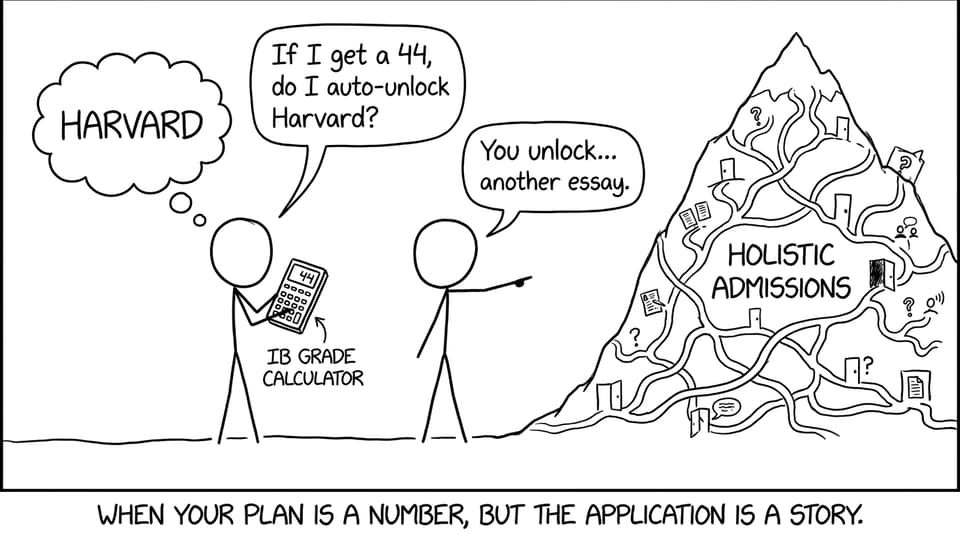
Harvard evaluates applicants holistically. In plain terms: your predicted IB score helps open the door, but it does not walk you through.
Admissions typically weighs:
-
Academic performance (including predicted grades)
-
Course rigor (your subject choices and level)
-
Recommendations
-
Essays
-
Activities, leadership, service, impact
-
Intellectual vitality (curiosity you can prove)
-
Context (school environment, opportunities, obstacles)
Your predicted IB score is one part of a larger narrative: What do you do with your ability? And who are you when nobody is grading you?
How predicted grades are actually built (and how to influence them)
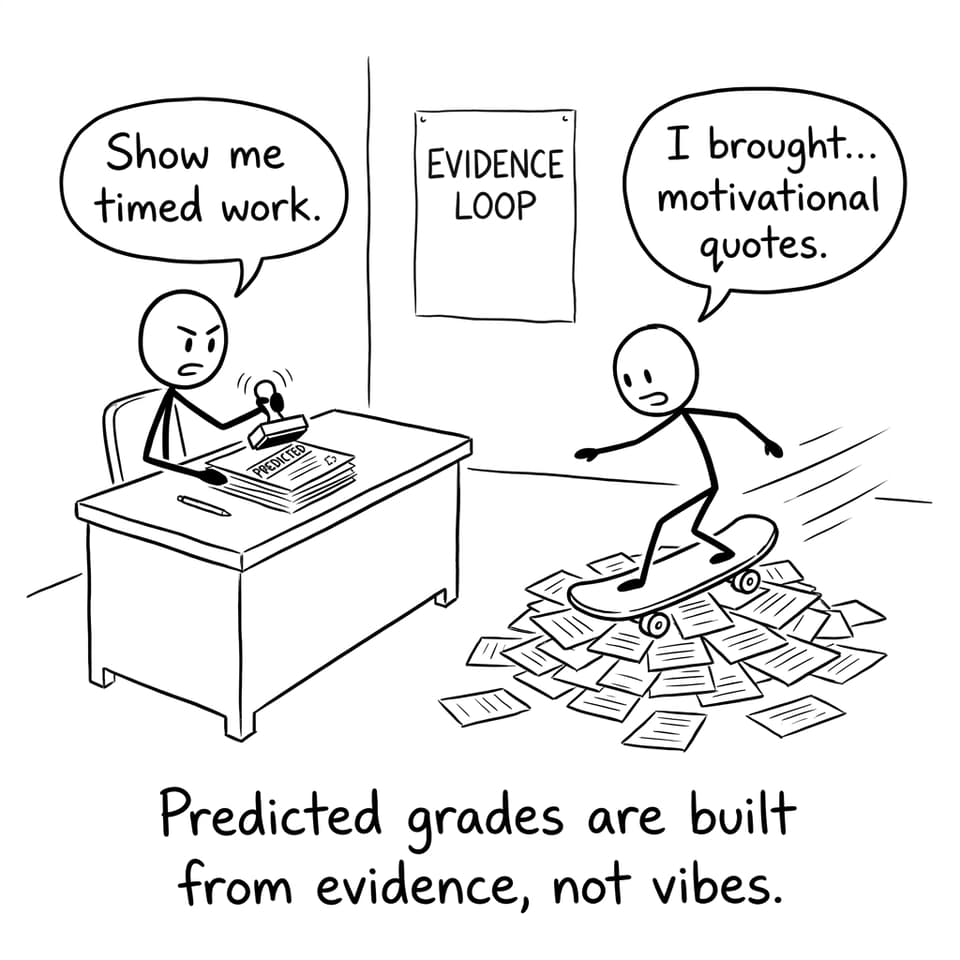
Most schools generate IB predicted grades using evidence such as:
-
Mock exams and timed papers
-
Topic tests and essays
-
In-class performance over time
-
Coursework progress (IAs, EE, sometimes TOK)
-
Teacher judgment about trajectory
So the best strategy is not to beg for points. It is to create new evidence.
If you want a deeper breakdown of how predicted grades impact early applications, see How Do Predicted Grades Affect Early Admissions Decisions?.
How to push your predicted IB score upward (without burning out)
Raising an IB predicted score usually comes from a boring, powerful loop: clarity -> practice -> feedback -> repeat.
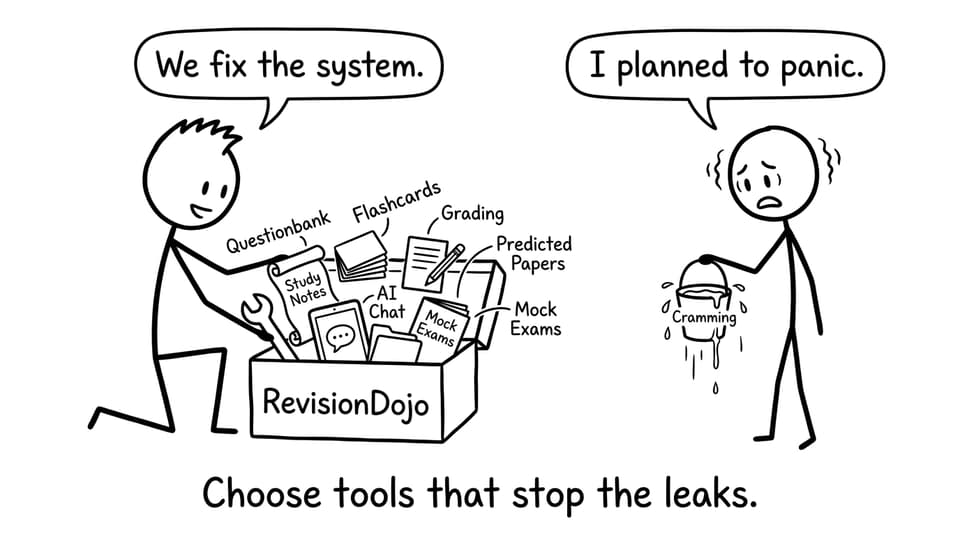
Build your “evidence loop” with RevisionDojo
Here’s a weekly system that works because it produces teacher-visible improvement.
-
Use IB Notes to clarify one weak topic fast.
-
Drill that topic with the Questionbank so you stop confusing familiarity with skill.
-
Use AI Chat to ask precise questions when you get stuck (not “teach me the whole chapter,” but “why does my method lose marks in this question type?”).
-
Run one timed session using IB Predicted Papers to train performance under pressure.
-
Use Grading tools to understand what earns marks in written responses.
-
Lock in daily recall with Flashcards.
If predicted grades have knocked your confidence, read IB Predicted Grades Don’t Define You (Here’s What Does).
Don’t ignore TOK and EE core points
Those 0-3 core points are small, but in elite admissions, “small” can separate applications.
If you’re unsure where to start:
-
Use the IB Extended Essay Guide Hub to choose a workable structure and research question.
-
For TOK writing structure, read Structuring for Success in IB TOK Essays.
When TOK and EE feel like “extra,” they tend to get neglected. When you treat them as points you can earn strategically, they start to feel calmer.
FAQ: Predicted IB score for Harvard
Is there a minimum IB score for Harvard?
Harvard does not publish a minimum IB score or a guaranteed cutoff. In practice, applicants who are successful tend to be academically exceptional, which often includes very strong predicted IB results. A predicted range around 42-44 is commonly seen as competitive, but it is not an “entry ticket.” Harvard’s admissions process is holistic, which means grades are evaluated alongside your essays, recommendations, impact, and context. A strong predicted IB score helps you look academically ready for intense university work. But it cannot replace a thin application story.
Can I get into Harvard with a predicted IB score of 39-41?
Yes, it is possible, but the application usually needs to be outstanding in other ways. A 39-41 predicted IB score can be competitive if your school context is rigorous, your subject choices are demanding, and your overall profile shows unusual depth. Harvard may be persuaded by rare achievement, original intellectual work, significant leadership, or meaningful service that has clear impact. Your essays and recommendations matter more in this range because they help interpret the number. You also need to show a convincing upward trend and strong evidence that final outcomes will be higher. The key idea is simple: the lower the predicted IB score, the more your story must explain why you are still a top-tier admit.
Do I need all 7s in the IB to reach a 42+ predicted?
No, you do not need straight 7s to reach a predicted 42+ in the IB. Many students reach 42-44 with a mix of 6s and 7s, especially if they earn 2-3 core points from TOK and the EE. What matters is where your points sit relative to your strengths and intended academic direction. For example, a strong HL profile aligned to your interests can be more persuasive than scattered perfection. Also, a single 6 is often fixable with better exam technique and clearer command-term execution. The smarter approach is to identify the subjects where one grade jump is most realistic and then build evidence through timed practice and feedback.
Closing thought: aim for the number, build the person
If Harvard is your dream, aim for a predicted 42-44 in the IB as a realistic competitive target. But don’t confuse the target with the mission.
The mission is to become the kind of student who can produce excellent work repeatedly: under time pressure, across subjects, with curiosity still intact.
That’s what RevisionDojo is built to support: Study Notes for clarity, Flashcards for daily recall, Questionbank for precision, AI Chat for fast unblocking, Grading tools for mark-aware improvement, plus Predicted Papers, Mock Exams, a Coursework Library, and Tutors when you need a human to sharpen the plan.
Use the IB as proof of discipline, not a referendum on your worth. Then build the application story that only you can tell.