
Choosing IB subjects can feel strangely consequential. A student is being asked to imagine a future degree, judge their academic strengths, and estimate a two-year workload before the programme has even begun. For parents, the course list can make a simple question seem complicated: what does the IB Diploma actually require?
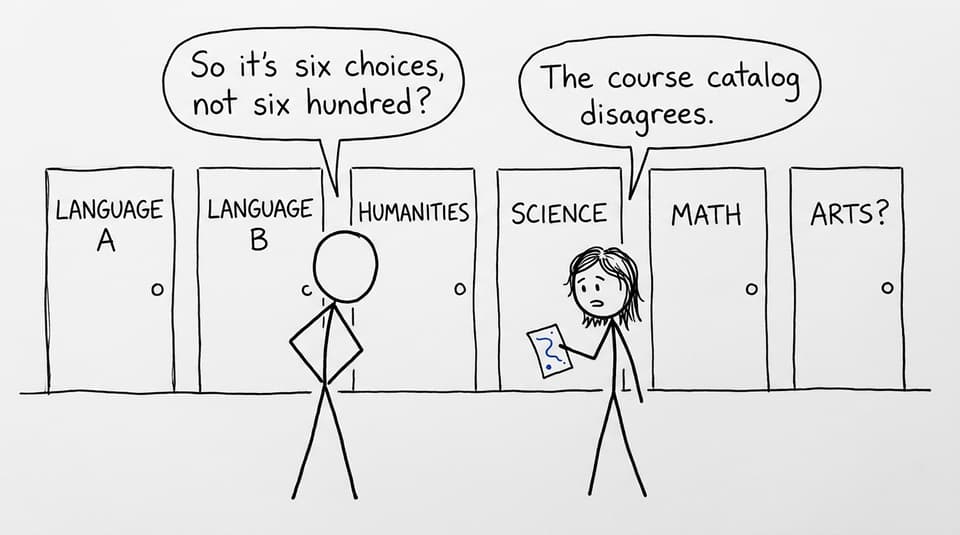
The reassuring answer is that the structure is clear. A full IB Diploma student studies six subjects, generally covering five required academic groups plus either an arts subject or an additional subject from another group. Of those six subjects, three or four are taken at Higher Level (HL) and the remainder at Standard Level (SL). Every Diploma student must also complete the three-part core: Theory of Knowledge (TOK), the Extended Essay (EE), and Creativity, Activity, Service (CAS).
The official framework is fixed, but the exact subjects available depend on the student's school. That distinction matters. The IB determines the overall rules; individual schools determine which approved courses they can offer.
IB subject requirements at a glance
Before considering individual courses, parents and students can use this checklist:
- Choose six subjects in total.
- Include at least one course from Groups 1 through 5, subject to approved alternatives such as studying two Group 1 languages.
- Choose an arts course from Group 6 or replace it with an additional language, humanities, or science course.
- Take at least three and no more than four subjects at HL.
- Take the remaining subjects at SL.
- Complete TOK, the Extended Essay, and CAS.
- Confirm that the combination satisfies relevant university prerequisites.
- Check which courses and levels the school actually offers.
Students can browse the wider IB syllabus and subject directory to see how the groups, subjects, and study resources fit together.
What are the six IB subject groups?
The six groups give the Diploma its breadth. Students cannot usually build a programme containing only sciences or only humanities. They are expected to continue working with language, quantitative reasoning, evidence, interpretation, and communication.
Group 1: Studies in language and literature
Group 1 is normally the student's strongest language. Depending on what the school offers, courses may include Language A: Literature or Language A: Language and Literature.
These are not simply grammar courses. Students interpret literary and non-literary works, analyse how writers and creators make meaning, and develop arguments through oral and written assessment. Both SL and HL demand close reading, but HL generally involves greater breadth and depth.
Students preparing for this group can explore IB English A Language and Literature resources, including notes, questions, lessons, and analytical support.
Group 2: Language acquisition
Group 2 develops an additional language. Common pathways include Language B for students with previous experience and language ab initio for beginners or students with very limited prior exposure. Ab initio is offered at SL only.
There is an important alternative. A student may study two different languages in Group 1 instead of taking a Group 2 language acquisition course, provided the programme meets IB rules and the school supports the combination.
Language choices should reflect actual experience rather than an attempt to find the easiest label. The school normally places students in the appropriate course. The IB English B resource library shows the kinds of comprehension, communication, and language skills developed in a Group 2 course.
Group 3: Individuals and societies
Group 3 examines people, institutions, places, decisions, and systems. Depending on school availability, options may include History, Economics, Geography, Business Management, Global Politics, Psychology, Philosophy, Digital Society, and Environmental Systems and Societies (ESS).
The common thread is not memorisation alone. Students must use evidence, explain relationships, interpret perspectives, and often evaluate competing arguments. A student who enjoys discussing why events happen or how policies affect different groups may feel at home here.
For an example of the depth involved, families can browse the IB Environmental Systems and Societies study notes. ESS is interdisciplinary and can satisfy requirements across Groups 3 and 4, after which the student still selects six subjects overall.
Group 4: Sciences
Group 4 includes courses such as Biology, Chemistry, Physics, Computer Science, Design Technology, Sports, Exercise and Health Science, and ESS. The exact list and available levels vary by school and examination session.
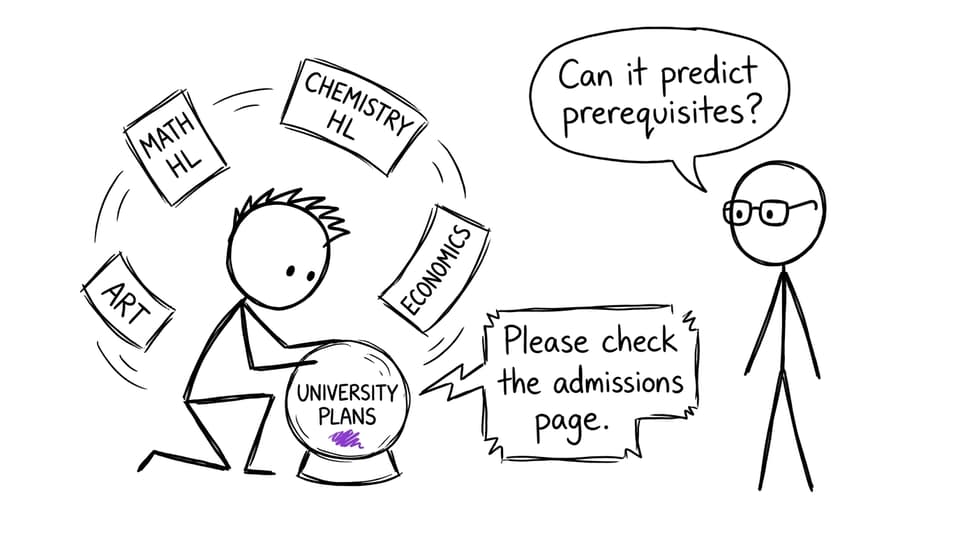
Science selection often deserves early attention because university programmes may name specific prerequisites. Medicine, engineering, and some natural science degrees can require particular sciences at HL, sometimes alongside a specified mathematics course. Those rules are set by universities, not by the IB, and they differ across institutions.
The IB Biology learning and practice library offers an example of how students can move between explanations, Flashcards, questions, and lessons when preparing for a science course.
Group 5: Mathematics
Every full Diploma student studies mathematics. The current pathways are Mathematics: Analysis and Approaches (AA) and Mathematics: Applications and Interpretation (AI), each available at SL and HL.
AA places greater emphasis on mathematical reasoning, algebraic methods, and analytical approaches. AI places greater emphasis on modelling, applications, statistics, and the use of technology. This is not a simple division between difficult and easy. The better choice depends on the student's strengths, intended degree, and the entry policies of prospective universities.
Families considering a mathematically demanding degree should check official admissions pages before selecting a pathway or level. Students can preview the style and scope of one option through the IB Mathematics Analysis and Approaches resources.
Group 6: The arts or an additional subject
Group 6 may include Visual Arts, Music, Theatre, Film, and Dance, depending on the school. Arts courses combine creative production with research, analysis, reflection, and sustained documentation. They should not be treated as automatic light options.
However, an arts subject is not compulsory for the full Diploma. Students may replace Group 6 with an additional subject from languages, individuals and societies, or sciences. A prospective medical student might use this flexibility to take two sciences, while a student interested in social sciences might select both Economics and History.
Students who choose an arts pathway can examine the IB Visual Arts Coursework Library to understand how strong work connects creative decisions with assessment criteria.
How do IB HL and SL subjects work?
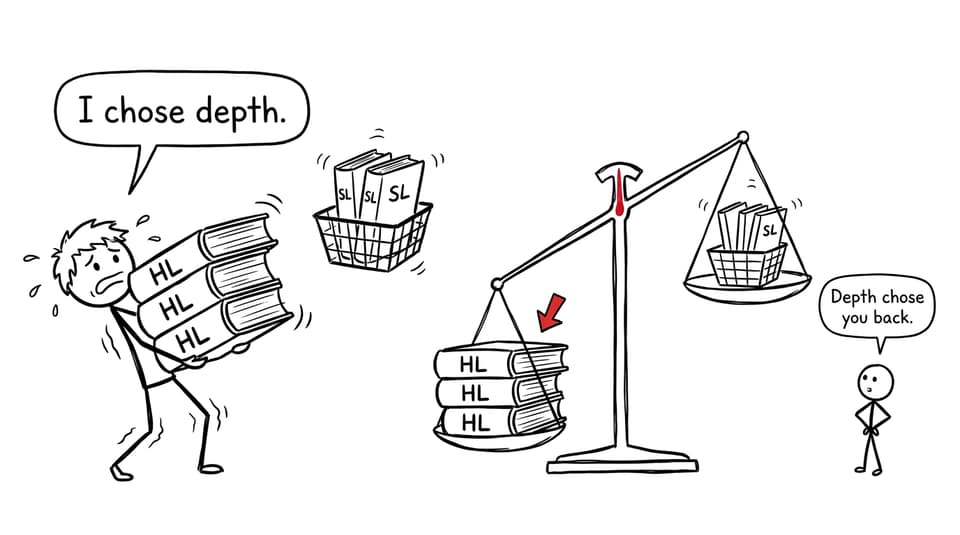
HL and SL courses are both serious Diploma subjects, but HL requires greater scope and depth. The IB recommends 240 teaching hours for an HL course and 150 teaching hours for an SL course. HL may involve additional content, more demanding assessment, or deeper treatment of shared concepts, depending on the subject.
| Requirement | Higher Level | Standard Level |
|---|---|---|
| Number normally selected | Three, sometimes four | Remaining subjects |
| Recommended teaching time | 240 hours | 150 hours |
| Academic scope | Broader or deeper | More focused |
| University relevance | Frequently used for prerequisites | May satisfy broader entry requirements |
| Diploma subject grade | Awarded from 1 to 7 | Awarded from 1 to 7 |
The safest approach is usually to place the student's strongest and most degree-relevant subjects at HL. Four HLs are permitted, but permission is not the same as wisdom. The extra workload should have a clear purpose.
The Diploma core is required too
Six subjects are only part of the Diploma. Every student also completes:
- Theory of Knowledge: A course examining knowledge, evidence, interpretation, and how claims are justified.
- Extended Essay: An independently researched academic paper of up to 4,000 words.
- Creativity, Activity, Service: A programme of experiences across the three CAS strands. CAS is not assigned a conventional subject grade, but successful completion is required.
TOK and the Extended Essay can contribute up to three additional points to the Diploma score. CAS contributes no points, yet it remains a completion requirement. This is why workload planning must account for more than six examination timetables. Research, reflection, coursework, and internal deadlines continue alongside subject revision.
How should families choose the right combination?
Subject selection is best treated as a constraint problem rather than a popularity contest. The student is trying to find the overlap between four things: Diploma rules, school availability, personal ability, and future entry requirements.
Start with likely university directions, even if they are still broad. Check the official admissions pages for several realistic institutions and note required subjects, accepted mathematics pathways, required levels, and minimum grades. Requirements can change, so current first-party guidance matters more than an old forum discussion.
Next, consider evidence from the student's present performance. Enjoyment matters, but so does the kind of work a subject repeatedly demands. A student may enjoy scientific ideas while disliking laboratory analysis, or enjoy historical documentaries while finding evidence-based essays exhausting. Course choice should reflect the work, not merely the label.
Finally, examine the full combination. Three individually reasonable HL choices can create an unreasonable week when major coursework deadlines converge. Ask the school's IB coordinator about timetabling, course availability, placement policies, and recent syllabus changes before finalising anything.
Turn the subject list into an exam plan
Once subjects are selected, the challenge changes. The question is no longer "Did we choose correctly?" but "How will the student manage six different forms of thinking?"
RevisionDojo helps make that workload visible. Students can begin with IB revision notes organised by subject, reinforce definitions and processes with Flashcards, and apply understanding through the Questionbank. AI Chat can clarify difficult concepts, while Grading tools and the Coursework Library help students interpret criteria and improve drafts responsibly.
As examinations approach, Predicted Papers and Mock Exams can build timing and stamina. Tutors can provide additional human guidance when a student needs a more individual explanation. The value is not simply having more resources; it is having one connected IB system for learning, practice, feedback, coursework, and exam preparation.
A clear structure leaves room for an individual path
The IB Diploma requires six subjects, a mixture of HL and SL study, and completion of TOK, the Extended Essay, and CAS. Groups 1 through 5 provide the academic foundation. The sixth choice can be an arts course or another approved language, humanities, or science subject.
Within that structure, there is considerable flexibility. The best combination is not the one that looks most impressive in isolation. It is the one that keeps university options open, matches the student's capabilities, and remains sustainable across two demanding years.
Once that combination is chosen, explore the relevant subject libraries on RevisionDojo and build a simple weekly rhythm: learn with Study Notes, recall with Flashcards, practise in the Questionbank, and review mistakes before they become habits. A complicated programme becomes more manageable when every subject has a clear next step.