

When people say they’re “not creative,” they usually mean something more specific: they don’t like feeling wrong in public.
And MYP Design has a way of putting that fear on the table.
You sketch an idea. You test it. It fails in a surprisingly dramatic way. Then you realise the point wasn’t to be clever first try. The point was to prove you can think, adapt, and show evidence of improvement.
That’s why MYP Design is one of the best training grounds for exam success: it turns creativity into a repeatable process. Not inspiration. Not luck. A cycle you can run when you’re tired, busy, and under pressure.
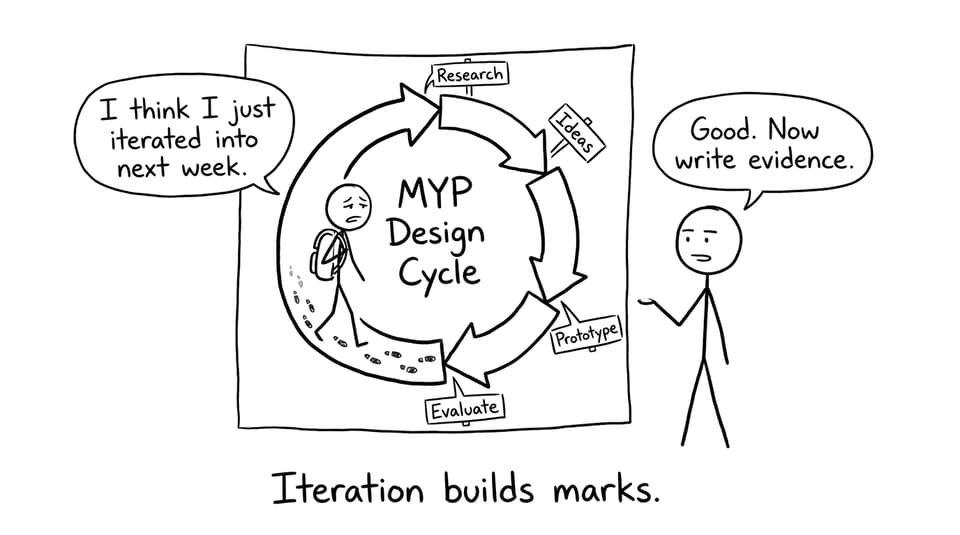
MYP Design in one exam-friendly checklist
Use this quick list before any MYP Design task, ePortfolio entry, or end-of-unit assessment:
-
Define a real user and a focused problem (not a theme)
-
Research like you’re trying to change your mind, not confirm it
-
Create success criteria you can actually test
-
Generate multiple ideas and justify your choice
-
Prototype early, then iterate on purpose
-
Collect feedback (quotes, scores, observations)
-
Evaluate against success criteria with evidence
-
Write reflections that explain what changed and why
If you need a central place to organise your wider MYP prep, start with the Middle Years Programme (MYP) hub.
What MYP Design is really teaching you
At its core, MYP Design is not “make a cool thing.” It’s “make a justified thing.”
The design cycle (inquire, develop ideas, create, evaluate) mirrors how you earn marks in almost every IB-style assessment: you build a claim, support it, test it, then refine it.
That’s also why Design connects so well to your exam subjects. The habits transfer:
-
Research and reasoning (like Individuals & Societies)
-
Testing and method (like Sciences)
-
Clear communication and criteria alignment (like Languages)
If you want to strengthen how you think about grading across subjects, read How Are MYP Students Graded? Criteria Explained.
Creativity that scores in MYP: build constraints on purpose
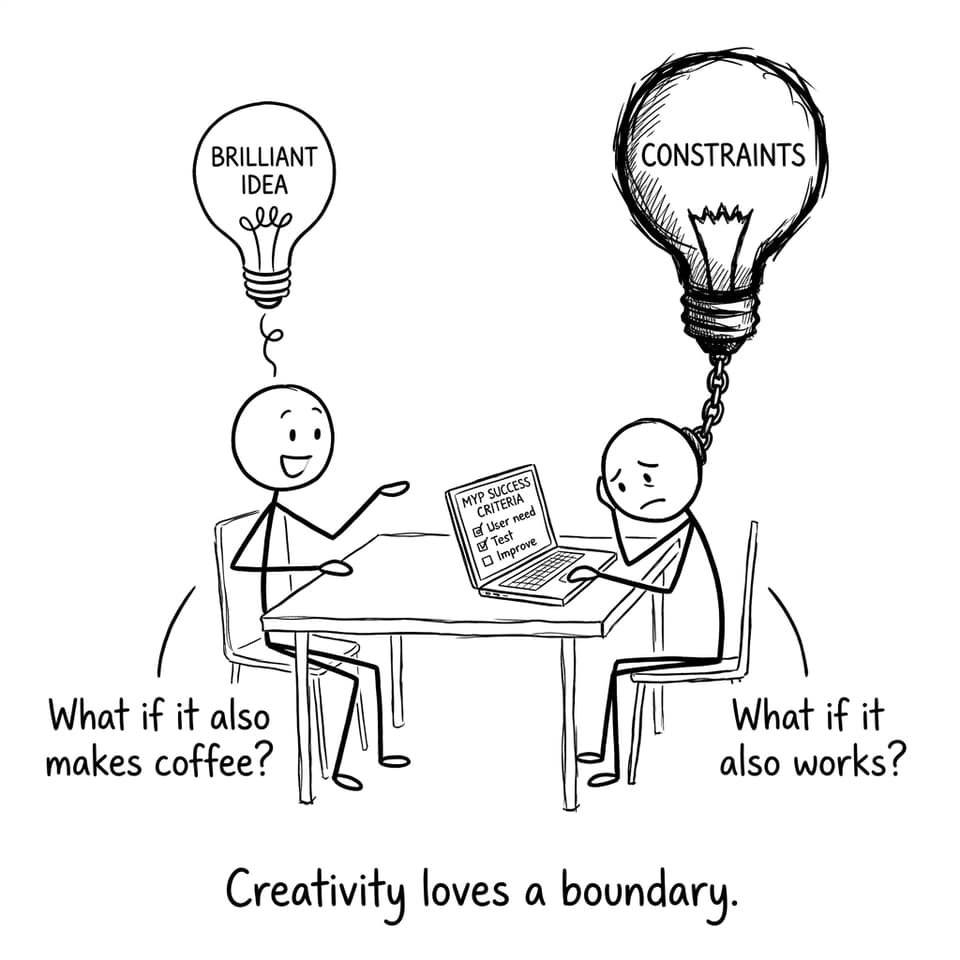
A small secret: creativity improves when you add a boundary.
In MYP Design, the boundary is usually one of these:
-
the user’s needs
-
time, materials, budget
-
sustainability or ethical impact
-
usability requirements (comfort, accessibility, safety)
Instead of brainstorming endlessly, decide your constraints early and let them guide your ideas.
A fast activity: “Two truths and a constraint”
-
Write two true user needs (based on research).
-
Add one constraint (time, cost, materials, environment).
-
Generate three solutions that respect all three.
This is MYP creativity that examiners can reward because it produces visible decision-making.
MYP problem-solving activities you can run in one lesson
These are short activities that create strong evidence for Criteria A--D in MYP Design.
User interview speed-run (Criterion A)
-
Interview one user for 5 minutes.
-
Ask only “why?” questions.
-
Pull out three pain points.
-
Turn them into a problem statement.
Your goal is not a perfect interview. Your goal is usable insight.
For help connecting context to design choices, see Embedding Global Contexts in MYP Design Projects.
The “ugly prototype” challenge (Criterion C)
Build the fastest possible version in 10 minutes.
-
Cardboard, paper, digital wireframe, anything.
-
Label what’s uncertain.
-
Test one function.
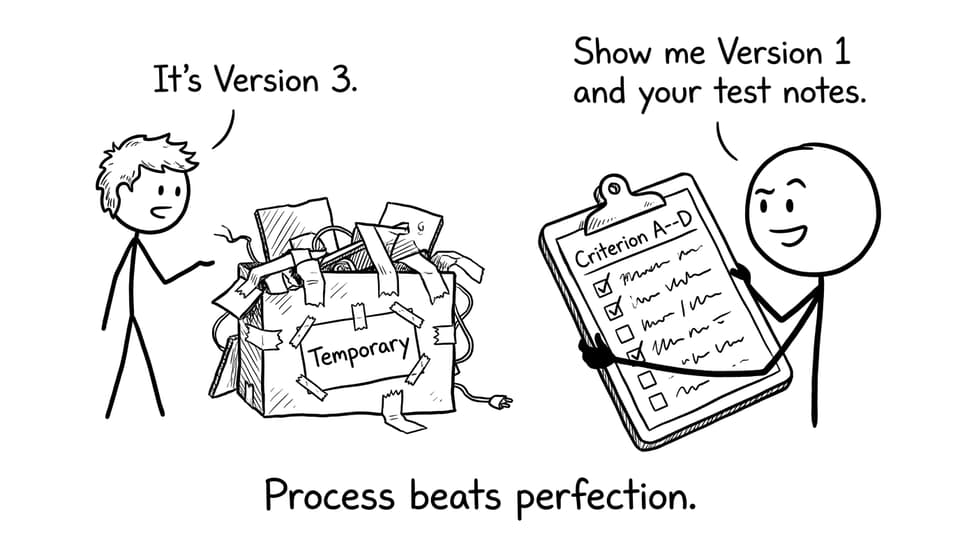
This trains the most important MYP design habit: prototype early so iteration has time to happen.
Feedback loop ladder (Criteria C and D)
Run feedback in three rounds:
-
Round 1: observe a user silently
-
Round 2: ask for a 1--5 rating on two criteria
-
Round 3: ask one open question: “What would you change first?”
Then write one sentence that starts with: “Because I observed X, I changed Y.”
That single sentence is basically an examiner’s dream in MYP.
How to link every action to MYP Criteria A--D
Students often lose marks not because the project is weak, but because the evidence is invisible.
Use this mapping during your work:
Criterion A: Inquiring and analyzing (MYP)
-
user profile and problem statement
-
research summary with sources
-
explanation of how research shaped decisions
Criterion B: Developing ideas (MYP)
-
multiple design ideas
-
chosen design justified against success criteria
-
clear plan (materials, steps, time)
Criterion C: Creating the solution (MYP)
-
prototype versions (v1, v2, v3)
-
proof of skills and techniques
-
documentation of changes
Criterion D: Evaluating (MYP)
-
testing results linked to success criteria
-
balanced reflection (what worked, what didn’t, why)
-
specific improvements for next iteration
If you want a broader MYP structure mindset, Design Effective MYP Interdisciplinary Units is a useful companion read.
Using RevisionDojo to study MYP Design like an exam subject
Even if Design is project-based, you can revise it like an exam skill: repeat cycles, tighten criteria language, and learn to explain decisions clearly.
Here’s a simple RevisionDojo loop that fits busy weeks:
-
Study Notes: use them to model concise explanation and research summaries
-
Flashcards: memorise design cycle terms, ATL language, and command terms using Flashcards
-
Questionbank: train transferable problem-solving with the Questionbank feature
-
AI Chat: ask for sharper success criteria or better test methods (then rewrite in your own voice)
-
Grading tools: check whether your reflection actually answers the rubric strand
-
Mock Exams and Predicted Papers: build timed stamina for your other MYP subjects so project work doesn’t steal exam confidence
-
Coursework Library: compare what “clear evidence” looks like across tasks
-
Tutors: when you need a calm human to help you simplify the project and raise the marks
For a complete routine that supports eAssessments alongside coursework, use MYP eAssessments: 30-Day Study Plan That Works.
FAQ
How do I show creativity in MYP Design without making something complicated?
Creativity in MYP Design is not the same as complexity. A simple solution can score highly if it is clearly connected to a user need, justified using research, and improved through testing. Examiners and teachers reward the thinking trail: how you moved from problem to criteria to prototype to evaluation. If your product is basic but your iteration is strong, you can still demonstrate top-band performance. Start by making success criteria that are easy to test (for example, “a user can complete the task in under 30 seconds”). Then run at least one feedback loop and show what changed. The creativity is often in the decision-making, not the decoration.
What are the best problem-solving activities for MYP Design exam preparation?
The best MYP problem-solving activities are the ones that create repeatable evidence quickly. Short user interviews, rapid prototyping, and structured feedback rounds work because they generate research notes, design changes, and evaluation data in a single lesson. Those artifacts become your Criterion A, C, and D proof. Another strong activity is redesigning an everyday object under constraints (budget, sustainability, accessibility) because it forces justified trade-offs. If you want an exam-style routine, pair one activity with timed reflection writing: 10 minutes to explain “what I changed and why.” That trains you to write like an assessor is reading.
How can I improve my MYP Design grades if my final product isn’t perfect?
In MYP, a perfect-looking final product is not the main source of marks. What usually lifts grades is clearer alignment to Criteria A--D, stronger success criteria, and better documentation of iteration. If something fails, treat it as data: record what happened, explain why, and show what you adjusted. Include photos or screenshots of early versions, not just the final result. Add testing notes with numbers, quotes, or observations that connect directly to your criteria. Then write an honest evaluation that proposes specific next steps instead of vague improvements. If you build that evidence trail, your grade can rise even when the outcome is smaller than you hoped.
Closing: run the MYP cycle when motivation disappears
The strongest MYP Design students aren’t the ones who never get stuck.
They’re the ones who treat “stuck” as a step in the cycle: research, ideas, prototype, evaluate, repeat. They keep the evidence. They write the reasons. They make improvement visible.
If you want that same calm structure across your whole MYP workload, use RevisionDojo as your home base: practise with the Questionbank, patch gaps with Study Notes, retain terms with Flashcards, get unstuck with AI Chat, and build confidence with Mock Exams and Predicted Papers. When you’re ready, explore more MYP guidance through the MYP tag archive.