


If you have ever opened an MYP unit plan and thought, “This feels global… but my exam is next month,” you are not alone.
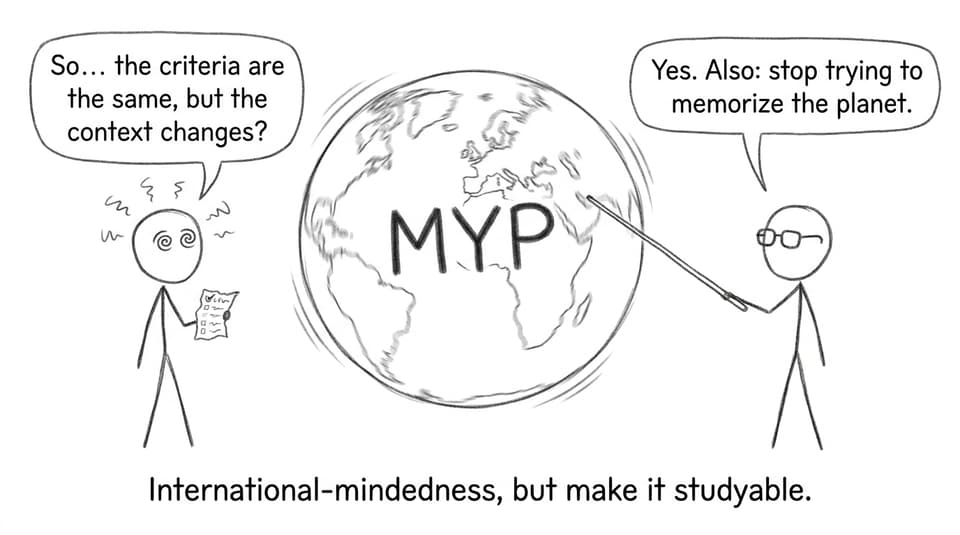
The MYP is designed to travel well. It keeps the same criteria, the same emphasis on inquiry, and the same learner profile language, whether you are studying in a high-rise campus in Singapore or a community-based program in Kenya. But the stories inside the framework change: which issues feel urgent, which languages shape classroom discussion, and which kinds of projects are possible.
For IB students preparing for exams, that global variety can feel like noise. The trick is to treat it as a pattern-recognition advantage. Once you understand how MYP stays consistent while contexts shift, you get better at the exact skill exams reward: applying learning to unfamiliar situations.
Quick checklist: what to notice when you study MYP globally
Use this mini checklist before you dive into “country spotlights.” It keeps the MYP useful for exam prep.
-
Same MYP criteria, different evidence: Ask what “success” looks like in Criteria A-D and how students prove it.
-
Concept + context pairing: Identify the Key Concept and Global Context driving the learning.
-
Assessment style trends: Is the emphasis on on-screen exams, ePortfolios, or project evidence?
-
Language environment: Monolingual, bilingual, or multilingual? How does that shape communication?
-
Service as Action: What “action” looks like locally, and how reflection is captured.
If your revision needs a structured starting point, use the Middle Years Programme (MYP) hub to see how RevisionDojo organizes MYP resources by subject and skill.
Why the MYP works across countries
The reason the MYP scales globally is not that every school teaches the same examples. It is that the framework is built around transferable thinking: inquiry, concepts, global contexts, Approaches to Learning (ATL), and criterion-related assessment.
That matters for exams because exam questions rarely ask, “Do you remember the exact worksheet?” They ask whether you can interpret a new scenario and respond with clear method, reasoning, and communication.
On RevisionDojo, you can train this transfer loop in a practical way:
-
Use the Questionbank feature to practice unfamiliar contexts.
-
Patch weak concepts quickly with Study Notes.
-
Lock in definitions and ATL language using Flashcards.
This is what the MYP is quietly teaching you: not just content, but the habit of adapting.
Country spotlight: Singapore (innovation meets inquiry)
In Singapore, many MYP schools lean into STEM, design cycles, and structured innovation because the broader academic culture rewards precision and high performance. The MYP fits well here because it gives “innovation” a method: inquiry questions, criterion-based success, and interdisciplinary units that connect disciplines rather than stacking them.
What you can steal for exams:
-
Treat every task like a design challenge: clarify the problem, define criteria for success, test your response.
-
Practice explaining your method, not just your final answer.
If you want a calm system for exam season, the routines in MYP eAssessments: 30-Day Study Plan That Works translate this mindset into daily actions.
Country spotlight: United Kingdom (balancing IB and national demands)
In the UK, MYP often runs alongside national curriculum expectations. That pushes teachers and students to become bilingual in assessment: you learn to meet external content requirements while still writing and reflecting in MYP language.
This can be frustrating at first. But it creates a powerful exam advantage: you learn to show evidence against criteria, even when the content is familiar.
What you can steal for exams:
-
Rewrite feedback in criterion terms: “What would move this from a 5 to a 6?”
-
Practice command terms deliberately, because they are how assessment stays consistent.
For practical technique, MYP Revision Guide: Study Tips for Success is a strong companion when you want to make MYP criteria feel studyable.
Country spotlight: Kenya (Service as Action with real proximity)
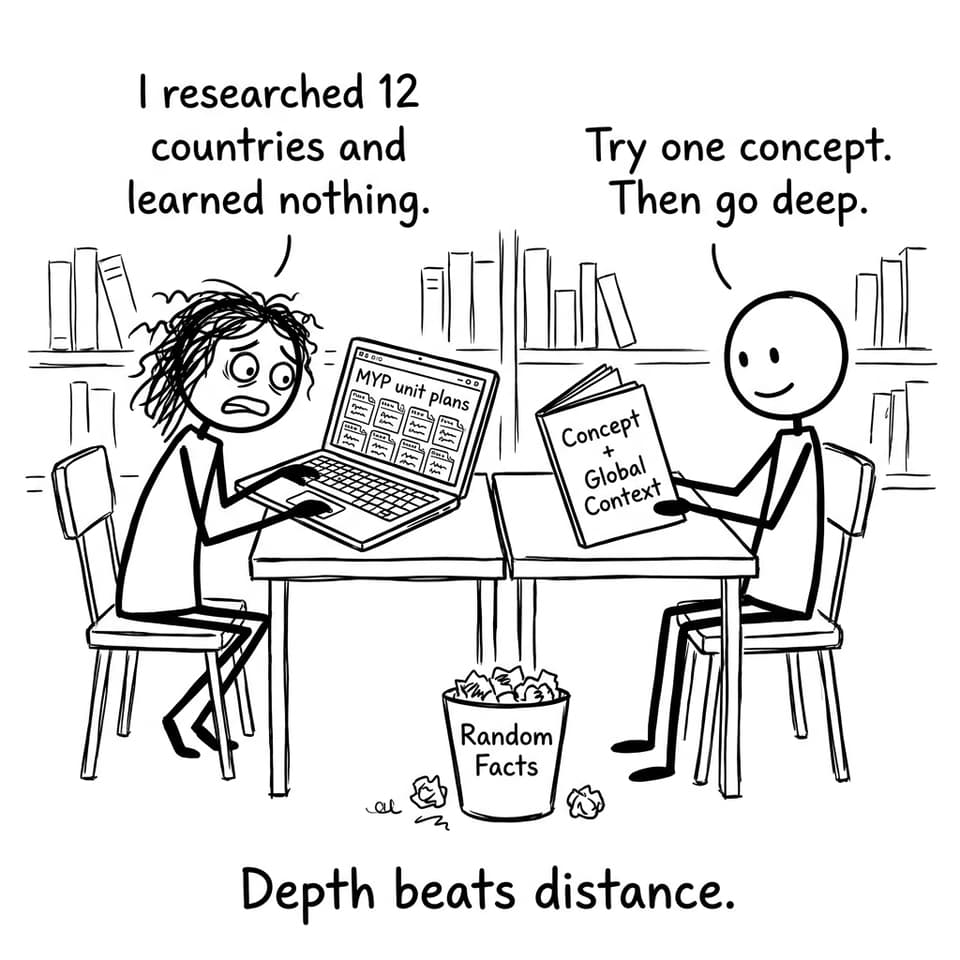
In Kenya, many MYP implementations emphasize Service as Action through direct community partnerships. The MYP mission becomes visible because the “global context” is not abstract; it is often something students can see and measure locally.
The academic payoff is subtle: reflection becomes less like a school requirement and more like evidence-based thinking. You do something, observe impact, and adjust.
What you can steal for exams:
-
Build the habit of evidence: examples, data, outcomes, and what changed.
-
Use reflection as a method for improvement, not as a diary entry.
If you are doing the Personal Project, the most detailed exam-aligned support is in MYP Personal Project: The Ultimate Student Guide, plus exemplar structure from the IB Personal Project (MYP) Examples library.
Country spotlight: United States (customization and interdisciplinary depth)
In the US, MYP is often blended with district standards and local graduation requirements. That tends to produce flexible course design and lots of project-based learning, especially where schools want students to demonstrate agency.
This flexibility can be a strength, but it can also hide gaps if you only do “fun projects” without tracking what criteria you are actually meeting.
What you can steal for exams:
-
Keep a simple criteria tracker: which strand are you proving, with what evidence?
-
Practice writing short, clear justifications under time pressure.
RevisionDojo’s workflow helps here because it turns “custom learning” into measurable progress: Questionbank practice for accuracy, then AI feedback, then targeted fixes.
Global MYP trends that matter for exam prep
Across regions, a few MYP trends keep repeating. If you revise with these in mind, you study smarter.
Digital assessment habits are becoming normal
On-screen exams, typed responses, digital annotation, and portfolio evidence are common. This makes time management and clarity even more valuable.
If you want the all-in-one workflow many students use to train this, see RevisionDojo App: The Smarter Way to Prep for IB Exams.
Multilingual learning is shaping communication skills
Many MYP schools are bilingual or multilingual. That pushes clarity: defining terms precisely, structuring explanations, and communicating purpose.
This is also why concise resources matter in revision. If you like visual summaries, use IB Cheatsheets to tighten recall before practice.
Well-being and balance are moving from slogan to system
Post-pandemic, more schools explicitly teach reflection, balance, and self-management. Those are ATL skills, and they are exam skills.
A useful mindset reset is in How to Study for IB Exams Without Burning Out because it treats consistency as a strategy, not a personality trait.
Sustainability and global citizenship are becoming default contexts
Service learning tied to SDGs appears everywhere. The content differs, but the assessment logic is stable: inquiry, action, reflection, evidence.
FAQ
Is the MYP the same in every country?
The MYP framework is consistent worldwide, especially the criterion-related assessment model and the focus on inquiry, concepts, and ATL skills. What changes is the context that teachers use to make the learning real: local issues, cultural references, community partners, and language environments. This is why MYP feels both familiar and different when you compare countries. For exam prep, this is good news because it means your method can stay stable even when the scenario changes. Train yourself to ask: “Which criterion is this question rewarding, and what evidence would earn marks?” If you practice that skill, the global variety of MYP becomes a strength, not a distraction.
Why do so many schools choose the MYP?
Schools choose MYP because it offers a structure that builds transferable skills without locking schools into one national style of teaching. The focus on inquiry helps students learn how to ask good questions, not just repeat answers. The criteria help students understand what quality looks like, which can be more motivating than vague grades. The learner profile and global contexts give schools language to discuss ethics, identity, and responsibility alongside academics. For students preparing for exams, the big advantage is that MYP trains you to respond to unfamiliar prompts with calm structure. That is exactly what strong exam performance looks like.
What challenges do students face when studying MYP in different systems?
A common challenge is mixed expectations: you might be doing MYP criteria while also being graded through local tests, which can feel like two different games. Another challenge is inconsistency in how teachers interpret criteria language, especially if a school is newer to MYP. Students also struggle when projects become big and reflective, but revision time is limited and exams are close. The solution is to create a repeatable study loop that works in any context: understand one concept, recall it, apply it to questions, review mistakes, repeat. RevisionDojo supports this with Study Notes for clarity, Flashcards for daily recall, Questionbank for exam-style application, AI Chat for quick explanations, and Grading tools when you need rubric-based feedback. When the system is stable, the school context matters less.
Bringing it home: make MYP global, but keep your revision local
The MYP is global because it is built on ideas that travel: inquiry, criteria, reflection, and action. Singapore might express that through design and STEM. The UK might express it through tight alignment with external standards. Kenya might express it through community partnership. The US might express it through flexible interdisciplinary learning.
Your exam does not require you to memorize those differences. It requires you to do what the MYP has been training all along: apply a stable method in a new situation.
If you want that method in one place, start with the Middle Years Programme (MYP) hub, then run the RevisionDojo loop: Study Notes to rebuild understanding, Flashcards to keep recall alive, Questionbank to practice under exam-style constraints, AI Chat to unblock confusion, and timed practice through Mock Exams and Predicted Papers when you are ready to simulate pressure. That is how MYP stops being “around the world” and becomes “in your hands.”