


If you have ever stared at a trigonometry question and felt your brain try to negotiate for a different topic, you are not alone. In IB Math, trig formulas are the quiet “multipliers” of your score: they turn messy expressions into one clean line, and they turn geometry questions into something you can actually finish on time. HL students meet them in proofs and calculus. SL students meet them in triangles and simplification. Everyone meets them under time pressure.
This guide is a practical, exam-first refresher on IB Math trig formulas for both HL and SL, plus a short system for making them stick.
Quick checklist: what to know for IB Math trig
-
Know the “big families”: Pythagorean identities, angle sum/difference, double-angle, sine rule, cosine rule.
-
Practice picking the right formula quickly (speed matters in IB Math).
-
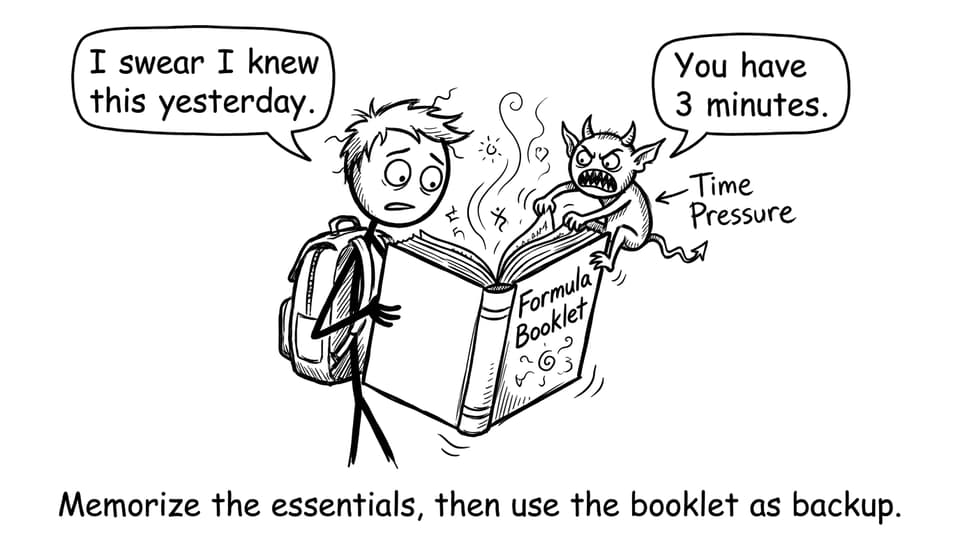
Use the formula booklet as backup, not as your first move.
-
Train two skills: simplification/proof steps and triangle problem setup.
-
Build routine practice using RevisionDojo’s Geometry & Trigonometry notes and Geometry & Trigonometry Questionbank.
The essential IB Math trig formulas (HL and SL)
In IB Math, most trig questions are really pattern-recognition questions. The formulas below are the patterns that show up most.
Pythagorean identities
These are your cleanup crew:
-
(\sin^2\theta + \cos^2\theta = 1)
-
(1+\tan^2\theta = \sec^2\theta) (more common in HL extension work)
A strong habit: rearrange them automatically.
For example, (\sin^2\theta = 1-\cos^2\theta). It saves time when simplifying.
Angle sum and difference
These are the “expand the brackets” tools of trig:
-
(\sin(A \pm B)=\sin A\cos B \pm \cos A\sin B)
-
(\cos(A \pm B)=\cos A\cos B \mp \sin A\sin B)
HL students: these identities are frequent in “Show that…” style arguments. SL students: they appear less, but knowing them can make a hard simplification suddenly straightforward.
Double-angle formulas
-
(\sin(2\theta)=2\sin\theta\cos\theta)
-
(\cos(2\theta)=\cos^2\theta-\sin^2\theta = 2\cos^2\theta-1 = 1-2\sin^2\theta)
That last line matters. In IB Math, (\cos(2\theta)) rarely appears in the form you want first.
Sine rule and cosine rule (non-right triangles)
Geometry questions often come down to choosing the right rule:
-
Sine rule: (\frac{a}{\sin A}=\frac{b}{\sin B}=\frac{c}{\sin C})
-
Cosine rule: (c^2=a^2+b^2-2ab\cos C)
For targeted practice, RevisionDojo’s IB Math AA Geometry & Trigonometry hub keeps these skills in one place.
How trig formulas show up in IB Math exam questions
A useful way to think about IB Math trig is this: you are almost never asked to “use a formula.” You are asked to choose a formula that makes the next step inevitable.
SL patterns you should expect
-
Simplifying expressions (often with (\sin^2+\cos^2=1))
-
Solving trig equations on an interval
-
Using sine/cosine rule to solve a triangle, including bearings and 3D contexts
If your triangle setup is shaky, pair practice questions with short explanations from RevisionDojo’s Geometry & Trigonometry videos.
HL patterns you should expect
-
Proving identities with clean, mark-earning steps
-
Rewriting expressions for calculus (especially turning squares into double-angle forms)
-
Combining trig with functions/transformations and sometimes vectors
HL students also benefit from a broader revision loop. Use How to revise IB Math AA and AI effectively to structure weekly practice.
A fast example (classic simplification)
Simplify (\sin^2\theta - \cos^2\theta).
Since (\cos(2\theta)=\cos^2\theta-\sin^2\theta), then
(\sin^2\theta-\cos^2\theta = -\cos(2\theta)).
That one move is very IB Math: you are not “doing trig,” you are recognizing a shape.
Common IB Math trig mistakes (and how to avoid them)
-
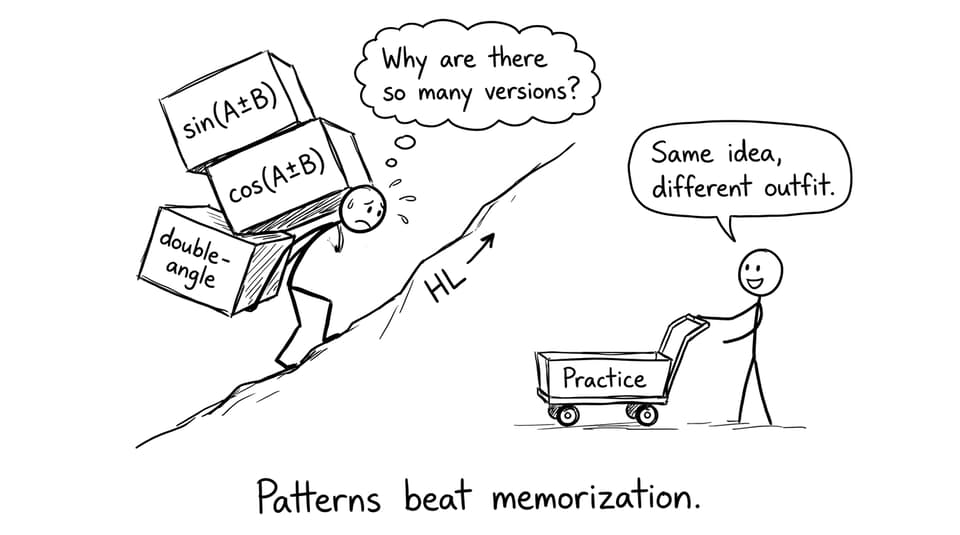
Confusing similar-looking identities: especially the different versions of (\cos(2\theta)). Write all three forms once, then practice converting between them.
-
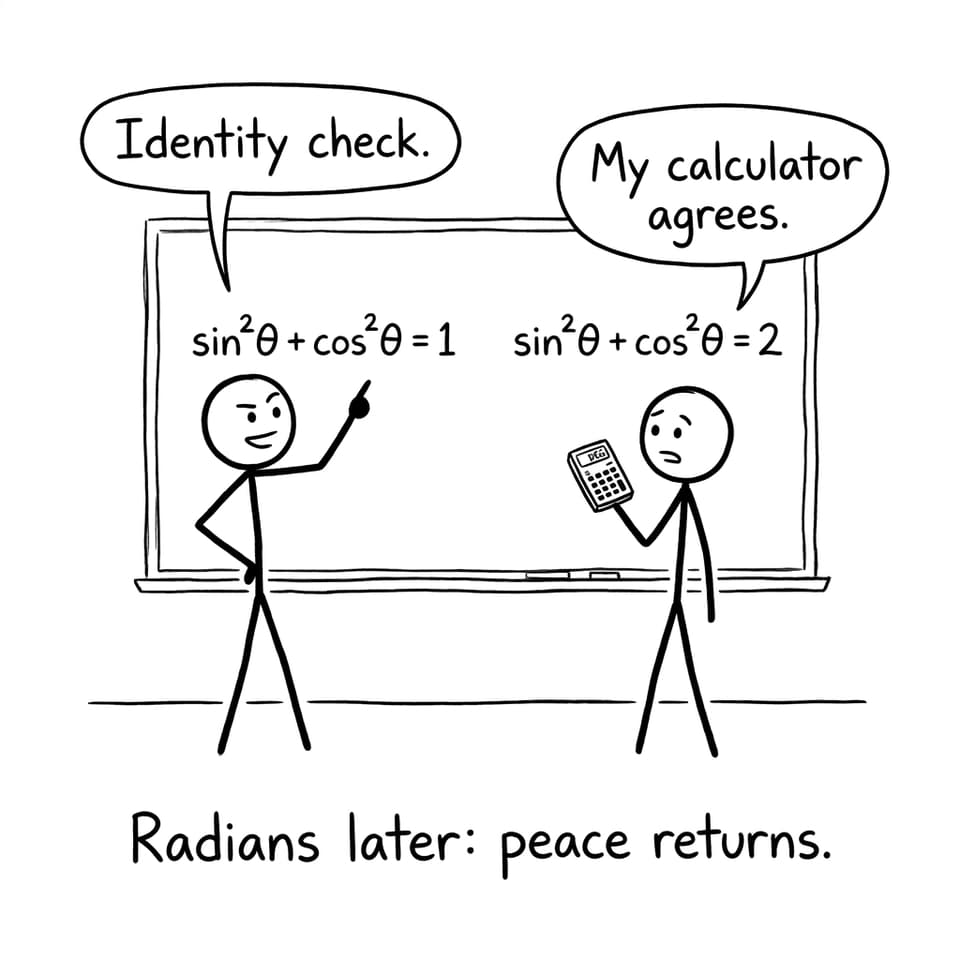
Calculator mode errors: degrees vs radians can quietly destroy a correct method.
-
Skipping steps in proofs: in IB Math, method marks live in the middle lines. Show each substitution clearly.
-
Using the formula booklet too late: the issue is not access, it’s speed. Learn where the trig section is and practice flipping fast.
For booklet strategy, see The importance of formula sheets in IB Math exams and keep the official-style reference open via the IB Math AA Data Booklet.
A simple practice loop that works
Here is a low-stress system you can repeat in IB Math:
-
Learn: read one subtopic in RevisionDojo notes (5-10 minutes).
-
Recall: make or review Flashcards for the identity family (2-3 minutes).
-
Apply: do a short Questionbank set focused on that exact skill (10-15 minutes).
-
Fix: use AI Chat or markscheme-style feedback to diagnose the mistake pattern.
RevisionDojo makes this loop easy because your Study Notes, Flashcards, AI Chat, and Questionbank sit together. When you are closer to exams, add Mock Exams and Predicted Papers for timed rehearsal, and use Grading tools to see where marks are leaking. If you need a human reset, the Tutors option is there for the week your confidence dips.
FAQ: IB Math trig formulas
Do I need to memorize trig formulas if the booklet exists?
In IB Math, the formula booklet is a safety net, not a strategy. Yes, many core results are provided, but looking them up mid-question costs time and breaks concentration. Memorizing the high-frequency identities (Pythagorean, double-angle, sine/cosine rule) gives you speed and calmer working. It also reduces silly errors, because you stop second-guessing what the booklet says. The best approach is a hybrid: memorize essentials, then use the booklet to confirm under pressure. RevisionDojo’s IB Math formula booklet guidance helps you decide what to learn vs what to locate quickly.
Which trig formulas matter most for IB Math HL?
For IB Math HL, you should treat trig identities as a small toolkit with a few “power tools.” Angle sum/difference and double-angle identities appear often in proofs and in transformations of expressions before calculus steps. The Pythagorean identity is still the most common simplifier, especially when you need everything in (\sin) or everything in (\cos). HL questions also reward clear algebra, so being able to rewrite (\cos(2\theta)) in different forms is a real advantage. The formulas are not hard individually, but HL difficulty comes from chaining them. Build that chaining skill with short, targeted drills in the Geometry & Trigonometry Questionbank.
How often does trig appear in IB Math exams?
In IB Math, trigonometry shows up consistently because it connects to so many other skills. You might see it as a triangle problem, but it can also appear as an identity proof, a function graph transformation, or a calculus setup where rewriting makes the integration or differentiation manageable. Even when a question is “really” geometry, you still need trig language to express angles and lengths efficiently. That is why practicing trig is high-return revision: it transfers across topics. If you want to place it inside a broader plan, use How to master IB Math AA HL topics efficiently and schedule weekly trig refreshers.
Conclusion: make IB Math trig feel automatic
Trig formulas are not a list to fear; in IB Math, they are a small set of shortcuts that buy you time, clarity, and marks. Learn the core families, practice recognizing the shapes, and treat the formula booklet as backup you can navigate quickly.
If you want a single place to run that routine, RevisionDojo is built for it: start with the Study Notes, drill with the Questionbank, lock recall with Flashcards, ask AI Chat when you get stuck, then level up with Mock Exams and Predicted Papers when timing starts to matter. Open the IB Math AA Geometry & Trigonometry hub and do one focused set today, future you will feel the difference in the exam.