
The moment DNA stops being “symmetrical”
In IB Biology, DNA replication feels tidy until you picture it happening in real time: helicase unzips, polymerase races forward, and then suddenly one side looks like it is building a road while driving backwards. That uncomfortable asymmetry is the whole point of leading vs lagging strands. It is not a trivia detail; it is the reason the replication fork needs a team of enzymes and a clever workaround.
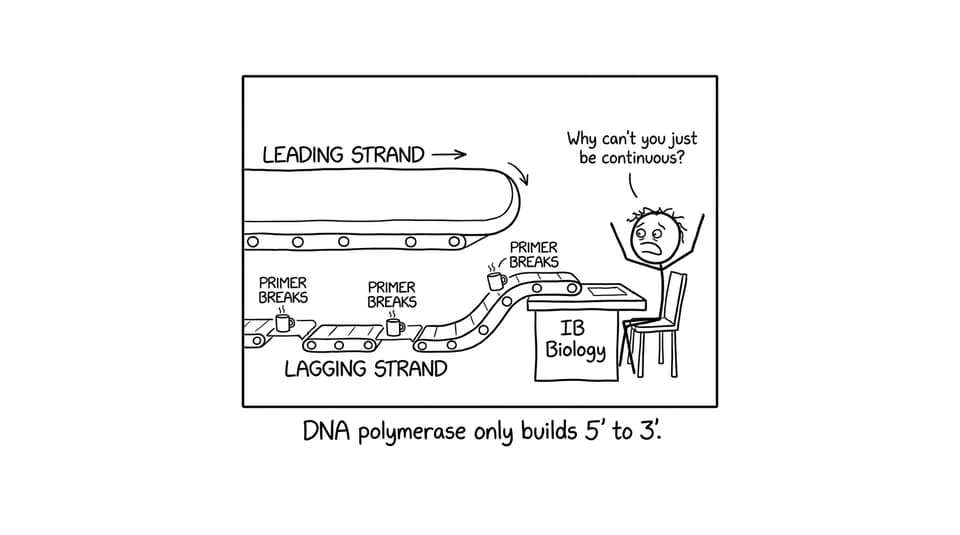
At the heart of it is one constraint you should keep repeating in IB Biology: DNA polymerase synthesizes only in the 5' to 3' direction. Because the two DNA strands are antiparallel, one new strand can be made smoothly, while the other has to be stitched together in pieces.
Quick checklist (what examiners expect)
Before you dive into details, keep this IB Biology checklist ready:
-
DNA strands are antiparallel (one runs 5' to 3', the other 3' to 5').
-
DNA polymerase adds nucleotides only 5' to 3'.
-
Leading strand = continuous synthesis toward the replication fork.
-
Lagging strand = discontinuous synthesis away from the fork.
-
Lagging strand uses Okazaki fragments, multiple RNA primers, and DNA ligase to seal.
For syllabus-aligned coverage, use the IB Biology Topic D1.1: DNA Replication hub and the D1.1 DNA replication Notes.
IB Biology explanation: the leading strand
The leading strand is the one that gets to feel “normal.” Its template strand runs 3' to 5', so DNA polymerase can read it and build the new complementary strand continuously in the 5' to 3' direction as the replication fork opens.
Key moves to describe in IB Biology answers:
-
Primase lays down one RNA primer.
-
DNA polymerase extends from that primer continuously.
-
Synthesis proceeds toward the replication fork.
If you want the clean, exam-style wording, compare with D1.1.7 Differences between replication on the leading strand and the lagging strand (HL) and revise the bigger picture in D1.1.1 DNA replication.
IB Biology explanation: the lagging strand (and why it must lag)
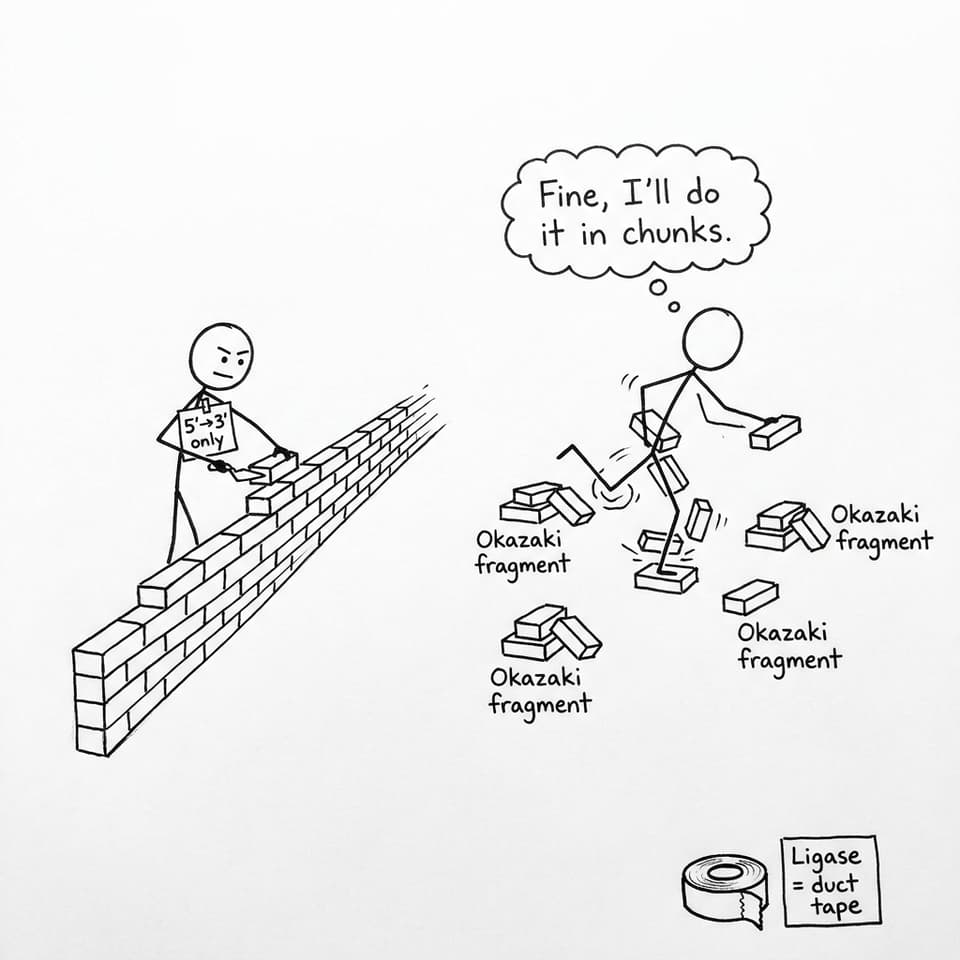
The lagging strand is built on a template that runs 5' to 3' into the replication fork. That sounds fine until you remember the rule: DNA polymerase cannot build 3' to 5'. So the cell compromises.
Instead of continuous synthesis, the lagging strand is made in short bursts:
-
Primase repeatedly adds RNA primers.
-
DNA polymerase extends each primer, creating Okazaki fragments.
-
RNA primers are removed and replaced with DNA (polymerase/exonuclease steps differ by organism).
-
DNA ligase seals the sugar-phosphate backbone, joining fragments into one strand.
That stop-start rhythm is exactly what IB Biology wants you to name and explain clearly.
Coordination at the fork: it is messy, but not random
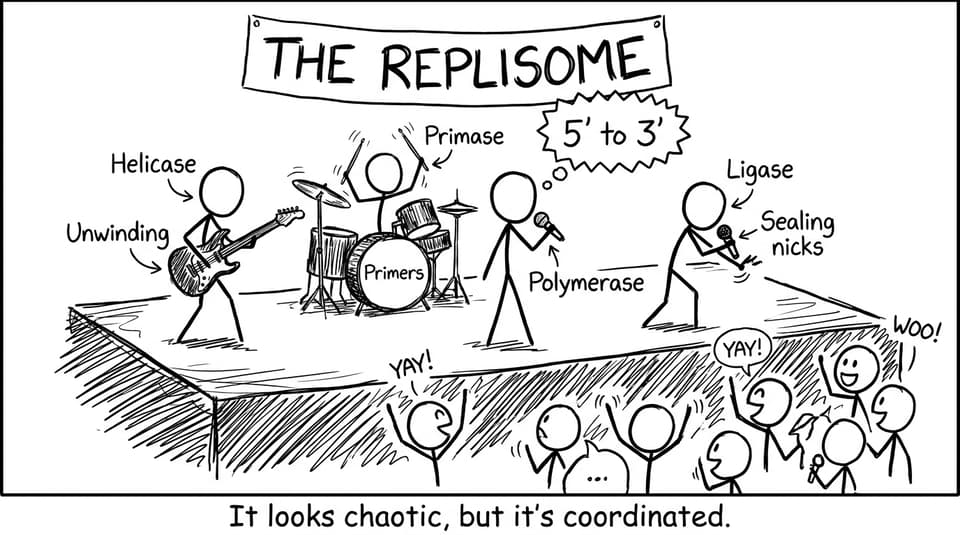
One reason students lose marks in IB Biology is describing leading vs lagging strands as if they happen separately. They do not. Replication is coordinated by the replisome so both strands are copied nearly simultaneously. A common detail: the lagging-strand polymerase can loop the DNA so it still travels with the fork physically, even if synthesis is discontinuous.
To strengthen your explanation, read How Enzymes Coordinate DNA Replication and practice with the Role of helicase and DNA polymerase in DNA replication Questionbank.
How to turn this into exam marks (RevisionDojo workflow)
In IB Biology, the best answers sound mechanical: direction, enzymes, fragments, sealing. On RevisionDojo, you can build that fluency fast:
-
Use the Study Notes for structure, then test with the Questionbank for recall under pressure.
-
Drill definitions with Flashcards (especially Okazaki fragments, ligase, primase).
-
Ask AI Chat to mark your short explanation and improve phrasing.
-
Use Grading tools to tighten command terms like “explain” vs “outline.”
-
Add Mock Exams and Predicted Papers for timing and stamina.
-
If you are stuck, the Tutors and Coursework Library help you keep the rest of the course steady while you fix this core concept.
For broader molecular practice, the Molecular biology Questionbank is a strong next step.
Closing: make the asymmetry your advantage
Leading vs lagging strands is one of those IB Biology ideas that feels annoying until you realize it is a gift: it forces you to explain directionality, enzymes, and coordination in one tight story. If you can write that story under timed conditions, you are building the same skill you need across genetics and molecular biology.
Use RevisionDojo to lock it in: review with notes, sharpen with flashcards, and pressure-test your understanding in the Questionbank. IB Biology rewards the student who can explain a messy process calmly and precisely. This is your chance to become that student.