


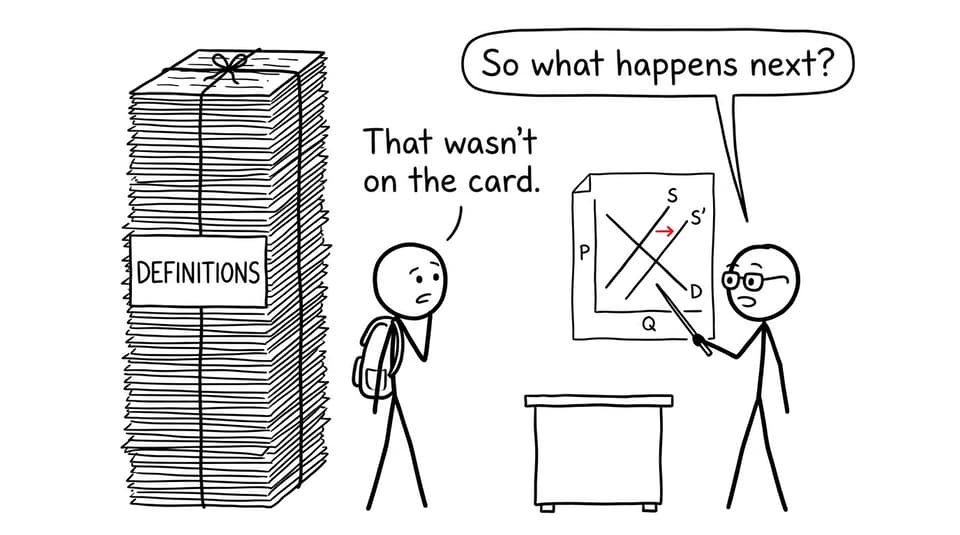
The hardest part of beginning IB Economics is rarely the vocabulary. It is discovering that knowing a definition is not the same as constructing an economic argument.
That distinction sits behind many IB Economics first term struggles. A student may accurately define scarcity, opportunity cost, demand, or supply, yet still feel lost when asked to apply the idea, draw a diagram, explain a causal chain, and judge what might happen in the real world.
IB Economics is not primarily a memory test. The course expects you to use models as tools for reasoning. The sooner you practise that process, the less intimidating the subject becomes.
The first-term adjustment checklist
If you are adjusting to IB Economics this fall, concentrate on five habits:
- Learn precise definitions, but do not stop there.
- Draw each new diagram from a blank page.
- Explain changes as connected causes and effects.
- Apply models to a specific situation.
- Evaluate conclusions through context, assumptions, and stakeholders.
Remember the sequence as define, diagram, explain, apply, evaluate. You will not need every stage in every classroom question, but practising the complete sequence prepares you for what the course ultimately assesses.
Why knowing the content can feel insufficient
Early lessons can create a reassuring rhythm. A term is introduced, the teacher explains it, and the student records it. The notebook fills up, so progress appears visible.
Then the question changes. Instead of asking what demand means, it asks how an event affects a market. Instead of requesting a definition of taxation, it asks who gains, who loses, and whether the intervention is likely to work. The model must travel from the page into a particular context.
The IB Economics framework includes knowledge and understanding, but it also expects application, analysis, evaluation, structured writing, quantitative techniques, and accurate diagrams. Content is the starting material, not the finished answer.
Begin with the IB Economics introduction topic. As you review scarcity, choice, and economic models, ask both, “What does this mean?” and “What could this explain?”
Build explanations as causal chains
Strong economic analysis resembles a row of dominoes. Each step creates the conditions for the next.
Suppose consumer incomes rise and the product is a normal good. A complete explanation might follow this chain:
- Higher income increases consumers' willingness and ability to buy the good.
- Demand increases, shifting the demand curve to the right.
- At the original price, excess demand emerges.
- Upward pressure on price encourages an expansion of supply.
- A new equilibrium forms at a higher price and quantity.
The important feature is continuity, not length. A reader should never have to guess how you moved from the initial event to the final outcome.
After learning a model through the IB Economics Study Notes, close the explanation and reconstruct the chain. If one step feels vague, you have found the point requiring attention. That is more useful than concluding that you are simply “bad at economics.”
Treat diagrams as arguments
A diagram should show the mechanism your paragraph explains. For each first-term market diagram, check whether:
- both axes and curves are labelled;
- the initial equilibrium is clear;
- the correct curve shifts;
- the new equilibrium is shown;
- the written explanation refers to the change.
A beautiful graph can still be weak if it is disconnected from the answer. A simple, accurate diagram becomes powerful when every movement is explained.
Try a five-minute drill after each lesson. Draw the model without notes, narrate what happens aloud, and then check it. The IB Economics Questionbank helps you move from reviewing a topic to testing whether you can use it.
Apply and evaluate before you feel ready
Students often postpone real-world application until they believe they have finished learning the theory. Yet application is one of the ways theory becomes understandable.
Keep a compact example bank. For each example, record the market or country, the economic change, the relevant model, the effects on stakeholders, and one limitation. When reading about a tax, price control, interest-rate decision, or trade measure, ask which curve might move and why.
Evaluation should also begin early. It is not merely an advantage followed by a disadvantage. Better evaluation asks what the conclusion depends on, including:
- the short run compared with the long run;
- effects on different stakeholders;
- elasticity and responsiveness;
- implementation costs and unintended effects;
- assumptions behind the model;
- possible alternative policies.
A subsidy may increase consumption of a beneficial good, for example, but its effectiveness could depend on consumer awareness, the ability of supply to expand, and accurate targeting. The guide to earning a 7 in IB Economics explains how to connect diagrams, examples, reasoning, and conditional judgment.
Use a realistic first-term study loop
The first term is the time to build correct habits while topics remain manageable. Use a weekly cycle:
Learn and retrieve
Read the explanation once, then close it. Define the main terms, redraw the model, and explain the mechanism from memory. Use IB Economics revision notes effectively by turning headings into questions, and use IB Economics Flashcards for terminology that must become automatic.
Apply, review, and retest
Answer one focused question without time pressure. Compare your response with feedback and record the precise error, such as “shifted supply instead of demand” or “did not explain the new equilibrium.” Several days later, test the same skill with a different question. Familiarity is not mastery unless you can reproduce the reasoning independently.
The topic-by-topic Economics revision guide can help maintain this cycle as the syllabus expands.
Diagnose overwhelm precisely
Do not respond to difficulty by adding more hours immediately. First identify which stage is failing.
If definitions are imprecise, use Study Notes and Flashcards. If diagrams collapse when the textbook closes, practise blank-page reconstruction. If explanations jump between ideas, ask RevisionDojo’s AI Chat to challenge the missing causal step. If your writing sounds knowledgeable but earns limited credit, use Grading tools to identify whether application or evaluation is missing.
Later, Predicted Papers and Mock Exams can develop timing and endurance. The Coursework Library shows how theory connects to real situations, while Tutors provide direct support when a misconception persists. These tools are available through the RevisionDojo IB Economics resource hub.
Turn adjustment into an advantage
The first-term shock comes from believing success means remembering more, then discovering that the course rewards using what you know.
Build the sequence early: define, diagram, explain, apply, evaluate. RevisionDojo brings together the Questionbank, Study Notes, Flashcards, AI Chat, Grading tools, Predicted Papers, Mock Exams, Coursework Library, and Tutors needed to practise each stage deliberately. The objective is not to avoid every first-term mistake. It is to turn each mistake into a precise next step.