


A quiet advantage in IB Chemistry
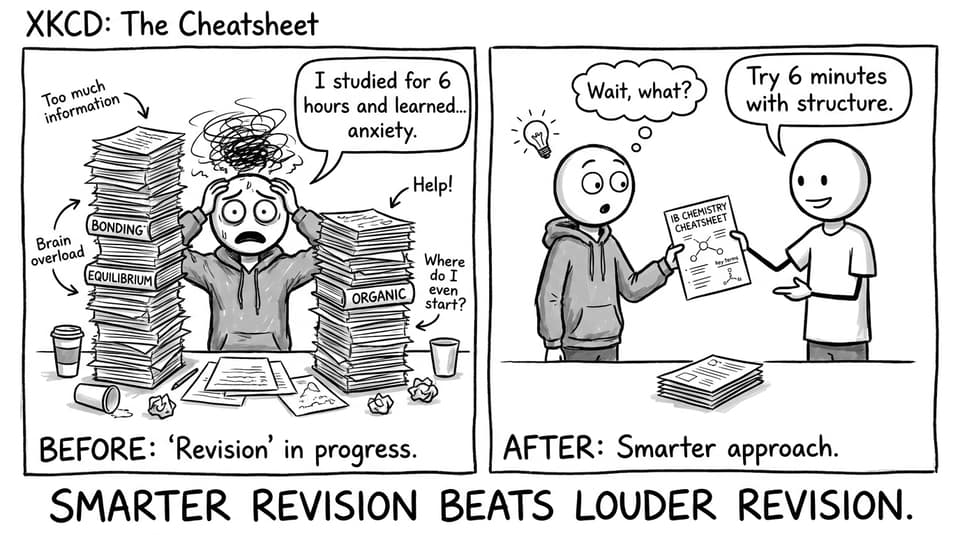
There’s a moment every IB student recognises: you open your IB Chemistry notes to “quickly review,” and suddenly it’s an hour later, your desk is a snowfall of paper, and you still can’t explain why equilibrium shifts when temperature changes. Not because you didn’t work. Because the work was pointing in too many directions.
The students who get calm in IB Chemistry usually aren’t memorising more. They’re compressing better. They build small, reliable reference points they can revisit under pressure: definitions that match the markscheme, formulas with units attached, and visual cues that keep abstract ideas grounded.
That’s the real role of cheatsheets. They don’t replace learning. They replace wandering.
If you want a clean starting point, begin with RevisionDojo’s IB Cheatsheets. They are designed to condense the syllabus into exam-ready pages you can actually use in the final weeks.
The cheatsheet method (quick checklist)
Use this short routine to make IB Chemistry cheatsheets work like a system, not just “nice summaries”:
-
Choose one topic and pull the matching sheet from RevisionDojo’s Chemistry hub.
-
Read it once for structure: headings, links between ideas, what the examiner is likely to ask.
-
Do a 3-minute blank recall: cover the sheet and recreate key steps (definitions, equations, conditions).
-
Immediately drill 10-15 targeted questions in the Questionbank to test whether recall survives pressure.
-
Convert your missed points into Flashcards and schedule reviews.
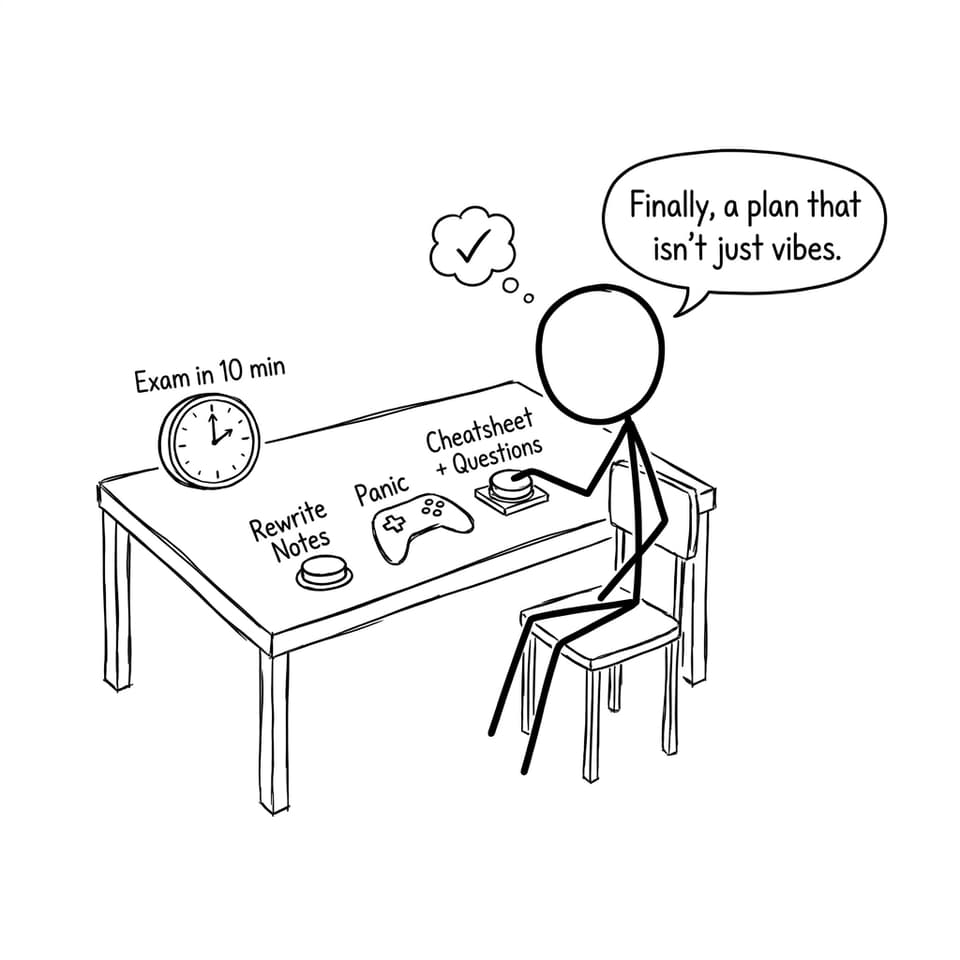
This turns IB Chemistry revision into a loop: compress, test, repair.
Why IB Chemistry feels heavy (and why cheatsheets help)
IB Chemistry is not difficult because the ideas are impossible. It’s difficult because the subject is dense.
You’re constantly switching layers:
-
microscopic particle models vs macroscopic observations
-
algebraic relationships vs lab reality
-
“definition marks” vs “explain using reasoning” marks
When content is dense, your brain starts dropping connectors. You remember bits, but not the wiring between them. A good IB Chemistry cheatsheet restores that wiring by doing three things:
-
Clustering: it groups concepts that frequently appear together in exam questions.
-
Reducing: it cuts filler and keeps only what changes your answer.
-
Standardising: it nudges your phrasing toward markscheme expectations.
If you want a deeper bank of topic-specific sheets, you can browse the dedicated IB Chemistry cheatsheets directory, for example: Reactivity 2 cheatsheets (How much, how fast, how far?).
What makes RevisionDojo cheatsheets different for IB Chemistry
Many summaries are written like miniature textbooks: complete, careful, and slow. Exam revision needs something else. In IB Chemistry, you need fast clarity with accuracy intact.
RevisionDojo cheatsheets are built to be:
-
Exam-relevant: equations, definitions, and conditions you are expected to recall.
-
Visually structured: so you can find a missing idea in seconds.
-
Aligned with active recall: short enough that you can test yourself from memory.
And cheatsheets don’t sit alone. They plug into the larger RevisionDojo ecosystem: Study Notes for full explanations, Flashcards for spaced repetition, AI Chat for “why does this happen?” questions, and the Questionbank for exam-style practice.
To stack these tools in one place, start from IB Chemistry Resources.
IB Chemistry cheatsheets for the toughest topics
You don’t need a cheatsheet for what you already own. You need it for the topics where you keep losing marks in the same way. Below are the usual suspects in IB Chemistry, and how cheatsheets shorten the path.
Atomic structure and periodic trends
Atomic theory becomes messy when students memorise isolated facts (electron configuration rules, ionisation energies, atomic radius trends) without the causal story.
A strong IB Chemistry cheatsheet acts like a map:
-
trends are shown as comparisons, not paragraphs
-
definitions are kept in examiner-friendly language
-
you see the “because” (effective nuclear charge, shielding) next to the “what”
If you want a companion narrative, pair the sheet with full topic lessons in the IB Chemistry Structure 2 hub.
Bonding and structure (where confusion hides)
Bonding is where IB Chemistry starts punishing vague thinking. “Ionic vs covalent” is never the real question. The real question is: what model explains the property in front of you?
Cheatsheets help because they put models side-by-side:
-
what particles are present
-
what forces dominate
-
what properties follow (conductivity, melting point, solubility)
For targeted practice, open a topic page like S2.2 The Covalent Model, then switch between notes, cheatsheets, and practice questions without losing your place.
Stoichiometry (the tiny mistake factory)
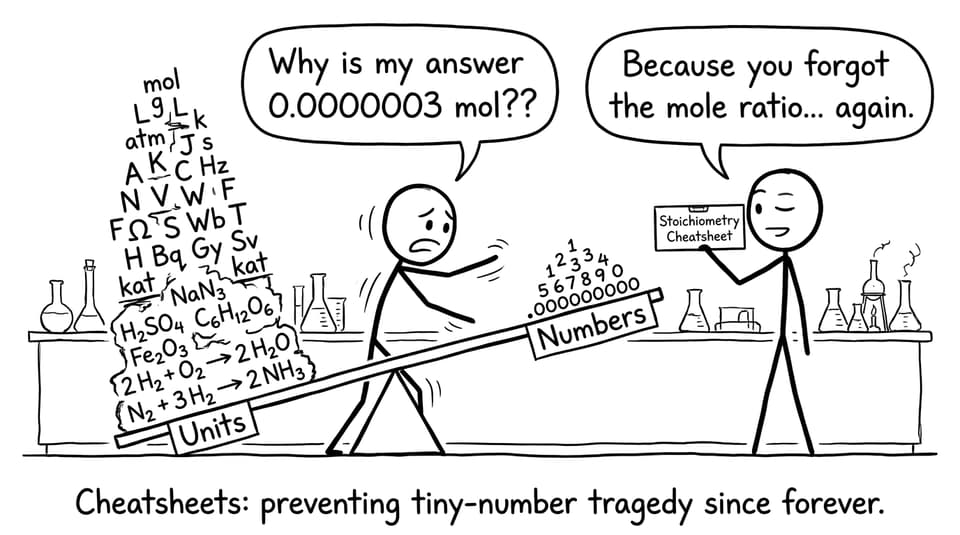
Stoichiometry is the most “I knew this” area of IB Chemistry because the errors feel small: a missing unit, a wrong mole ratio, a slipped significant figure.
A cheatsheet is valuable here because it standardises your method:
-
convert to moles first
-
apply coefficients as ratios
-
convert back to requested units
-
sanity check with magnitude and units
Then validate your method under exam conditions using the Questionbank, for example: R2.1 How much? (Amount of chemical change) Questionbank.
Energetics and spontaneity
Energetics becomes easier when you stop treating formulas as independent facts. In IB Chemistry, the same relationships keep returning: energy transferred, enthalpy change, entropy, Gibbs.
A cheatsheet earns its keep by putting the formulas, units, and interpretations in one frame. That matters in timed responses, where students lose marks not from ignorance but from hesitation.
When you need “allowed data” fast, keep the official-style reference open too: IB Chemistry Data Booklet.
Equilibrium and kinetics (two topics that talk to each other)
Equilibrium and kinetics often get revised separately, but exam questions love their overlap: rate vs extent, conditions vs mechanism.
A good IB Chemistry cheatsheet reduces both topics to decision rules:
-
what changes equilibrium position (and what doesn’t)
-
what changes rate (and why)
-
how to justify using collision theory or Le Chatelier
If equilibrium still feels foggy, the simplest conceptual reset is here: IB Chemistry: Dynamic Equilibrium, Finally Clear.
For kinetics practice at topic level, use a focused hub like IB Chemistry Chemical Kinetics.
Organic chemistry (where memory needs structure)
Organic IB Chemistry revision fails when you collect reactions like trading cards. What you want is a pathway: functional group interconversions, conditions, reagents, and typical mechanisms.
Cheatsheets help by turning “a list of reactions” into “a navigation system.” You see:
-
what transforms into what
-
what reagent signals which outcome
-
which conditions matter enough to write down
Then, instead of re-reading, you practice recognition: “Given this reagent, what is the product?” That’s where Flashcards shine alongside cheatsheets.
To build that habit, use RevisionDojo Flashcards and add cards only from questions you got wrong.
How to turn IB Chemistry cheatsheets into points on the markscheme
Cheatsheets become powerful in IB Chemistry when they change what you do, not just what you read.
Here’s a simple structure that mirrors how high scorers revise:
-
Before learning: skim the cheatsheet to preview the “shape” of the topic.
-
While learning: use Study Notes to understand the reasoning, then return to the sheet to compress.
-
After learning: do Questionbank sets and watch what the markscheme rewards.
-
After mistakes: ask AI Chat to explain why your answer missed marks, then add that phrasing to your sheet margin or Flashcards.
This is where RevisionDojo feels like an advantage: you can move from cheatsheet to Questionbank, then into AI Chat, and back into a cleaner summary without breaking momentum.
Closing: make IB Chemistry smaller, then make it stick
The hardest part of IB Chemistry is not the difficulty of any single idea. It’s the accumulation: dozens of ideas, each easy to forget when you’re tired. Cheatsheets solve that by shrinking the subject into something you can hold, revisit, and test.
If you want to simplify IB Chemistry in minutes and then convert that clarity into marks, start with RevisionDojo’s IB Cheatsheets, practise with the Questionbank, reinforce with Flashcards, and use AI Chat when the “why” won’t settle. Smart revision is rarely dramatic. It is quiet, repeatable, and surprisingly fast.