


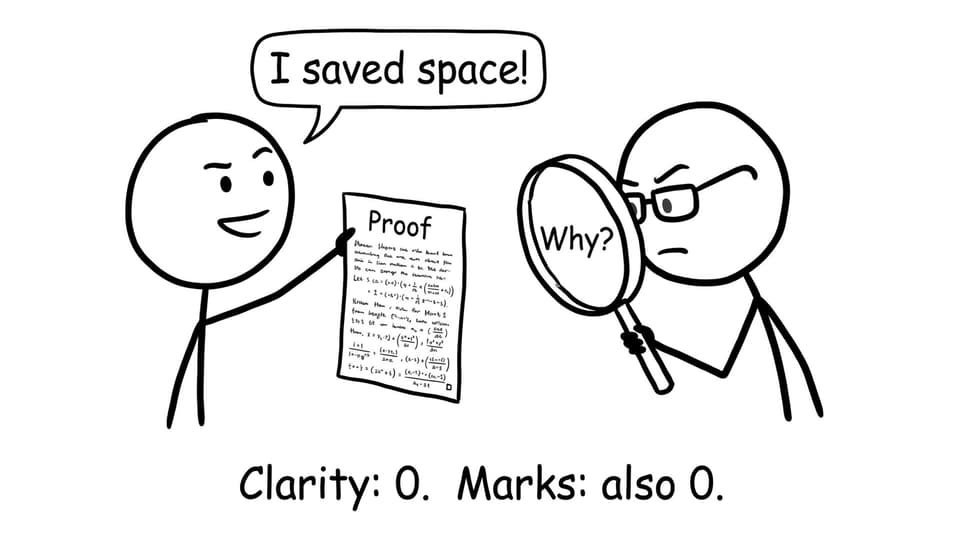
A proof can feel like a trap.
You write something you know is true, the algebra works out, the graph behaves, and yet you still lose marks because the examiner can’t see what you were thinking. In the IB Math IA, that gap between “I did it” and “I explained it” is where scores quietly disappear.
Here’s the good news: writing mathematical proofs and justifications for the IB Math IA is less about sounding like a textbook and more about guiding a tired reader through your reasoning without making them guess.
A fast checklist for IB-proof-ready writing
Before you add a proof or justification to your IB Math IA, check that you can answer “yes” to each item:
-
I stated exactly what I’m proving or validating.
-
I listed the givens, definitions, and assumptions.
-
Every line of math has a short reason (a rule, theorem, or link to context).
-
I used consistent symbols, units, and domain restrictions.
-
I ended with a sentence that closes the loop back to my aim.
If you need a structure template before you start, pair this post with How to Structure Your IB Math IA Logically.
Proof vs justification in the IB Math IA (and why it matters)
In IB coursework, “proof” and “justification” often blur together, but the examiner treats them differently:
-
A proof shows that a mathematical statement is true by logical deduction (e.g., deriving an identity, proving a property, showing a method always works).
-
A justification explains why a choice you made is valid in your IA context (e.g., why this model fits your data, why you can linearize, why assumptions are reasonable).
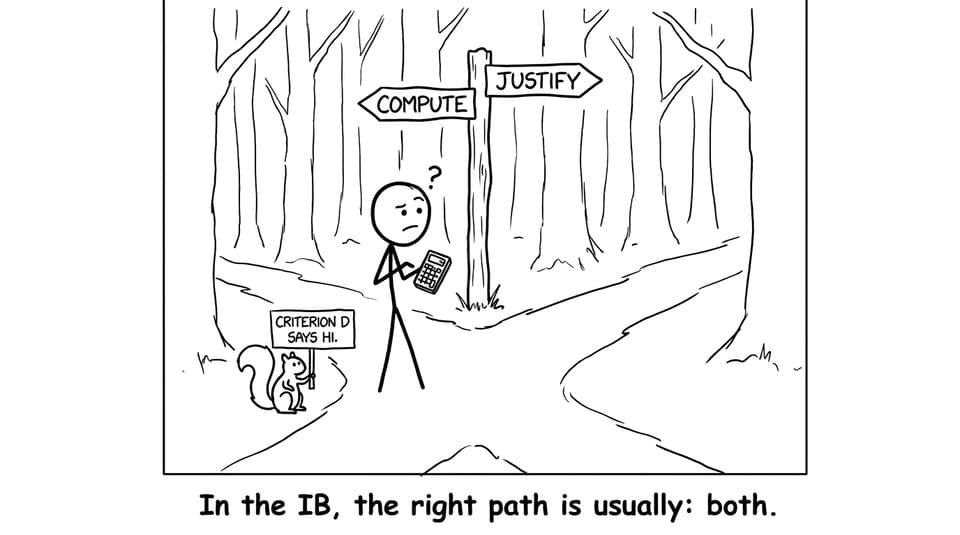
Think of a proof as math-first, and a justification as context-first. Strong IAs usually contain both: a proof-like derivation somewhere, and ongoing justifications for each modeling decision.
To see how high-scoring explorations balance rigor and explanation, skim Using IA/EE Exemplars to Improve Your IB Math IA.
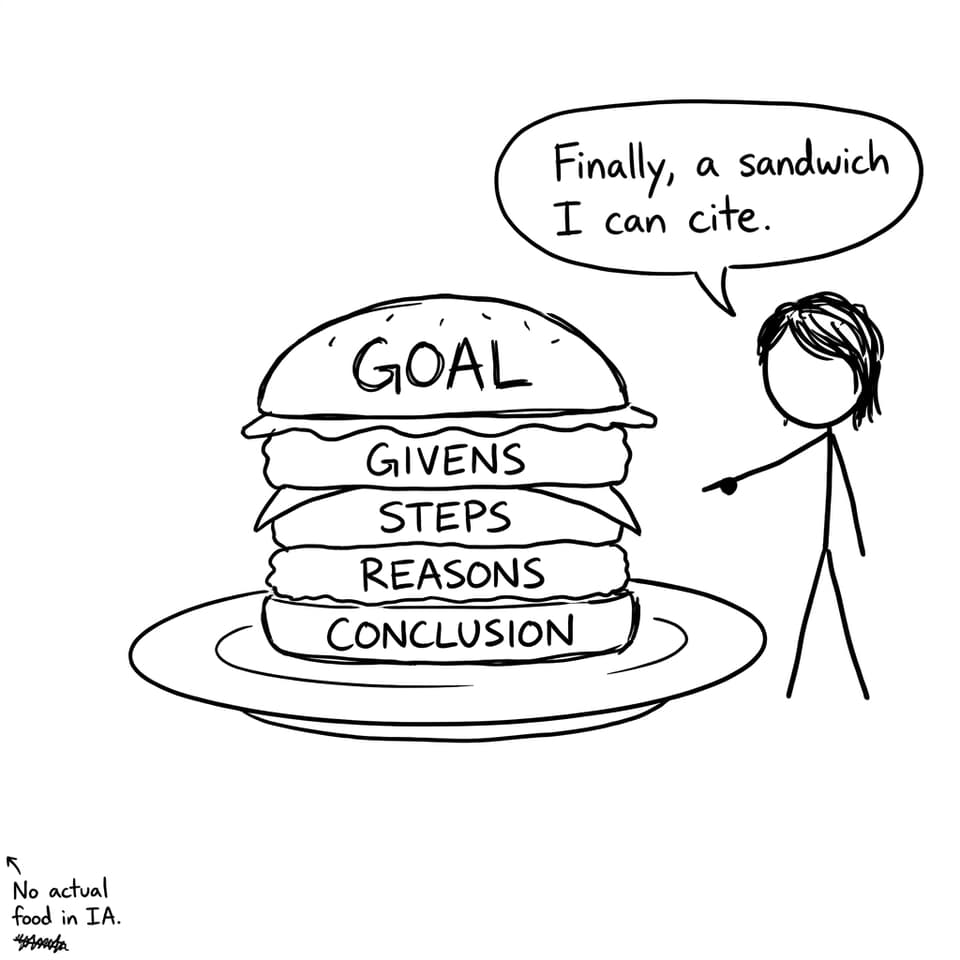
The “proof sandwich” structure that keeps your logic readable
When IB students struggle with proofs, it’s rarely because they don’t know enough math. It’s because they jump straight into the middle. Use this simple structure to keep the reader oriented.
Top bun: state your goal in one sentence
Write a direct intent line, like:
-
“I will show that the turning point occurs when (f'(x)=0).”
-
“To justify the exponential model, I will show that the data has an approximately constant percentage change.”
This is especially useful when you’re writing the methodology and need clarity. See How to Write the Methodology Section for Maximum Clarity.
Middle layers: givens, assumptions, and definitions
Before any manipulation, list what you’re allowed to use.
Example (modeling):
-
Let (t) be time in seconds.
-
Assume air resistance is negligible.
-
Domain: (t\ge 0).
This is not padding. In the IB rubric, explicit assumptions are a signal of control, and they create space for reflection later.
The filling: steps + reasons (the part most students skip)
A clean proof is not “equations only.” It’s equations + reasons.
A reliable pattern is:
-
Write one algebraic step.
-
Add a short reason in words.
-
Move to the next step.
Example:
-
(R(\theta)=\frac{v^2\sin(2\theta)}{g}). (Given range model)
-
Differentiate with respect to (\theta). (Optimization method)
-
Set derivative equal to zero. (Stationary point condition)
If you need to rebuild fluency with the underlying techniques, use targeted practice in the IB Mathematics Analysis and Approaches resources or the IB Mathematics Applications & Interpretation resources. Then reinforce weak spots with a focused set from the Math AA Calculus Questionbank.
Bottom bun: conclusion that links back to your aim
End with a sentence that does two jobs:
-
confirms what you proved/justified, and
-
tells the examiner why it matters for your IA.
Example:
“Therefore, the model reaches a maximum at (\theta=45^\circ), which supports using this angle as a benchmark when comparing my measured launch data.”
How to write justifications that feel “IB-level” (without being long)
A strong IB justification answers one of these questions:
Why this method?
Explain why regression, calculus, a transformation, or a statistical test matches your aim.
Why this model?
Point to features of the data (shape, residuals, growth rate) and connect them to the form of the function.
Why these assumptions?
Make assumptions explicit, then briefly defend them (or flag them as limitations).
If your IA is heavy on reflection, you’ll benefit from How to Demonstrate Critical Thinking in the IB Math IA. It shows how to turn “I assumed…” into examiner-friendly evaluation.
Common proof mistakes IB examiners notice instantly
-
Unstated domains: you simplify (\sqrt{x^2}=x) without noting (x\ge 0).
-
Magic steps: you jump from line 2 to line 7 with no reasoning.
-
Inconsistent notation: (t) becomes (x), or units disappear.
-
Over-formality: you imitate a university proof style and forget to connect it back to your exploration.
If presentation is the issue, How to Format and Present Your IB Math IA Professionally is an easy fix that often lifts perceived quality fast.
How RevisionDojo helps you build proof-level clarity
In the IB, better writing often comes from better feedback loops, not more effort. RevisionDojo is built around those loops.
-
Study Notes to learn the “why” behind methods before you write them.
-
Questionbank to practice the exact manipulations you’ll later justify (and to train clean reasoning under pressure). A good starting point is How to Use the Questionbank for Targeted Math Revision.
-
Flashcards to lock in definitions, conditions, and theorem statements so your proofs stop wobbling.
-
AI Chat to stress-test your steps: “Is this implication valid?” “What assumption did I use here?”
-
Grading tools to check whether your explanation matches what an examiner rewards.
-
Predicted Papers and Mock Exams to keep your IA writing aligned with exam-style reasoning and notation, especially when deadlines stack.
-
Coursework Library and Tutors when you need examples of tone or a quick sanity check on logic.
If you’re also preparing for exams alongside your IA, add a simple routine like The Ultimate IB Math Study Routine for Busy Students so the IB workload doesn’t become a single panic sprint.
Closing: turn your IB math into something examinable
A proof in the IB Math IA isn’t a performance of intelligence. It’s a promise to your reader: “You won’t have to guess what I meant.” When you state your goal, declare your assumptions, and attach reasons to steps, you stop relying on the examiner’s generosity and start earning marks on purpose.
If you want a system for that kind of clarity, build your workflow in RevisionDojo: use Study Notes to learn the method, drill it in the Questionbank, lock conditions into Flashcards, sanity-check logic with AI Chat, and polish with Grading tools, Predicted Papers, and Mock Exams. That’s how IB students write proofs and justifications that feel calm, controlled, and examiner-ready.