
If you’ve ever reached the end of your Math IA and felt oddly empty, you’re not alone. The calculations are done, the graphs look neat, the regression line behaves (mostly), and yet writing the last 200-300 words feels harder than the whole exploration. That’s because the conclusion isn’t a formality in the IB world. It’s the moment your work has to mean something.
A strong IB Math IA conclusion is where you prove you weren’t just following steps. You were thinking. You were choosing. You were noticing what worked and what didn’t. And you can explain it with calm precision.
The job of an IB Math IA conclusion (in one sentence)
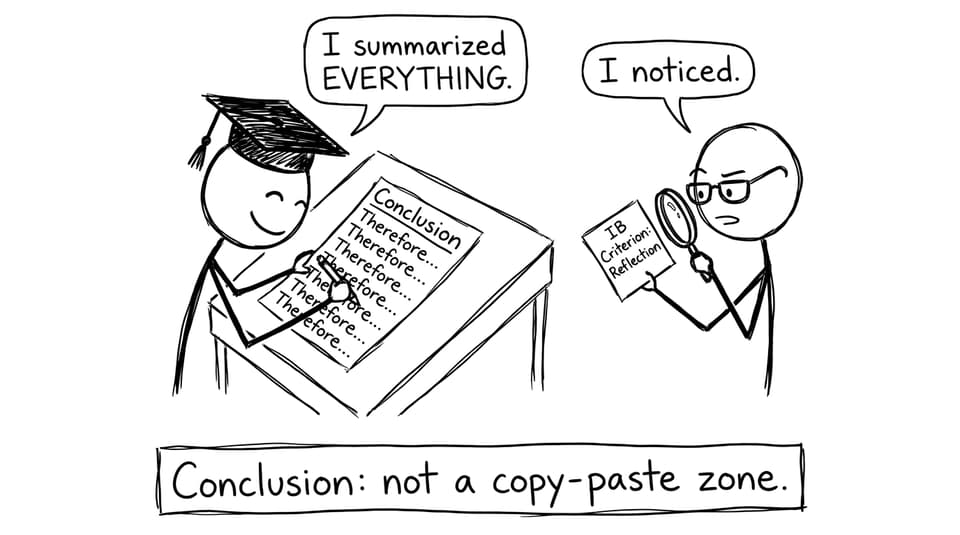
An IB Math IA conclusion should answer your aim directly, spotlight the key result(s), interpret what they mean, evaluate reliability, and point to realistic improvements, all without re-running the math.
If you want to see what this looks like in examiner-style structure, it helps to read a full conclusion walkthrough and then compare it to a model structure guide so you can hear the “voice” of top-band writing.
Useful starting points:
Quick checklist: the last page sanity scan
Before you write your final paragraph, run this fast checklist. A high-scoring IB conclusion usually includes:
-
A restated aim (1 sentence)
-
Your headline finding(s) (1-2 sentences)
-
Interpretation: the “so what?” (2-4 sentences)
-
Evaluation of the model/method (3-6 sentences)
-
Limitations with impact (2-4 sentences)
-
Extensions/improvements that are mathematically plausible (2-4 sentences)
-
A final line that closes the loop back to the aim (1 sentence)
If you’re building this inside RevisionDojo, the IB Mathematics Analysis and Approaches (AA) IA Guide and Essentials of the Internal Assessment are the clearest rubric-aligned anchors to keep you from drifting into summary-only mode.
Start by returning to your aim (without sounding robotic)
The easiest way to weaken an IB Math IA conclusion is to pretend the introduction never happened. Examiners want coherence: you set out to investigate something, and now you can say what you found.
A simple template that stays natural:
- “This investigation aimed to… The results suggest… therefore…”
Example (adapt the wording, not the topic):
“This exploration aimed to test whether a quadratic model could describe the relationship between ___ and ___. Overall, the model captured the trend well within the observed range, with the strongest fit occurring when ___.”
Notice what’s missing: no method retelling, no calculator instructions, no paragraph about how hard it was. In an IB conclusion, clarity is confidence.
Summarize results like a headline, not a diary
A conclusion that lists every number is usually a conclusion that doesn’t know which numbers mattered.
Instead, pick the 1-3 results that directly answer the aim:
-
a parameter with meaning (e.g., growth rate, coefficient)
-
a fit statistic or error measure (only if it supports your claim)
-
a turning point result (where you changed models or assumptions)
If you need a benchmark for what “selective summarizing” looks like, reviewing a few high-level examples helps. RevisionDojo’s Using IA/EE Exemplars to Improve Your IB Math IA is useful precisely because it shows restraint: strong writing chooses, it doesn’t dump.
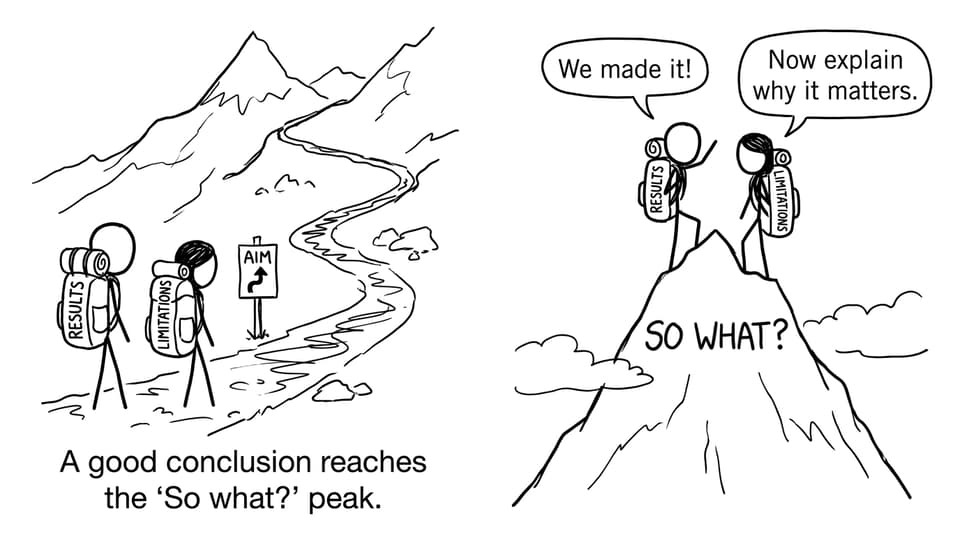
Interpret the results: the IB marker is asking “So what?”
This is the step most students rush. They say what happened, but not what it means.
Interpretation can connect to:
-
the theory you expected (does it match?)
-
the context (what does the parameter imply in real terms?)
-
the behavior of the model (where it works, where it breaks)
A useful approach is to write one sentence beginning with “This suggests that…” and another beginning with “This matters because…”. It forces you into meaning.
If your IA is grounded in context (sports, biology, economics, physics), read How to Reflect on Real-World Applications in the IB Math IA and borrow the style of its interpretation: specific, grounded, not dramatic.
Evaluate your model’s effectiveness (the honest middle)
In IB math writing, evaluation is not self-criticism. It’s mathematical maturity.
A strong evaluation paragraph usually includes:
-
what your model captures well
-
where it deviates (and how you know)
-
why that deviation makes sense (assumption? data limitations? structure?)
Try phrasing like:
-
“The model was effective for… because…”
-
“However, accuracy decreased when… suggesting…”
If you’re unsure what counts as a “real” limitation (not just “I didn’t have time”), use How to Reflect on Model Limitations in the IB Math IA. It’s one of the fastest ways to turn vague evaluation into criterion-friendly analysis.
Name limitations with impact, not apologies
A common IB trap is writing limitations like a confession. Examiners don’t want regret. They want reasoning.
Instead of:
- “My data wasn’t very good.”
Write:
- “The small sample size increases the influence of outliers, which likely inflated/deflated ___ and reduced confidence in ___.”
This is what earns marks: you identify the flaw and explain the consequence.
To level up the tone and depth of your reflection sentences across the IA (not only at the end), How to Use Reflection to Strengthen Your IB Math IA Grade and How to Include Reflection Throughout Your IA are worth skimming before you finalize your conclusion.
Offer extensions that are realistic (and mathematically interesting)
Extensions signal curiosity, but in the IB they also signal judgement. A good extension is not “collect more data” (though sometimes that’s valid). It’s a next step that changes the mathematics.
Stronger extension moves include:
-
switching to a piecewise model and justifying the breakpoint
-
adding an extra variable and describing how it could be fitted
-
comparing two models using a clear criterion (error, residuals, plausibility)
-
testing sensitivity: “if this assumption changes by 10%, what happens?”
Extensions should feel like you could actually do them if you had another week, not another year.
A simple 220-word IB Math IA conclusion template
Use this as a structure, then rewrite into your own voice:
“This exploration aimed to ___. The analysis indicates that ___, with the most significant result being ___. In context, this suggests ___, which aligns/does not align with ___ because ___.
The model was most effective when ___, as shown by ___. However, it became less reliable when ___, likely due to ___ (assumption/measurement/model form). This limitation matters because it affects ___, meaning the conclusion is strongest within ___.
A realistic improvement would be ___, which could reduce ___ by ___. A natural extension would be to ___, allowing the investigation to test ___.
Overall, the findings support the aim by showing ___.”
Closing: finish like an IB mathematician, not a tired student
At the end of your IA, the conclusion is your last chance to show the IB examiner what kind of thinker you are. Not just someone who can compute, but someone who can decide what matters, explain what it means, and admit where certainty ends.
If you want a cleaner path to that final page, RevisionDojo is built for the whole workflow: Study Notes and Flashcards to lock in the concepts, AI Chat to help you phrase reflection with precision, Grading tools to check rubric alignment, the Coursework Library and IA/EE Exemplars for models of top-band writing, and Tutors when you want human feedback before submission. Then, when it’s time to return to exams, the Questionbank, Mock Exams, and Predicted Papers keep your practice structured and realistic.
Write the conclusion the way you want to be read: calm, specific, and unmistakably IB.