
A friend once told me their IB Math IA was “basically finished,” all that was left was the reflection.
They wrote it in twenty minutes.
Later, they were confused by their mark. The math was fine. The graphs were clean. But the work read like a polished report with no mind behind it. In IB, that missing mind is exactly what the reflection is meant to reveal.
A high-scoring IB Math IA reflection is not a diary entry. It’s your evidence trail: what you noticed, what you changed, what you learned about the mathematics, and why your results deserve trust.
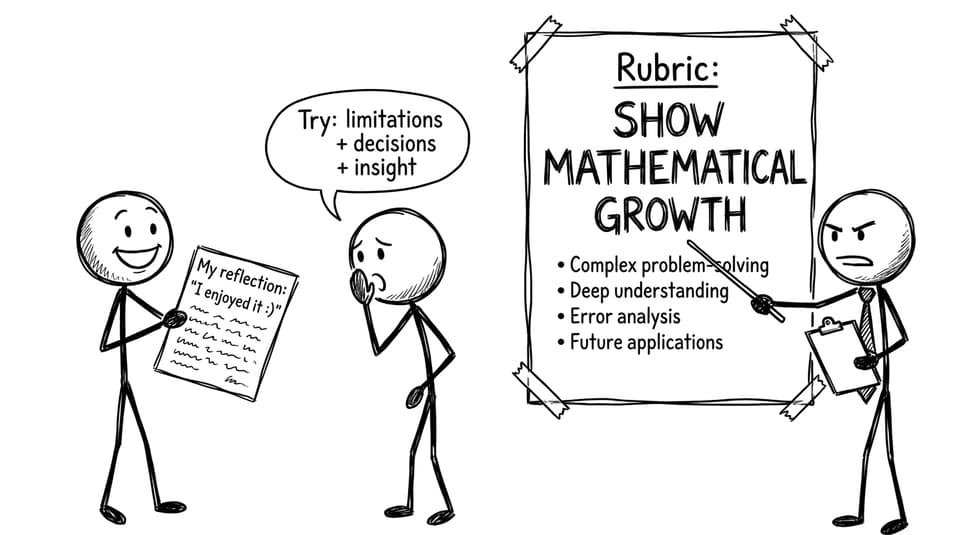
A quick checklist before you write your IB Math IA reflection
Use this as your “don’t panic” list. It keeps your IB reflection tight and marks-focused.
-
Write the reflection after the main investigation is truly done (methods, graphs, interpretation).
-
Pick 2-4 turning points: a decision, an obstacle, a surprise, a correction.
-
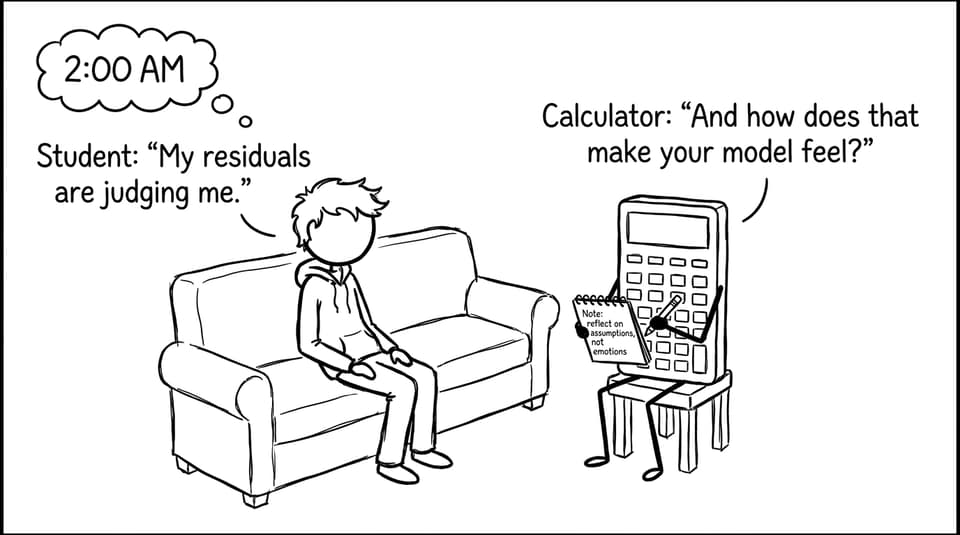
Link each turning point to mathematical reasoning (assumptions, validity, limitations).
-
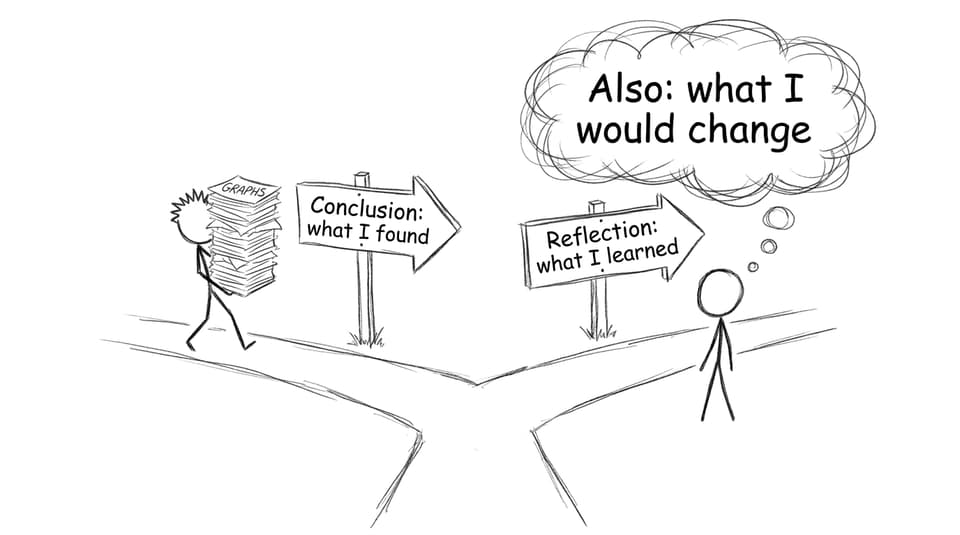
Separate “conclusion” (what you found) from “reflection” (what you learned and would improve).
-
Calibrate tone using a top example from IB Coursework Examples: IA, EE and TOK Exemplars.
If you want the criteria language in front of you while you draft, keep the IB guide open: IA/EE Guides (hub).
What IB examiners actually reward in a Math IA reflection
In IB Math, the reflection is where you show mathematical maturity, not just completion. Examiners reward reflections that do three things consistently:
Show how your understanding changed
Don’t say, “I learned a lot.” Show the moment learning happened.
Example of useful growth language:
- “My first model assumed constant percentage growth, but residual patterns suggested curvature, so I tested an exponential alternative.”
That sentence proves you were thinking.
Evaluate choices, not feelings
Your reflection can be personal, but “personal” in IB Math means decisions and judgement. A good reflection sounds like an investigator who can explain why they did what they did.
If you need a template for this kind of writing, read How to Include Reflection Throughout Your IA and mirror the logic.
Acknowledge limitations without self-sabotage
A strong IB reflection doesn’t hide imperfections. It explains them.
If you’re not sure what counts as a legitimate limitation (and how to phrase it), use: How to Reflect on Model Limitations in the IB Math IA.
The three-phase structure that keeps your IB reflection clear
Most IB students lose marks because their reflection becomes a summary, or it becomes vague. A simple three-phase narrative prevents both.
Opening: why this topic was worth exploring
Keep it short. One to three sentences. The goal is to show intention.
Good prompts:
-
What did you expect the mathematics to reveal?
-
What was your initial plan or model choice, and why?
Avoid: “I chose this because it was interesting.” In IB, interest matters only when it drives mathematical choices.
Middle: the moment your IA stopped being straightforward
This is where marks live. Pick 1-2 challenges and explain:
-
what went wrong (specific)
-
what options you considered (brief)
-
what you changed (clear)
-
what that taught you (mathematical insight)
For challenge phrasing support, use How to Reflect on Challenges in Your IB IA or EE.
Ending: what your results mean, plus what you’d do next
High-scoring IB reflections do not end with “therefore my model works.” They end with judgement.
Include at least two of these:
-
reliability: how trustworthy are the results?
-
sensitivity: what assumptions matter most?
-
improvements: what would you refine with more time?
-
extension: what would be the next mathematical step?
Make the reflection mathematical: four sentences you can adapt
If you’re staring at a blank page, start by drafting one sentence from each category, then polish.
Method decision
“In my IB IA, I chose ___ because it allowed me to ___. However, I later realized ___, so I adjusted by ___.”
Interpretation
“The result suggested ___, but when I checked ___ (for example, residuals/fit/conditions), it indicated ___, which changed my interpretation.”
Limitations
“A key limitation is ___, because mathematically it affects ___ by ___.”
Improvement
“If I repeated this IB investigation, I would ___ to reduce ___, which would likely improve ___.”
Want to see how top students sound when they do this well? Study one example closely in Using IA/EE Exemplars to Improve Your IB Math IA.
Use RevisionDojo tools to sharpen your IB reflection fast
A reflection improves fastest when you can compare your writing to criteria and strong models.
Here’s a practical workflow using RevisionDojo:
-
Use the Coursework Library via IB Coursework Examples: IA, EE and TOK Exemplars to internalize tone and depth.
-
Keep the criteria nearby with the IA/EE Guide: IB Math AI Coursework Guide.
-
If your reflection references techniques you revised during the process, reinforce the math using Study Notes and Flashcards from IB Notes.
-
For exam readiness while you finish coursework, rotate into the Questionbank so your IA season doesn’t weaken your paper performance: IB Math AA Calculus Questionbank (or your relevant topic).
-
Use AI Chat to test whether your reflection actually answers “why” and “so what?” rather than just describing steps.
-
Run your draft through RevisionDojo’s Grading tools to check if your reflection sounds aligned to IB criterion language.
And if you’re balancing deadlines, this helps: The Ideal IB IA and EE Timeline for Busy Students.
Common mistakes that quietly lower IB reflection marks
Confusing reflection with a conclusion
A conclusion states results. A reflection evaluates the journey and the mathematics.
Writing “personal engagement” like a diary
In IB Math, engagement is proven by choices: selecting a model, refining a method, validating results, questioning assumptions.
Listing limitations with no mathematics
Don’t just name a limitation. Explain its effect.
If you want a quick integrity check on what not to do, read IB Math - Avoiding Common Integrity Pitfalls.
Closing: the IB reflection is your proof of thinking
Your IB Math IA reflection is the moment you step out from behind the calculations and show the examiner how you think. Not what you did. Why you did it. What changed. What you now believe about your results.
If you want your reflection to feel calm, precise, and criteria-aligned, build it with RevisionDojo: use the Coursework Library, IA/EE Guides, AI Chat, and Grading tools to turn “I finished” into “I understand.” Then keep your momentum for exams with Study Notes, Flashcards, Mock Exams, and Predicted Papers inside the same system.
Write the reflection like it’s the last page of your mathematical story, because in IB, it often decides how the whole story is judged.