


Mathematical proofs are the moment you stop being someone who can “get the answer” and start being someone who can explain why the answer had to be true.
In the IB Math IA, that shift matters more than most students expect. Because a proof (or proof-like justification) is not decoration. It’s evidence: evidence that you understand the machinery behind your model, not just the buttons on your calculator.
The problem is that proofs can also backfire. The wrong proof wastes pages, drifts off-topic, or becomes a wall of symbols that an examiner can’t follow. This guide shows you how to use proofs effectively in an IB Math IA: concise, relevant, and tightly linked to what earns marks.
Proofs in an IB Math IA: a fast checklist
Use this quick filter before you add any proof to your IB Math IA:
-
Does the proof justify a key step in your exploration (not a side quest)?
-
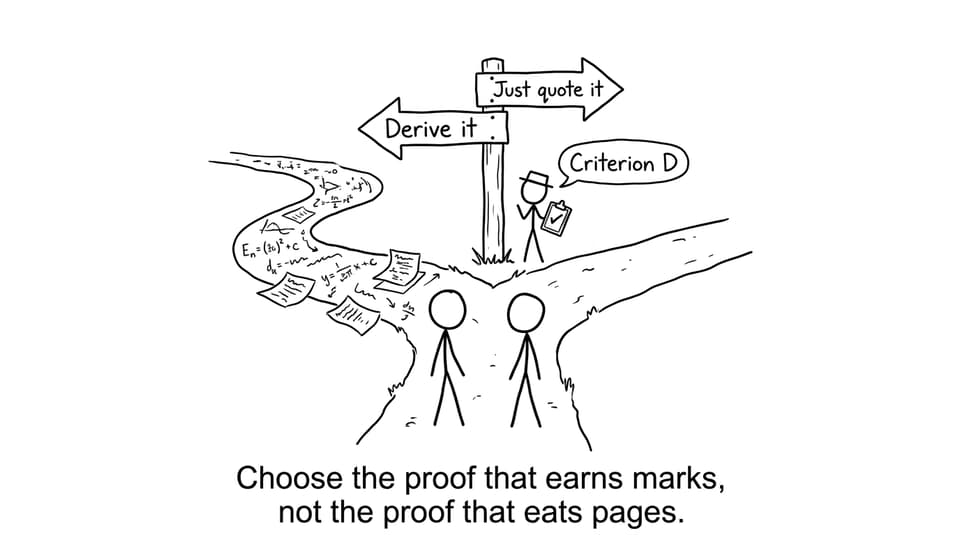
Does it strengthen Use of Mathematics (often discussed as Criterion D) by showing reasoning, not just results?
-
Can you explain the logic in words alongside the algebra?
-
Can you keep it short enough that your IA still feels like an investigation?
-
Will a diagram or small example make the argument easier to follow?
If you’re still building your overall structure, keep this open as a reference: How to Structure Your IB Math IA Logically and How to Write a Top-Scoring Math IA (2025 Guide).
What counts as a “proof” in IB Math IA writing?
In IB Mathematics, you’re not expected to produce research-level proofs. What examiners reward is mathematical justification that matches your level and your topic.
A proof in an IB Math IA can be:
-
A clean derivation of a formula you later use in modeling.
-
A logical argument that a method is valid (or valid under certain assumptions).
-
A verification of a pattern you noticed in data or simulations.
-
A counterexample that explains a limitation.
Think of it as: “Here is the bridge between my idea and my calculation.” Without that bridge, your IA can read like a spreadsheet with paragraphs.
If you’re doing AA and want targeted skill support while you write, the IB Mathematics Analysis and Approaches Resources hub is a useful anchor.
Where proofs actually help your IB Math IA (and where they hurt)
A good IB Math IA proof feels inevitable: it appears exactly where a thoughtful reader would ask, “Wait, why is that true?”
Strong places to include IB Math IA proofs
Deriving your main model. If you model projectile motion, growth curves, or optimization, proving a key step signals real understanding.
Justifying parameter choices. If you choose bounds, constraints, or assumptions, a short proof can show those choices are not arbitrary.
Validating a method. For example, explaining why taking a derivative finds turning points, or why a linearization step is acceptable for your domain.
Explaining limitations. A proof-like counterexample can turn a weakness into reflection, which is pure IB currency.
Places proofs usually hurt
Proving famous results with no IA payoff. If your IA doesn’t use the proof later, it’s likely filler.
Overly formal proofs that drown the narrative. Your IA is still a story of investigation.
Copying a proof from a textbook and paraphrasing. Even when cited, it often reads like borrowed authority, not your thinking.
If you need topic inspiration that naturally creates opportunities for proof and justification, browse The Best IB Math IA Topics for 2025.
How to write IB Math IA proofs that examiners can follow
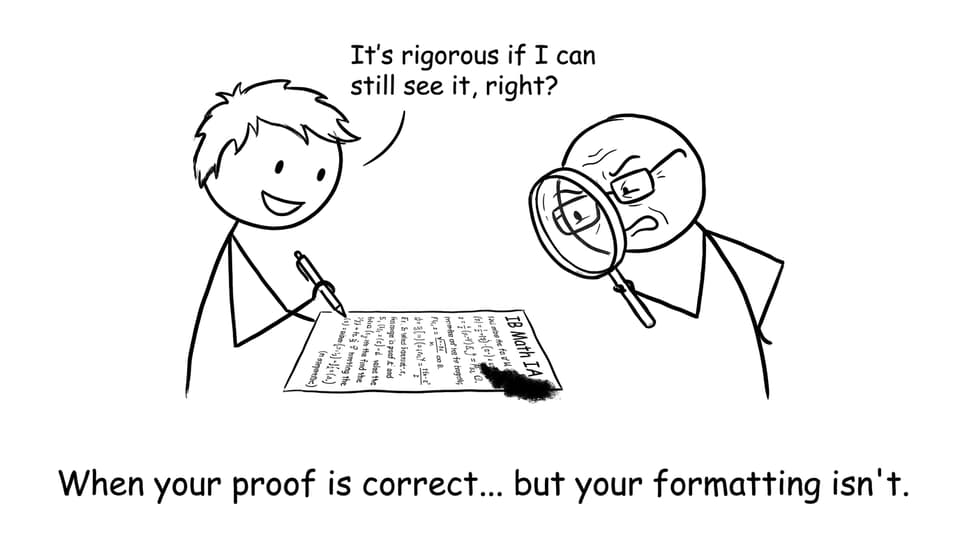
The easiest way to lose IB marks with a proof is to be correct but unreadable. Clarity is part of mathematical communication, and in an IA, communication is inseparable from understanding.
Use a simple four-part proof structure
State the claim. One sentence: what are you proving or deriving?
State assumptions. Domain restrictions, definitions, and constraints.
Show the steps. Each step should have a reason (a rule, identity, theorem, or previous line).
Close the loop. End with a sentence that ties the result back to your IA.
Example phrasing you can adapt:
“To justify using this optimal value in my model, I show that the function has a turning point where (f'(x)=0), and then confirm it is a maximum by analyzing (f''(x)) (or the sign of (f'(x))).”
If you want to reinforce calculus techniques while drafting, timed practice helps you spot gaps quickly. Use the IB Mathematics Analysis and Approaches Topic Calculus Questionbank to drill the exact skills that show up in typical IA optimization or modeling.
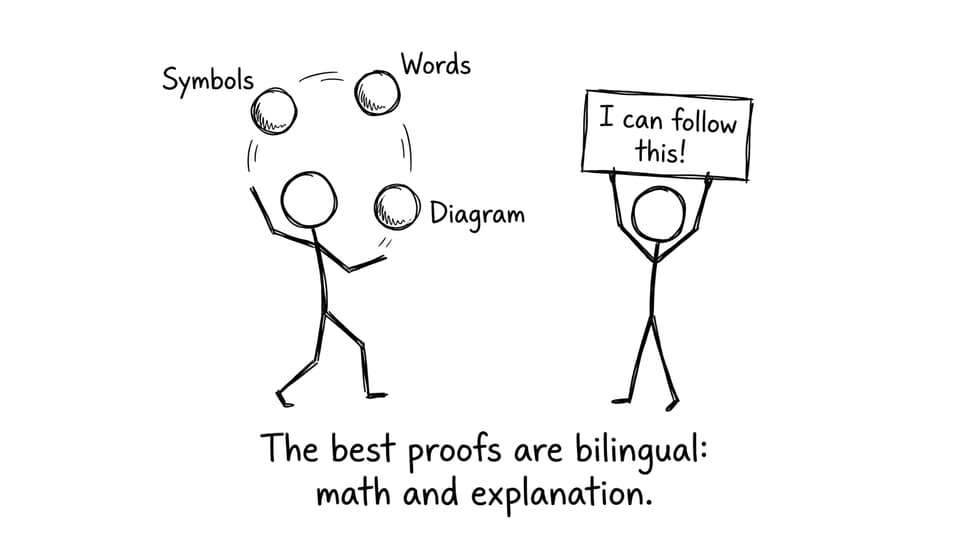
Write proofs in symbols and words (not one or the other)
In an IB Math IA, the best proofs are “bilingual.” The algebra does the work. The sentences tell the reader what the work means.
A practical rule:
-
Every 2-4 lines of algebra should have one line of explanation.
-
Any non-obvious step gets a reason (identity used, theorem applied, substitution made).
Use diagrams as proof support (especially in geometry and trig)
A diagram isn’t “extra.” In many IB Math IA topics, it’s the fastest way to make reasoning transparent.
Good diagram habits:
-
Label variables exactly as in your equations.
-
Reference the diagram in your proof (“From Figure 2…”).
-
Only include what you use. Minimal diagrams beat busy ones.
If your IA involves real data and visual interpretation, pairing proofs with clean analysis can raise the overall level. This guide is helpful for the workflow: How to Use RevisionDojo to Prepare for IB Math IA Data Analysis.
How to keep IB Math IA proofs short, original, and mark-focused
Conciseness is a form of respect: for your reader, your page limit, and your own argument.
Three tactics to stay concise
Prove the step, not the universe. If you need (A=\tfrac{1}{2}r^2\theta), derive it quickly and stop.
Use “proof sketches” when appropriate. In IB, a well-structured proof sketch can be stronger than a long proof because it shows judgment.
Move extended algebra to an appendix (sparingly). Keep the main body readable and narrative-driven.
If you’re unsure whether your IA voice is reflective enough, use a reflection framework like How to Reflect on Challenges in Your IB IA or EE and integrate what the proof taught you about your assumptions.
Using RevisionDojo to strengthen proofs while preparing for IB exams
Most students treat the IA and the exams as separate lives. In IB, they’re connected.
When you practice exam questions, you learn clean methods. When you write proofs in your IA, you learn why the methods work. Done together, they compound.
RevisionDojo is built for that loop:
-
Use Study Notes and Flashcards to keep identities, definitions, and theorem conditions fresh.
-
Use the Questionbank for targeted practice when your proof reveals a weak link (calculus steps, algebraic manipulation, function reasoning).
-
Use AI Chat to test the logic of a proof outline and to generate alternative explanations you can adapt into your own words.
-
Use Grading tools to check whether your mathematical communication is actually examiner-readable.
-
Use Mock Exams and Predicted Papers to keep exam readiness moving while your IA takes time.
-
Use the Coursework Library for exemplars and calibration before you commit to a proof-heavy approach.
-
If you’re stuck, Tutors can help you choose a proof that fits your topic and level without overcomplicating it.

For broader revision structure alongside IA work, these are strong anchors: 10 Proven Study Techniques for IB Students and The Ultimate Guide to Revision for IB Students.
Closing: make your IB Math IA proof earn its place
In an IB Math IA, the best proof is rarely the longest. It’s the one that arrives at the exact moment your reader needs trust, then leaves before it starts stealing attention from the exploration.
If you want your IA proofs to feel clean, purposeful, and examiner-friendly, build a simple loop: learn the method (Study Notes), test it (Questionbank), explain it (AI Chat), and polish it (Grading tools). Then keep your exam momentum moving with Flashcards, Mock Exams, and Predicted Papers.
When you’re ready to make your reasoning as strong as your results, start with RevisionDojo’s IB IA Guides hub and use the platform to turn IB math understanding into marks.