
TOK is the one place in the IB where you can be “right” and still lose marks.
Not because your ideas are bad, but because TOK rewards something rarer: showing how your thinking works. The best TOK students don’t sound like philosophers. They sound like careful people making careful claims, then stress-testing those claims with real-life examples, counterclaims, and a clear line back to the question.
This guide gives you a practical way to tackle the IB TOK essay and TOK presentation so you can write with control and present with calm.
A quick IB TOK success checklist
-
Choose a title you can link to two strong Areas of Knowledge (AOKs)
-
Convert the prompt into a focused knowledge question (KQ)
-
Build each main section around claim -> example -> evaluation -> counterclaim -> evaluation
-
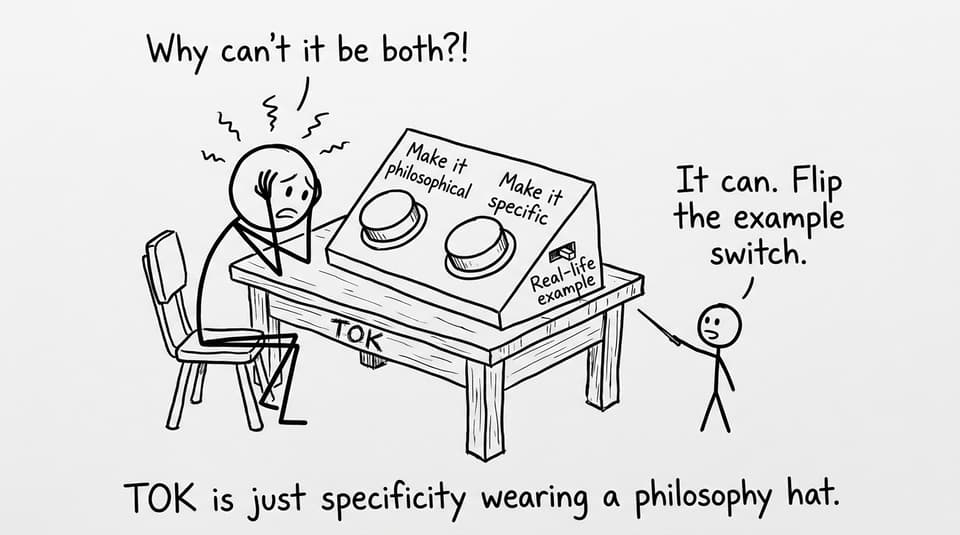
Use specific real-life situations (not generic textbook references)
-
Rehearse the TOK presentation until it fits time and still feels human
-
Use feedback loops: draft, get comments, refine, repeat
If you want a strong home base for TOK resources, start with IB Theory of Knowledge resources on RevisionDojo.
Understanding the IB TOK essay (what it’s really asking)
A TOK essay is not a subject essay in disguise. In the IB, it’s closer to a guided investigation: you’re asked to respond to a prescribed title by exploring how knowledge is produced, justified, shared, and challenged.
A useful mindset shift: your job isn’t to “prove” your view. Your job is to show that you can evaluate your view.
That starts with converting the title into a working knowledge question. If that step still feels slippery, use TOK essay titles explained: what are knowledge questions? to turn vague panic into something you can outline.
Choosing a TOK essay title you can actually develop
Pick the title that gives you:
-
Two AOKs where the standards of evidence clearly differ (e.g., Natural Sciences vs History)
-
Real-life examples you can explain in 3-4 sentences
-
A genuine tension (something that invites “to what extent” rather than a one-sided answer)
If you’re working toward the May session, it helps to see how top frameworks map onto prompts. RevisionDojo’s Ultimate TOK May 2026 essay guide shows what examiners tend to reward across titles.
How to structure an IB TOK essay (without sounding robotic)
Structure is not a cage. It’s a promise to the examiner that your thinking will arrive in an orderly way.
A strong model is:
-
Introduction: interpret the title, define key terms, state your line of argument
-
Body section 1 (AOK 1): claim + real-life example + evaluation + counterclaim + evaluation
-
Body section 2 (AOK 2): repeat with a different knowledge setting
-
Conclusion: answer the title with nuance (not a summary)
For a full blueprint, use Comprehensive guide to IB TOK essay structure. If you want a shorter, punchier breakdown, Structuring for success in IB TOK essays is a great companion.
The real-life example rule most IB students miss
Most TOK essays don’t fail because students lack concepts. They fail because examples stay blurry.
A good real-life example:
-
Names a specific event, study, controversy, artwork, court case, or historical episode
-
Shows who claimed what
-
Explains how knowledge was justified (methods, evidence, authority)
-
Includes a limitation or alternative interpretation
If your examples are strong but your links back to the KQ are weak, Tips for writing a clear and coherent TOK essay helps you tighten the “so what?” after each paragraph.
The IB TOK presentation: make the thinking visible
The TOK presentation is where many students overcomplicate things. They pick a massive global issue, then drown in it.
The simplest approach is usually best: choose one real-life situation that’s concrete, then use TOK tools to reveal the hidden knowledge questions inside it.
A reliable flow is:
-
Present the real-life situation
-
State the knowledge question clearly
-
Analyze using AOKs/WOKs (only when they change the analysis)
-
Offer a counterclaim and why it matters
-
Conclude with implications: what changes if we accept your evaluation?
Rehearsal tips that actually raise marks
-
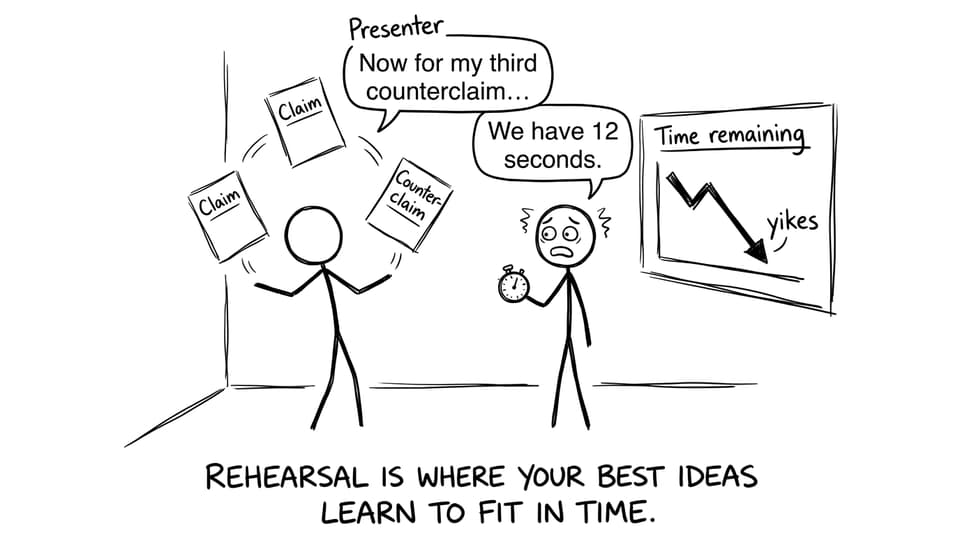
Rehearse out loud with a timer from day one
-
Cut anything that sounds like a textbook definition without application
-
Build one slide (or cue card) that lists: KQ, claim, counterclaim, example, implication
-
Practice transitions: “This matters because…” and “However, this assumes…”
If you’re the kind of student who freezes when questioned, the best prep is to practise defending your choices. How to prepare for the TOK oral defense is a useful training partner because it forces you to justify your moves.
How RevisionDojo helps you execute TOK (not just read about it)
Good TOK work is iterative. You write, you test the logic, you revise, you tighten. RevisionDojo is built around that loop.
-
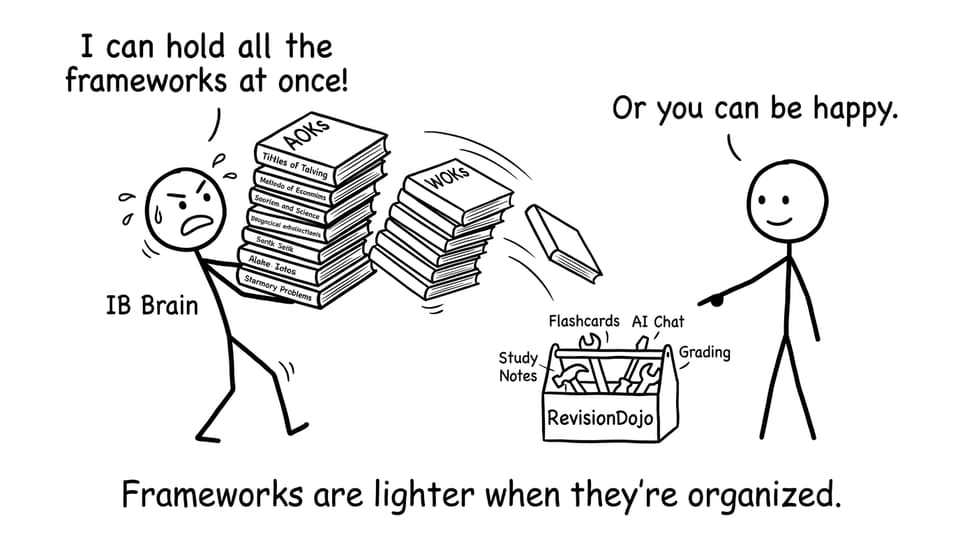
Use Study Notes to clarify AOK differences and core TOK concepts
-
Use Flashcards to lock in key distinctions (e.g., evidence vs interpretation)
-
Use AI Chat to challenge your claim, generate counterclaims, or stress-test examples
-
Use Grading tools via the IB Coursework Grader to get rubric-aware feedback on your TOK essay draft
-
Use the TOK Coursework Library examples to see what “good” actually looks like in full length
-
If you need accountability or high-level strategy, add RevisionDojo Tutors to turn feedback into a plan
For broader workflow, TOK thinking and skills: how to succeed in IB TOK connects the mindset to the marks.
Closing: treat TOK like a skill you can train
TOK can feel like fog at first, especially inside the IB where everything else has cleaner right answers. But fog clears when you keep moving in a straight line: knowledge question, claim, real-life example, counterclaim, evaluation.
If you want that process in one place, RevisionDojo gives you the full toolkit: Questionbank practice habits for your other IB subjects, Study Notes and Flashcards to keep TOK concepts sharp, AI Chat to challenge your arguments, Grading tools to tighten drafts, Predicted Papers and Mock Exams for exam readiness, a Coursework Library for model work, and Tutors when you want human guidance.
Build the method now, and the IB TOK essay and presentation stop being mysterious, they become manageable.