




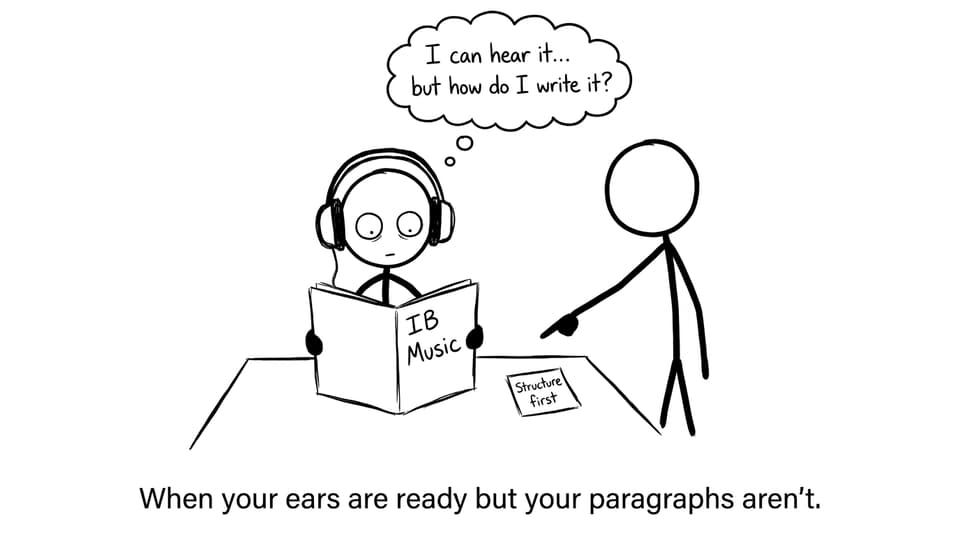
When the audio starts, it’s easy to feel confident. You can hear the modulation, sense the texture shift, even catch the rhythmic displacement. Then you look at the page and realise the hard part of IB Music is not noticing things; it’s organising them so an examiner can award marks quickly.
This guide gives you a clean structure for IB Music exam responses: a fast plan, an examiner-friendly body, and a conclusion that turns observations into insight.
A quick IB Music response checklist (save this)
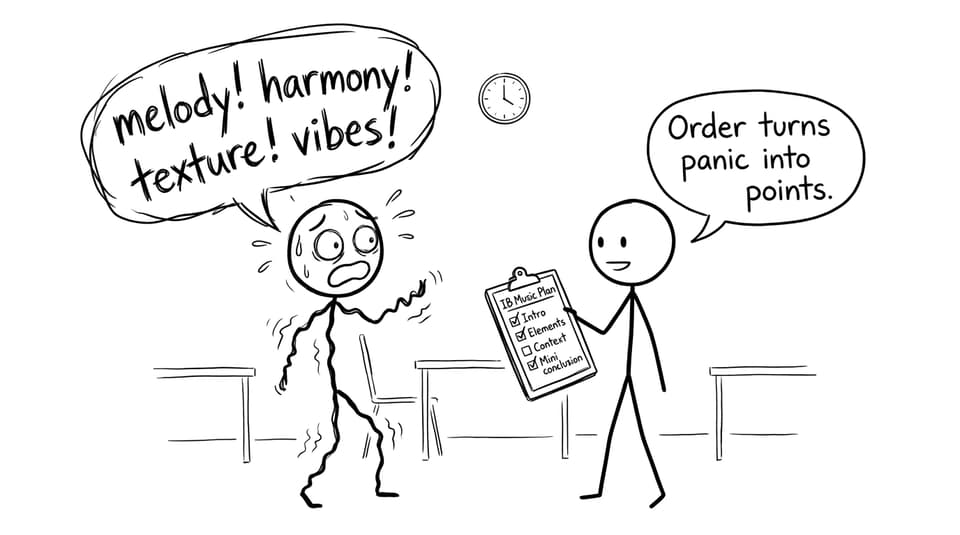
Before you write full sentences in IB Music, write a mini-plan using four lines:
-
Identify: style/genre, forces, tempo, mood
-
Outline: 2-3 main musical elements you will discuss
-
Evidence: one specific moment for each element (bar/time stamp/section)
-
Meaning: what the features suggest about function, context, or intention
If you’re revising listening technique alongside writing, pair this with How to Revise Effectively for IB Music Listening Exams.
Start with a 2-sentence introduction (what + overall effect)
Strong IB Music introductions do two jobs: they orient the examiner and they give you a thesis to prove.
Template
-
Sentence 1: Identify style/genre + forces.
-
Sentence 2: Describe overall character (tempo, mood, texture) and a big structural clue (contrast, build, repetition).
Example: This extract suggests a jazz-influenced small ensemble with drum kit and syncopated melodic lines. The overall effect is energetic and layered, with clear contrasts between a sparse opening texture and a denser, more driving section later on.
Build the body by musical elements (but link each to a claim)
In IB Music, “naming features” is not enough. Aim for Claim, then Evidence, then Comment in each paragraph.
Good element order (choose 3-4 to keep it tight):
-
Melody: motifs, range, contour, ornamentation
-
Harmony/tonality: chords, cadences, pedal points, modulation, modality
-
Rhythm/meter/tempo: ostinato, syncopation, polyrhythm, tempo changes
-
Texture: monophonic, homophonic, polyphonic, heterophonic layering
-
Timbre/instrumentation: tone colour, technique, blend, register
-
Form/structure: sectional contrast, repetition, episodes, transitions
For comparative writing skills that transfer directly to listening responses, see Best Strategies for IB Music Comparative Analysis.
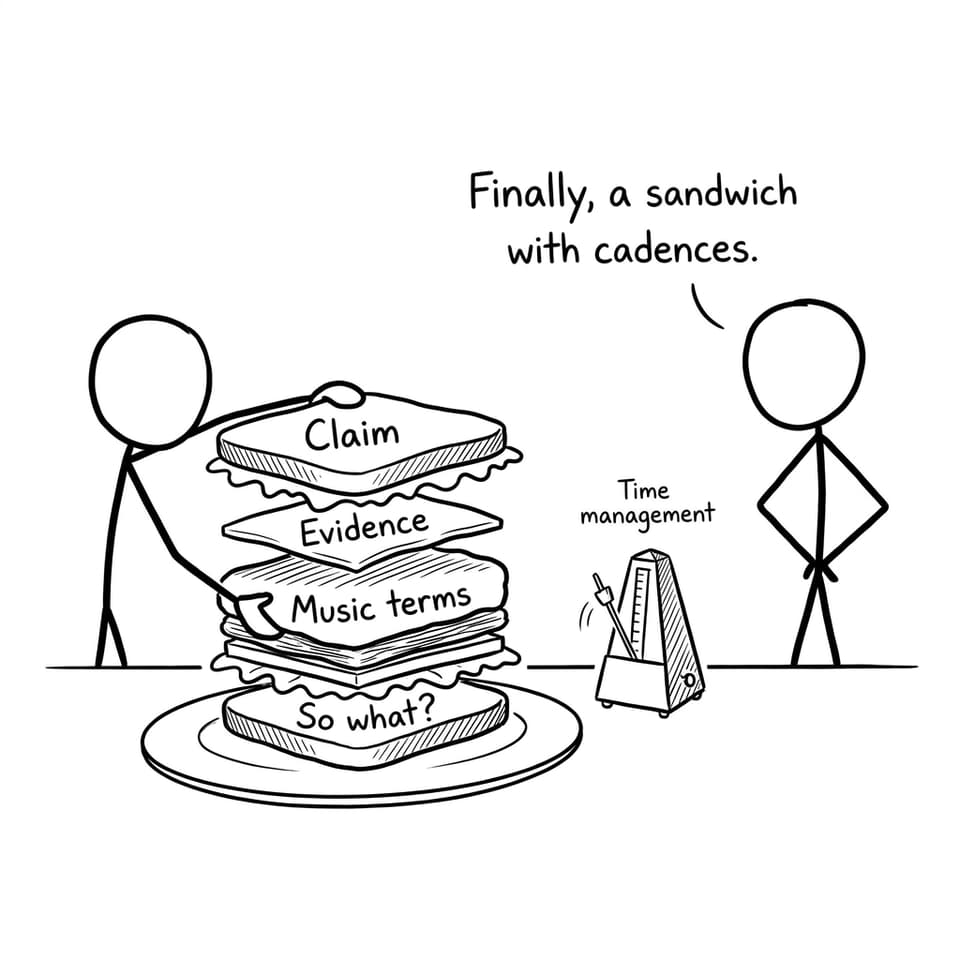
A high-scoring paragraph pattern for IB Music
Use this as your default:
-
Claim (1 sentence): what feature stands out?
-
Evidence (1 sentence): where do you hear it? be specific.
-
Comment (1-2 sentences): why does it matter for style, function, or expression?
This keeps your IB Music writing focused and prevents the “list of random observations” problem.
Add context without turning it into a history essay
Examiners reward context when it explains sound. In IB Music, a good contextual sentence links tradition to technique.
Try:
-
This layered percussion suggests a communal dance function, where interlocking patterns create momentum.
-
The call-and-response phrasing hints at a participatory performance setting rather than a purely concert style.
If you want a broader course anchor, browse All IB Music Posts and build a topic map for recurring features.
Finish with a mini conclusion (2 sentences, no new details)
A great IB Music conclusion is not a summary dump. It’s a final judgement.
Template
-
Sentence 1: restate the defining musical features.
-
Sentence 2: state the overall effect or significance (style, purpose, audience, cultural role).
Practise structure faster with RevisionDojo
Structure is a habit, not a last-minute trick. RevisionDojo helps you repeat the habit until it’s automatic:
-
Use the Questionbank to practise exam-style prompts under time pressure.
-
Tighten terminology with Study Notes.
-
Use Flashcards for key vocabulary (cadences, textures, rhythmic devices).
-
Ask AI Chat to test you with “identify + justify” questions.
-
Use Grading tools to check whether your response actually earns marks.
-
Build confidence with Predicted Papers and Mock Exams for full-timing practice.
-
Pull examples from the Coursework Library, then book Tutors when you need targeted feedback.
Conclusion: make your IB Music thinking easy to mark
A high-scoring IB Music response is a small act of empathy: you are guiding a tired examiner through your listening. Start broad, analyse by element with Claim, then Evidence, then Comment, add context that explains the sound, and end with a judgement. Then practise the same structure until it feels like muscle memory.
When you’re ready to drill the habit, RevisionDojo’s Questionbank, Study Notes, AI Chat, Grading tools, Predicted Papers, Mock Exams, Coursework Library, and Tutors turn structure into consistent exam marks for IB Music.