
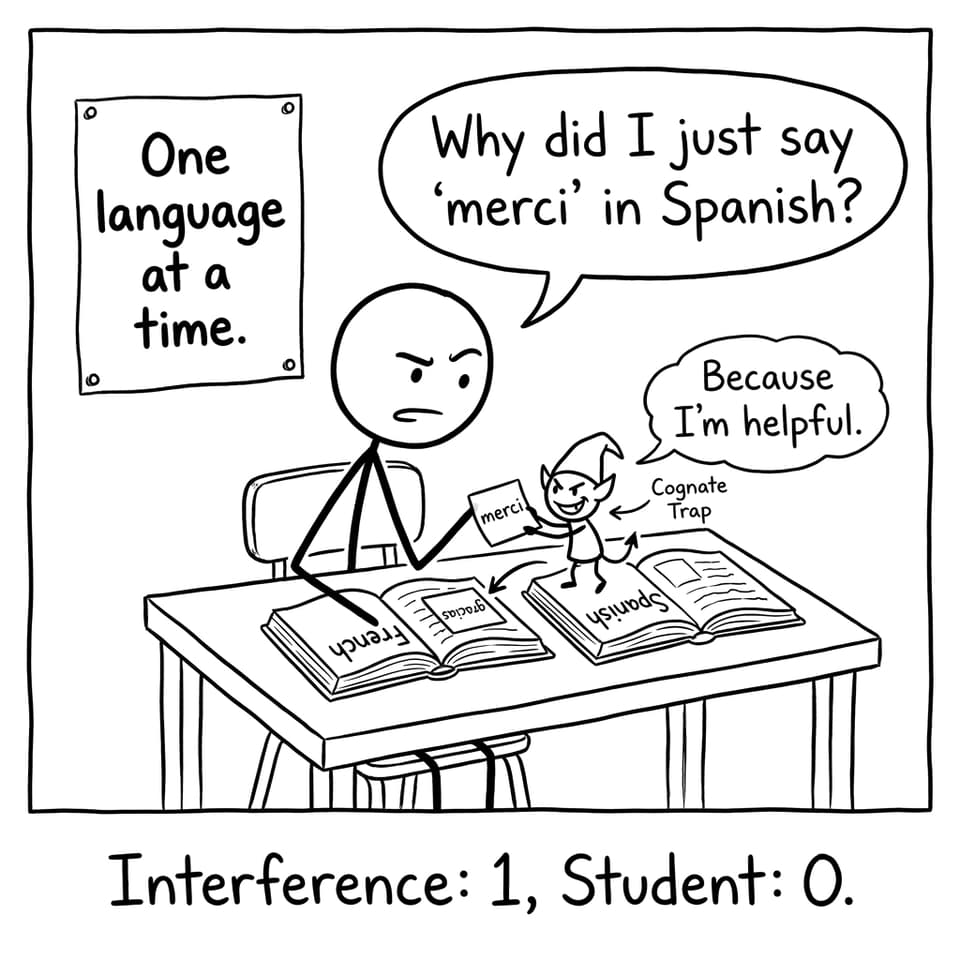
Mixing up French and Spanish always happens at the worst moment: you’re finally speaking smoothly, your brain relaxes for half a second, and out comes gracias in a French sentence.
For IB Languages students, that tiny slip feels bigger than it is. It can knock your confidence right before the oral, or make your Paper 1 writing feel shaky. The good news: language interference is normal, predictable, and very trainable.
A quick checklist to stop cross-language confusion
Use this as your daily reset for IB Languages:
-
Study one language per session (even if it’s only 20 minutes).
-
Use different cues: notebook color, playlist, location, even a different pen.
-
Build a “false friends” list and review it with spaced repetition.
-
Practice output (speaking/writing) in short bursts, not only passive exposure.
-
Get fast feedback so the wrong pattern doesn’t fossilize.
Why French and Spanish get tangled in your head
French and Spanish are both Romance languages, which means they share roots, cognates, and familiar grammar shapes. Your brain loves efficiency. It stores patterns, then reaches for the closest match under pressure.
In IB Languages, pressure is part of the course. Timed writing. Listening where you can’t rewind. Oral tasks where you have to improvise. That’s exactly when the brain grabs the “almost correct” word.
If you want a structured, exam-aligned routine for language skills, start with How to Effectively Revise for Language B Exams.
Build separation with context (the easiest win)
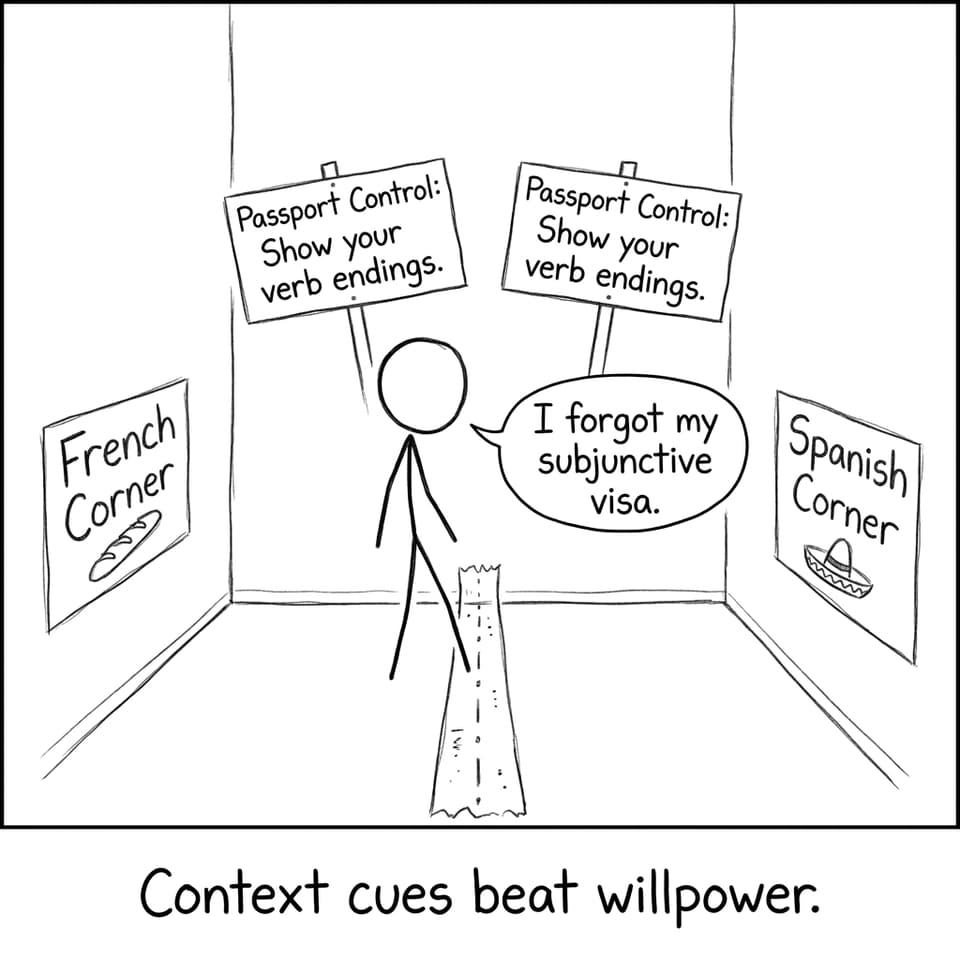
Your goal isn’t to “try harder.” It’s to make each language feel like it lives in a different room.
Create two study identities
Pick cues that are slightly dramatic so your brain can’t miss them:
-
French = blue notebook, French playlist, desk.
-
Spanish = red notebook, Spanish playlist, kitchen table.
It sounds silly. It works because memory is contextual.
On RevisionDojo, you can reinforce that separation by keeping language-specific practice organized: use Study Notes for one language at a time, and review with Flashcards right after.
Separate your inputs, too
If you watch a French video and then immediately read a Spanish article, you’re basically training your brain to code-switch. Instead, block your inputs:
-
One weeknight: all French media.
-
Next weeknight: all Spanish media.
For ideas that feel realistic during an IB schedule, see Realistic Ways to Make Language Acquisition Outside the Classroom More Engaging.
Train your “switch” for exam conditions
Separation is step one. Step two is controlled switching, because IB Languages sometimes demands flexibility.
Use micro-output drills
Try this 6-minute routine:
-
2 minutes: write 3 sentences in French on an IB theme.
-
2 minutes: write 3 sentences in Spanish on the same theme.
-
2 minutes: circle what you nearly mixed up.
Then turn those errors into a tiny deck. Spaced repetition is where confusion goes to die.
RevisionDojo makes this easier because you can convert weak points into targeted review with IB Flashcards with Spaced Repetition (SRS).
Catch mistakes early with feedback
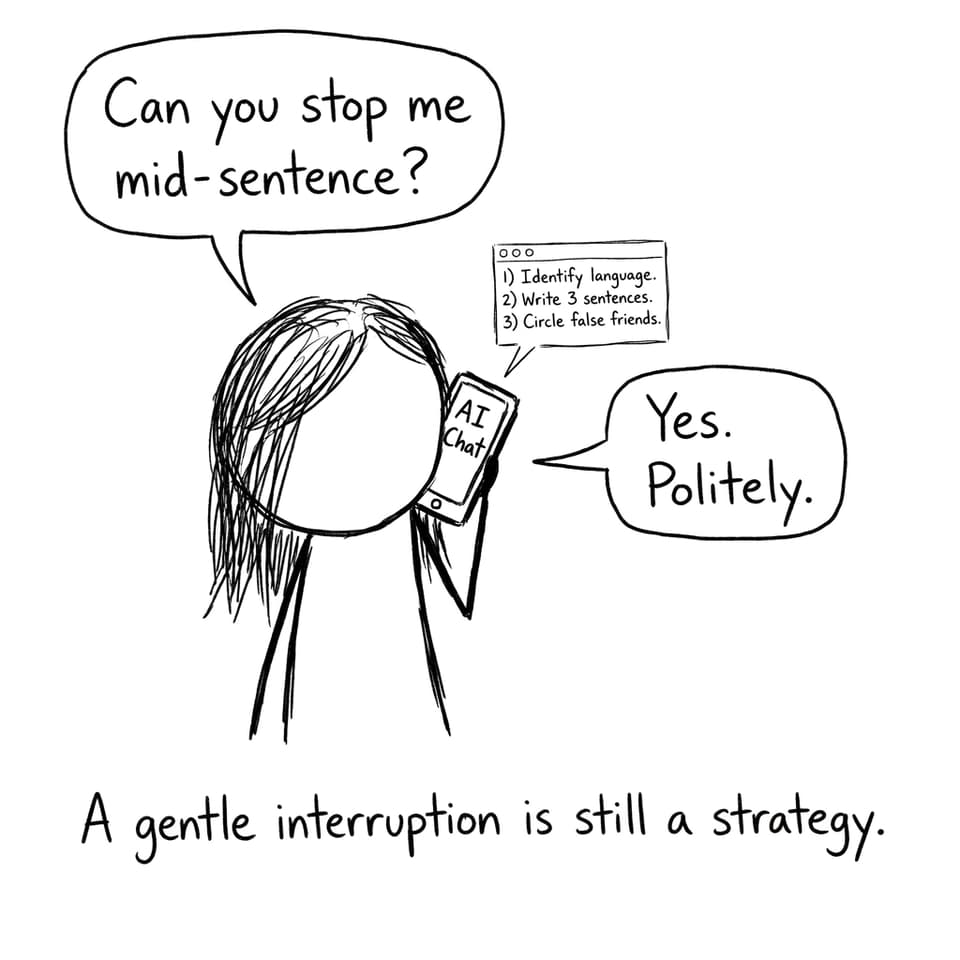
Interference becomes a habit when you repeat it uncorrected. If you’re writing or speaking and you’re unsure, ask for a quick correction immediately.
RevisionDojo’s AI Chat is built for that exact moment: you try a sentence, get feedback, and redo it cleanly before the mistake settles. Pair that with focused practice in the Questionbank mindset: attempt, get feedback, fix, repeat.
Use RevisionDojo to keep IB Languages tidy
When everything lives in one place, you stop “accidentally revising both.” Build a simple loop:
-
Learn with Digital IB Study Notes
-
Lock in vocab and grammar with Flashcards
-
Practice under pressure using the RevisionDojo app workflow
If you’re choosing between courses or clarifying expectations, IB Language B vs Ab Initio: Can You Take Both? is a useful anchor.
Conclusion: make your brain choose the right door
To stop mixing up French and Spanish, you don’t need perfection. You need separation, cues, and a feedback loop strong enough to keep the right patterns alive.
That’s exactly what IB Languages revision is: building reliable habits under pressure. If you want one calm home base for notes, flashcards, targeted practice, AI Chat support, grading tools, predicted papers, mock exams, a coursework library, and tutors when you need a human reset, RevisionDojo is built for the whole journey.