


The moment your “perfect” model meets the real world
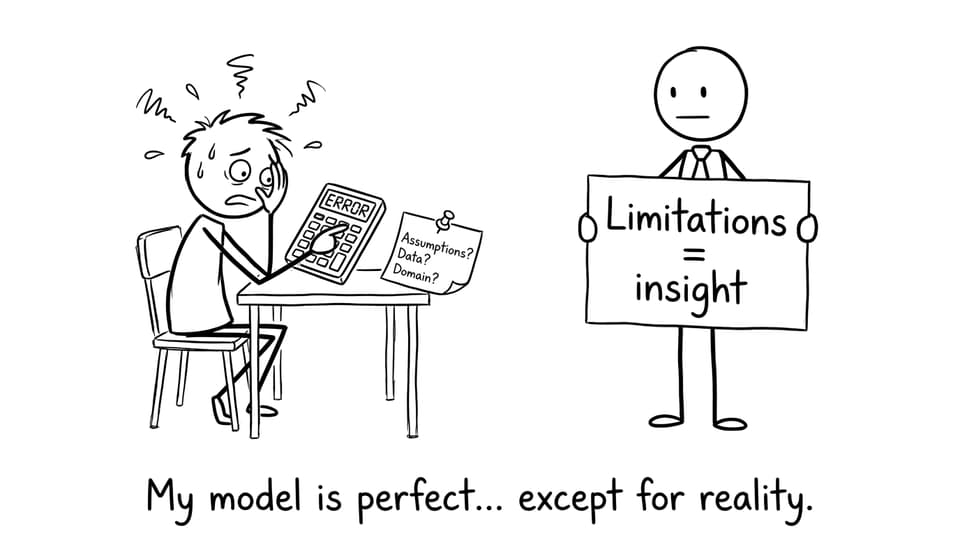
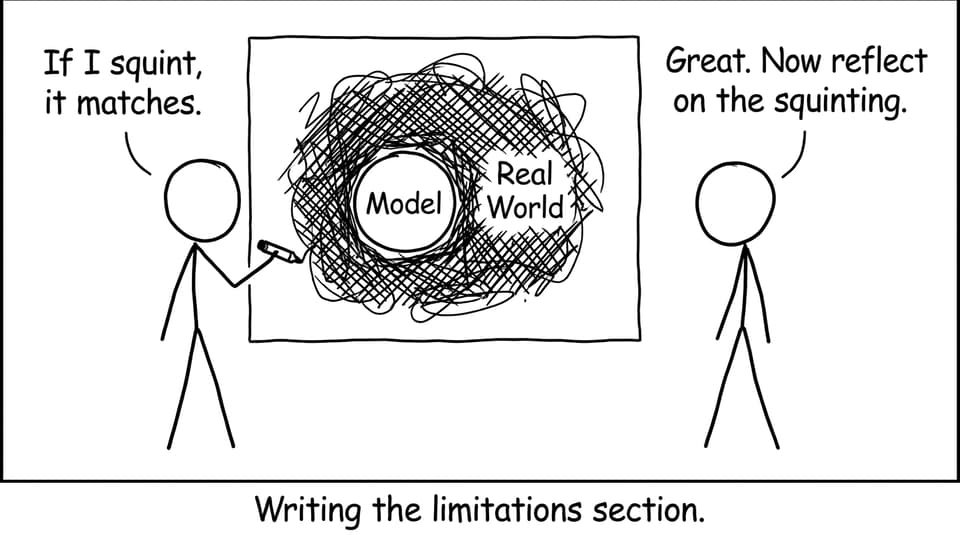
There’s a specific kind of panic that hits halfway through an IB Math IA. Your regression looks clean. Your graphs are labelled. Your algebra behaves. Then one awkward point refuses to cooperate, your residual plot starts whispering unpleasant truths, and you realize something: your mathematics is powerful, but it isn’t reality.
That realization is exactly what examiners reward.
In the IB Math IA, reflecting on mathematical limitations isn’t an apology paragraph you tack on at the end. It’s proof you understand the boundary between a model and the world it’s trying to describe. That boundary is where high-scoring reflection lives.
If you want the bigger picture of what the examiner is looking for, keep How to Write a Strong Reflection Section in the IB Math IA open as you draft.
A quick checklist for your limitations paragraph (save this)
Use this mini-checklist each time you write a limitation in your IB Math IA:
-
Name the limitation clearly (assumption, data, method, domain, technology).
-
Explain why it exists mathematically (not just “it’s inaccurate”).
-
Describe how it affects results (direction and size of impact).
-
State the valid range/conditions where your model works.
-
Propose one realistic improvement or extension.
-
Link it back to your aim or research question.
For structure help before you even reach reflection, see How to Structure Your IB Math IA Logically and How to Structure the IB Math IA for Maximum Clarity.
What counts as a “mathematical limitation” in an IB Math IA?
A limitation is not a mistake. In an IB Math IA, a limitation is a condition under which your approach becomes less reliable, less meaningful, or undefined. You’re showing the reader where your mathematics stops being a trustworthy map.
Common categories show up again and again:
-
Assumptions that simplify the situation (linearity, constant rate, independence).
-
Data limitations (sample size, measurement precision, biased collection).
-
Model form limitations (forcing exponential when behavior saturates).
-
Mathematical constraints (domain restrictions, discontinuities, non-negativity).
-
Technology limitations (rounding, regression settings, calculator defaults).
If you want an example-driven walkthrough, compare your draft against How to Reflect on Model Limitations in the IB Math IA.
Reflect on assumptions like a mathematician, not a narrator
Most IB students write assumptions as a list. Strong students write assumptions as trade-offs.
Try this framing:
-
What did the assumption buy you? (simpler calculus, solvable equation, linearizable form)
-
What did it cost you? (lost variable, distorted relationship, reduced generality)
Example sentence pattern:
“Assuming a constant rate of change allowed a linear model and clear parameter interpretation; however, it ignores seasonal variation, so predictions outside the measured interval may systematically overestimate peaks.”
That single sentence signals mathematical awareness: you’re not blaming the data, you’re evaluating your chosen structure.
RevisionDojo helps you pressure-test those decisions with its AI Chat (to ask “what hidden assumptions am I making?”), and its Study Notes (to quickly revisit regression, calculus, or statistics you’re using).
Data limitations: quantify the damage, don’t just confess it
In an IB Math IA, “small dataset” is not reflection. It’s the opening line of reflection.
Better questions to answer:
-
Is the limitation likely to change the shape of your model, or just the confidence in parameters?
-
Are errors random (noise) or systematic (bias)?
-
Does uncertainty increase for certain x-values (heteroscedasticity)?
If you have outliers, don’t hide them. Use them to show judgement. This is where How to Handle Outliers and Anomalies in the IB Math IA can guide your wording so you sound analytical, not defensive.
Model fit limitations: go beyond R²
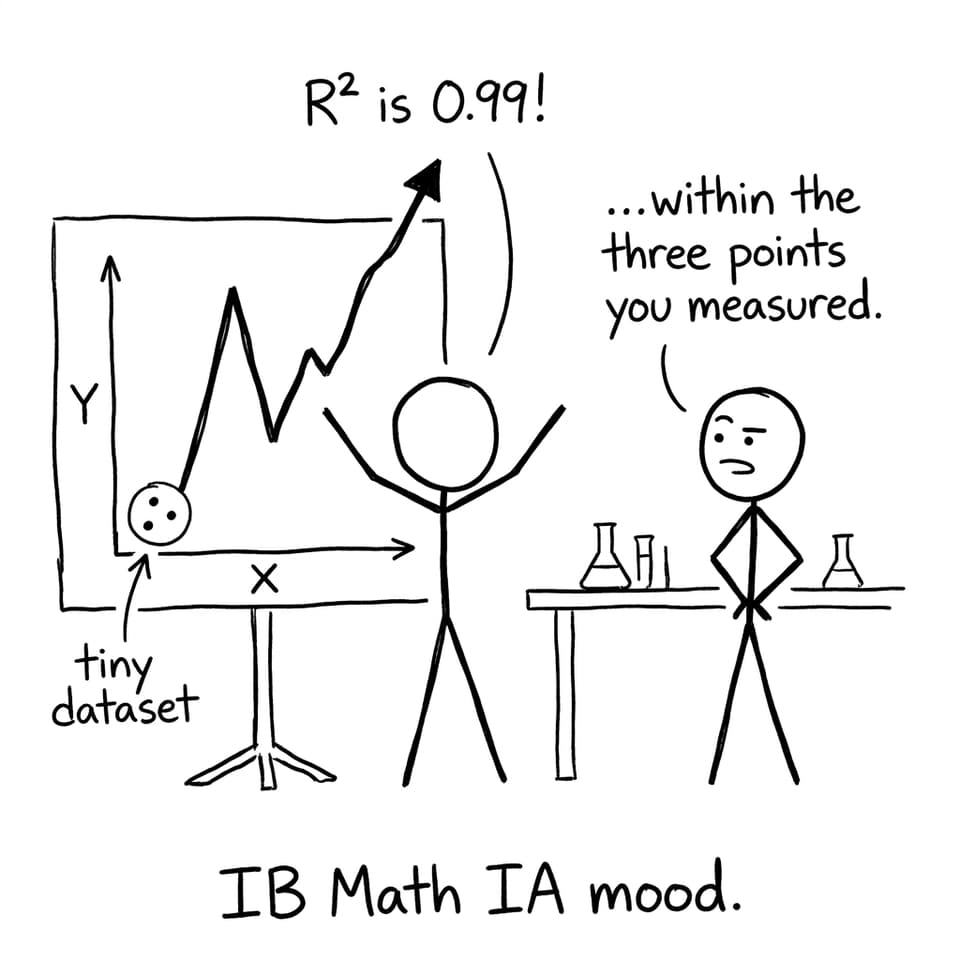
R² can be impressive and still be misleading. In the IB context, you earn more credit when you evaluate fit using multiple lenses:
-
Residual plots (patterns suggest missing structure)
-
Overfitting risk (especially with high-degree polynomials)
-
Parameter meaning (do coefficients make sense in context?)
-
Valid interval (where the model agrees with observed behavior)
A strong limitation sounds like this:
“Although the model achieves a high R², residuals show curvature, suggesting the relationship is not purely linear; this may cause underestimation at higher values and limits the model’s usefulness for extrapolation.”
If modeling is where you lose marks, read How to Avoid Common Mistakes in IB Math IA Modeling. It’s essentially a catalogue of limitations examiners keep seeing.
Mathematical constraints: name the boundary conditions explicitly
Some limitations are baked into the mathematics itself. This is where IB students can sound unusually mature, because the language is precise.
Examples you can adapt:
-
“The logarithmic model is undefined for x \le 0, restricting the investigation to positive inputs only.”
-
“The approximation relies on small-angle assumptions; for \theta above a certain threshold, the error increases nonlinearly.”
-
“The method assumes differentiability; sharp corners reduce the validity of the derivative-based argument.”
This kind of limitation is clean, objective, and easy for an examiner to reward.
Improvements: keep them realistic (and aligned to your aim)
The best improvements in an IB Math IA feel like the next chapter of the same story, not a new project.
A good improvement has three parts:
-
Action: collect more data, add a variable, switch model family, test another method.
-
Reason: what limitation it directly addresses.
-
Expected effect: how your conclusions might change.
Example:
“To reduce the effect of measurement error at larger x-values, future data collection could use repeated trials and average values, which would likely decrease variance in residuals and improve parameter stability.”
This is also a good moment to protect academic honesty. If you’re tempted to “smooth” inconvenient points, read IB Internal Assessment: What If My IA Data Is Just AI-Generated Nonsense? and IB Mathematics Internal Assessment: Avoiding Common Integrity Pitfalls. Real reflection beats fake perfection every time.
Use RevisionDojo to make reflection easier (and more IB-aligned)
If reflection feels vague, it usually means you’re trying to invent criteria while writing. RevisionDojo gives you the criteria first.
-
Use the IA Guides hub to see what each criterion rewards.
-
If you’re in AI, anchor decisions with the IB Mathematics Applications & Interpretation (AI) IA Guide and the deeper coursework pathway in IA/EE Guides for IB Math AI.
-
For planning your whole exploration (so limitations don’t feel like an afterthought), use How to Write a Top-Scoring Math IA (2025 Guide).
Then, when you’re exam-prepping alongside IA work, RevisionDojo’s Questionbank, Flashcards, Mock Exams, Predicted Papers, and Grading tools help you keep the course content sharp. The Coursework Library and Tutors are there when you need a second set of eyes on whether your limitation is mathematical enough.
Closing: turn limitations into leverage
In the IB Math IA, your limitation section is where you stop sounding like someone who followed steps and start sounding like someone who made decisions. The goal isn’t to prove your work is flawless. It’s to show you know exactly where it’s strong, where it’s fragile, and what you would do next if you had more time.
If you want a rubric-aligned way to write that with confidence, use RevisionDojo’s IA Guides, build skill alongside it with the Questionbank and Study Notes, and tighten your final draft with Grading tools and Tutors. In an IB course, reflection is often the difference between “correct” and “excellent.”