


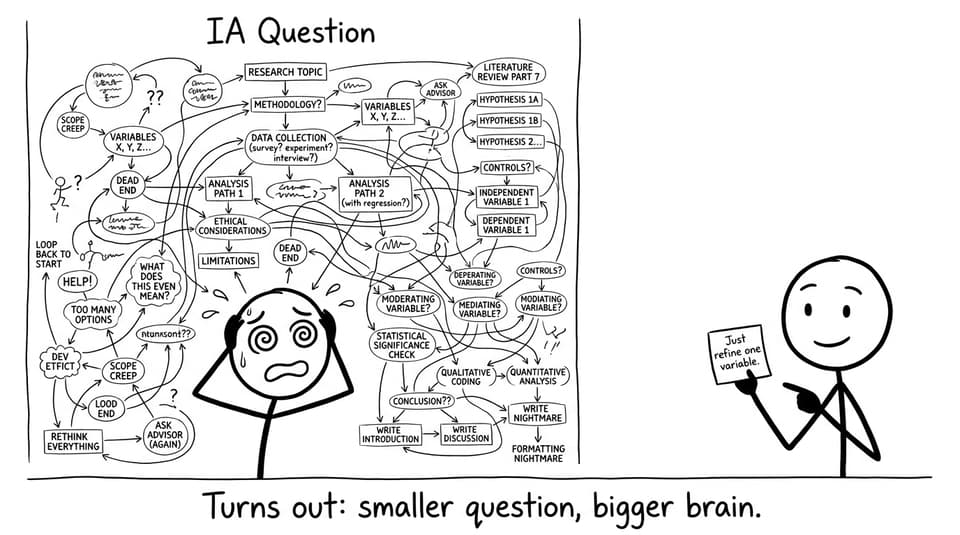
You know the moment.
You reread your IA question (or your EE research question) and it suddenly feels… slippery. Too big. Too vague. Too hard to prove. And your brain jumps to the most expensive solution: start over.
Don’t.
Most IA drafts are not broken. They’re just unfocused. The smartest move is usually refinement: tightening the question so your existing work becomes sharper, more analytical, and easier to evaluate.
If you want a deeper hub of coursework support, start with IB IA Guides and the step-by-step Coursework Guide.
The 2-minute IA refinement checklist
Before you change anything, run this quick check. If you answer “yes” to any two, your IA question likely needs refinement, not replacement.
-
Can you explain the question in one sentence without using “and” three times?
-
Do your paragraphs drift into background knowledge because the focus is unclear?
-
Does your evaluation feel generic (same limitations any student could write)?
-
Are you studying multiple variables when one would create deeper analysis?
When you want a calm benchmark of what examiners reward, read Why Most IA Research Questions Are Too Broad.
Why your IA question is usually “almost right”
Here’s the quiet truth: a decent IA topic can still produce a weak IA score if the question doesn’t force analysis.
The difference is rarely effort. It’s precision.
A question that is slightly too broad makes everything else feel harder: structure, conclusions, and especially evaluation. And if you’re also preparing for exams, the last thing you need is coursework chaos.
RevisionDojo is built for that exact pressure. You can keep exam revision moving (Study Notes, Flashcards, Questionbank, Mock Exams, Predicted Papers, Tutors) while tightening coursework with the Coursework Library, AI Chat, and Grading tools.
For a clear comparison, see The Difference Between a Good IA Question and a High-Scoring One.
Step 1: Find the exact place your IA goes vague
Don’t edit your question first. Audit your draft.
Scan for the first paragraph where your writing turns into:
-
broad explanation instead of targeted analysis
-
summary instead of interpretation
-
“this might suggest” without proof
That paragraph is the clue. It tells you what your IA question is failing to demand.
If you want to understand how markers actually judge your work, Who Marks the IA? The Truth Behind Your Final Score is worth reading before your next revision session.
Step 2: Reduce variables, not effort
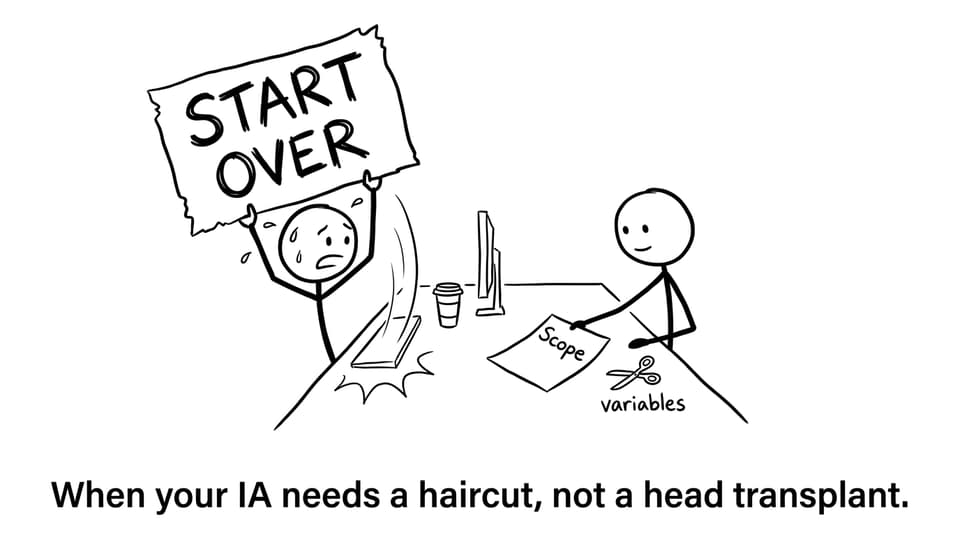
When students panic, they delete pages. When strong students refine, they delete variables.
Examples of refinement moves that save your existing work:
-
keep the same topic, but focus on one factor instead of three
-
keep your data, but limit the timeframe or context
-
keep your case study, but add one clear comparison point
This is the heart of an IA refinement: fewer moving parts means your analysis can finally breathe.
Step 3: Make the relationship explicit (so analysis becomes automatic)
A high-scoring IA question tells the reader what relationship you’re investigating.
Instead of:
- “the effect of X on Y”
Try refining toward:
-
which effect (rate, magnitude, significance, efficiency, accuracy)
-
under what conditions (temperature range, time period, text corpus, location)
-
using what lens (model, theory, criteria, method)
Need models and phrasing ideas? Use How to Refine Your IA Research Question for Clarity and Focus.
Step 4: Use the evaluation test
The fastest way to tell whether your IA question is improving is to check evaluation.
After rewriting your question, ask:
-
Are limitations now specific to your method and context?
-
Do conclusions feel more justified, not just “reasonable”?
-
Can you explain significance without sounding like you copied a template?
If evaluation gets easier, your IA question is getting stronger.
A practical workflow is to run one draft through IB Coursework Grader, then use AI Chat to ask targeted follow-ups like: “What would a stronger limitation look like for my method?”
Step 5: Adjust sections, don’t rewrite everything
Once your IA question is refined, revise like an engineer:
-
keep evidence that still answers the refined question
-
rewrite topic sentences so every paragraph points back to the IA
-
remove only what no longer fits the new boundaries
If you’re unsure what “enough” looks like, the All #IA Posts page is a helpful map for common problems and fixes.
Closing: your IA doesn’t need a reboot
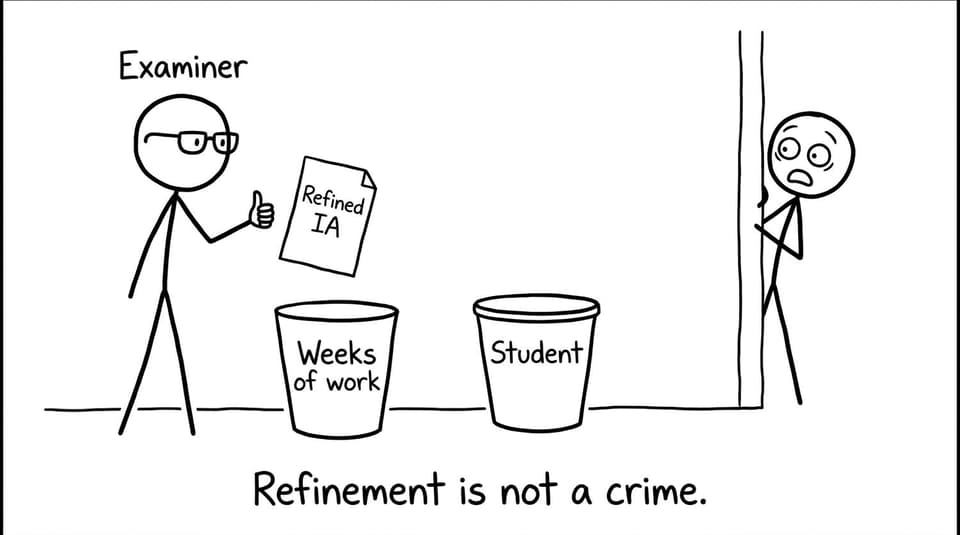
Refining an IA question is not a sign you failed. It’s a sign you’re thinking like a researcher: tightening scope, clarifying relationships, and making evaluation possible.
If your IA question feels “almost right,” treat that as good news. You’re closer than you think.
Use IB IA Guides for structure, the Coursework Guide for a step-by-step process, and IB Coursework Grader plus AI Chat to run fast improvement cycles. Then get back to what matters too: exam readiness.


