

Somewhere in the middle of writing an IA, many IB students hit the same wall. You’ve collected solid evidence. You can explain what you did. You can even make it sound “academic.” And yet the feedback comes back with a frustrating note: too descriptive.
That moment stings because it’s not about effort. It’s about a shift in thinking. Description is reporting. Analysis is meaning. And in an IB IA, marks rise when you stop narrating the work and start interpreting it.
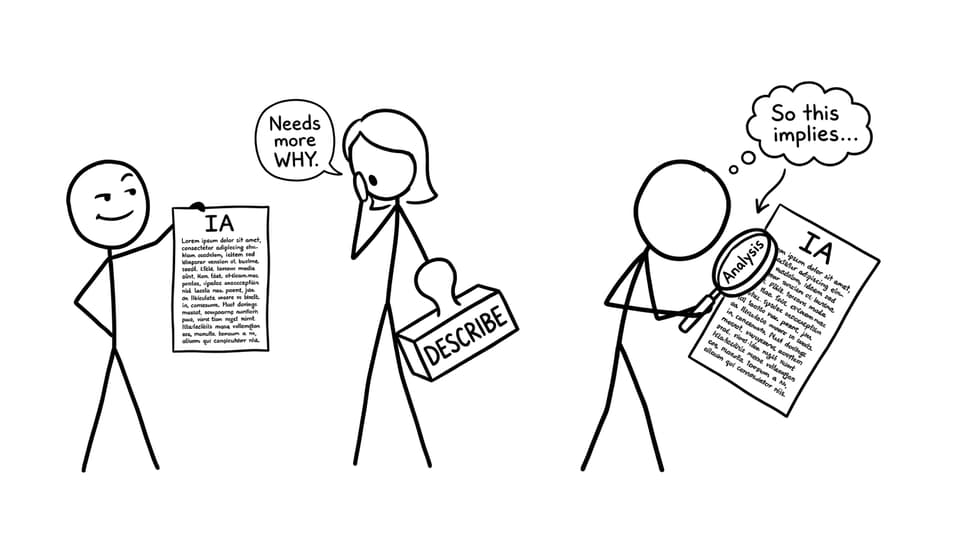
The IA analysis checklist (save this)
Use this quick checklist every time you finish a paragraph in your IA:
-
Did I answer why this happened, not just what happened?
-
Did I connect the point directly to the research question?
-
Did I explain what the evidence implies?
-
Did I compare results to expectations, theory, or an alternative?
-
Did I add a limitation or reliability note that follows logically from the analysis?
If you’re missing two or more, you’re probably still describing.
Why IB students stay descriptive in an IA
Description feels safe because it’s controllable. You can be accurate without taking a stance. Analysis asks you to do something riskier: make a judgement based on evidence.
Students usually drift into description when:
-
Their research question is broad (so nothing feels worth interpreting)
-
They think analysis means “add more information”
-
They’re unsure what examiners reward
If you need a clearer overview of what an IB IA is actually assessing across subjects, see IB Internal Assessment: A Complete Guide.
Description vs analysis in an IA: one sentence test
A fast diagnostic: look at the last sentence of each paragraph in your IA.
-
If it ends with “This shows…” you’re often still describing.
-
If it ends with “This suggests…” “Therefore…” “This implies…” you’re moving into analysis.
Even better, force yourself to add one more line after the description:
“This matters because…”
That single phrase pushes you toward interpretation and significance.
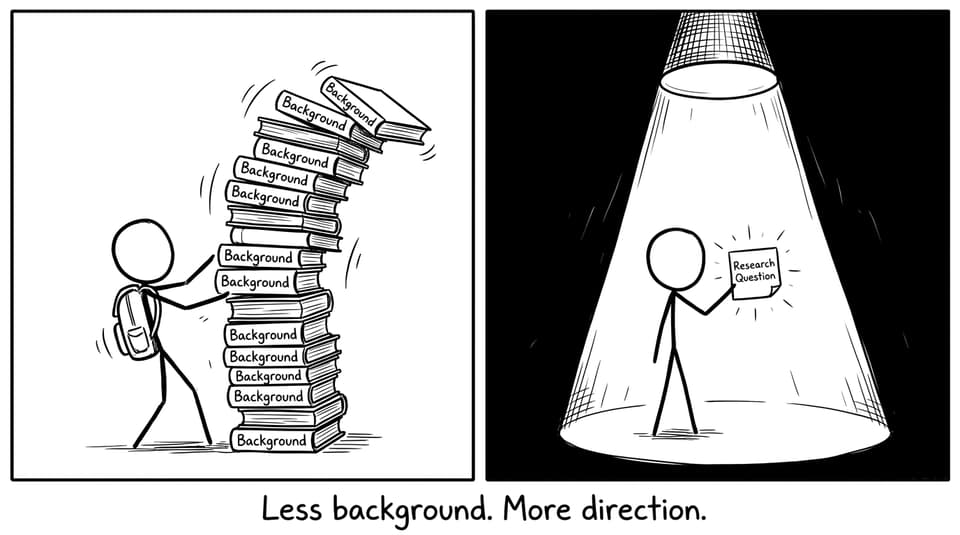
The move that changes everything: link back to the research question
Analysis in an IA is not a personality trait. It’s a habit: tying every claim back to the question you promised to answer.
After you present evidence (a quote, a data point, a pattern, a calculation), ask:
-
How does this help answer my research question?
-
Which part of my claim becomes stronger (or weaker) because of this?
-
What would someone disagreeing with me point out here?
If your research question itself isn’t built to invite analysis, fix it first using How to Write a Strong IA Research Question.
A simple paragraph framework that forces analysis
When students say “I don’t know how to analyse,” they usually mean: I don’t have a repeatable structure.
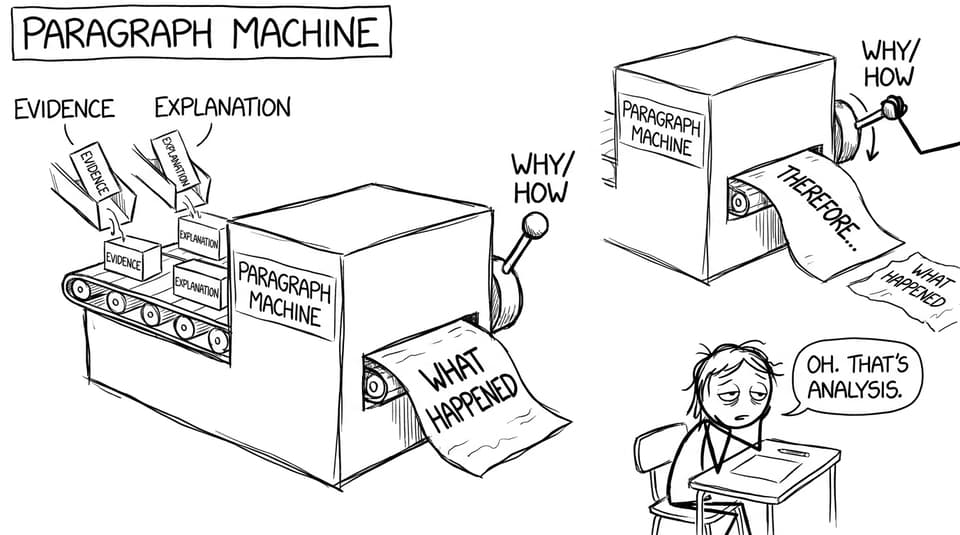
Try this four-step pattern in your next IA body paragraph:
-
Point (your claim)
-
Evidence (specific and relevant)
-
Why/How (cause, mechanism, reasoning)
-
So what (implication for the research question)
This is also why data-heavy work can still be descriptive: numbers alone don’t interpret themselves. If you’re working with results, use How to Use Data Effectively in Your IA Analysis as a companion.
Use comparisons and cause-effect to sound like an examiner
Two analysis engines work in almost every IA:
Comparison
Compare your result to something meaningful:
-
a second data set
-
a different condition
-
theoretical expectations
-
a model or assumption
Cause-and-effect
Explain mechanisms:
-
Why did the pattern occur?
-
Which variable most plausibly drove the change?
-
What confounding factor could mimic this result?
If you’re in Math, you’ll see this clearly in How to Analyze Graphs and Results in the IB Math IA.
Let evaluation grow out of analysis (not the other way around)
Evaluation is easiest when it’s the natural next step after analysis. Once you’ve explained why something happened, you can evaluate:
-
reliability (Was the method consistent enough to trust the pattern?)
-
validity (Does the evidence truly answer the question?)
-
limitations (What specifically weakened confidence?)
If you want examples of what strong analysis looks like in practice, browse IB Coursework Examples: IA, EE and TOK Exemplars.
How RevisionDojo helps you build analysis faster
When your exam season is busy, “just analyse more” is not actionable. RevisionDojo turns it into steps.
-
Use the IB IA Guides to see what each subject rewards.
-
Pull models from the Coursework Guides to structure your sections.
-
If you’re stuck, ask AI Chat for alternative interpretations or missing links to the research question.
-
Run your draft through the IB Coursework Grader to get rubric-aware feedback.
-
Reinforce the skills for exams with Study Notes, Flashcards, the Questionbank, Predicted Papers, and Mock Exams inside RevisionDojo.
Conclusion: make your IA about meaning
A high-scoring IA isn’t the one with the most facts. It’s the one where every fact is doing a job: supporting a claim, answering the research question, and leading to a reasoned judgement.
If you want a faster way to practice that shift, use RevisionDojo’s IA Guides, Coursework Library exemplars, AI Chat, and rubric-aligned Grading tools, then lock the skill in for exams with Study Notes, Flashcards, the Questionbank, Predicted Papers, and Mock Exams. Your IA improves when your writing stops saying “here’s what happened” and starts saying “here’s what it means.”