
The last page of an IB Math IA can feel like the moment after a sprint: your calculations are done, your graphs look clean, and your brain wants to stop.
That’s exactly why reflection and evaluation often get rushed. And it’s also why they quietly separate a “technically fine” IA from one that reads like a real mathematical exploration.
In IB terms, reflection and evaluation are where you prove you can think like a mathematician: not just produce results, but judge how trustworthy they are, what they mean, and what you would do differently if the world gave you another week.
The fast checklist (before you write a single sentence)
Use this quick checklist to keep your IB reflection and IB evaluation sharp and mark-focused:
-
Re-state your aim in one clean sentence.
-
Identify 2-3 decision points (where you changed methods, refined a model, or corrected an approach).
-
Evaluate your model with evidence (residuals, parameter meaning, error discussion, domain limits).
-
Name assumptions explicitly, then explain how each assumption affects results.
-
Suggest improvements that are realistic (more data, better measurement, alternative model, better validation).
-
Add one “what I learned about mathematics” insight, tied to your work.
If you want to see how top students structure this in full reports, start with Using IA/EE Exemplars to Improve Your IB Math IA.
What IB examiners are actually looking for
A useful way to think about IB reflection is this: examiners reward judgment. Not vibes. Not a recap.
Strong IB reflection and IB evaluation usually show three things:
Evidence of thinking changing over time
Moments like: “I tried X, saw Y, therefore I switched to Z.”
Evidence you can critique your own mathematics
Not “my model is accurate,” but “my model fits well in this interval because…, but becomes unreliable when…, likely due to…”.
Evidence you understand the relationship between math and reality
IB loves when you notice where mathematics simplifies, and what that simplification costs.
For criteria clarity, it helps to read the rubric breakdown and interpret it in plain English. RevisionDojo’s guide here is a strong starting point: Unpacking the IB Math IA Assessment Criteria.
Reflection vs evaluation (and why you need both)
Students often blend these into one block of text. That can work, but you still need both moves.
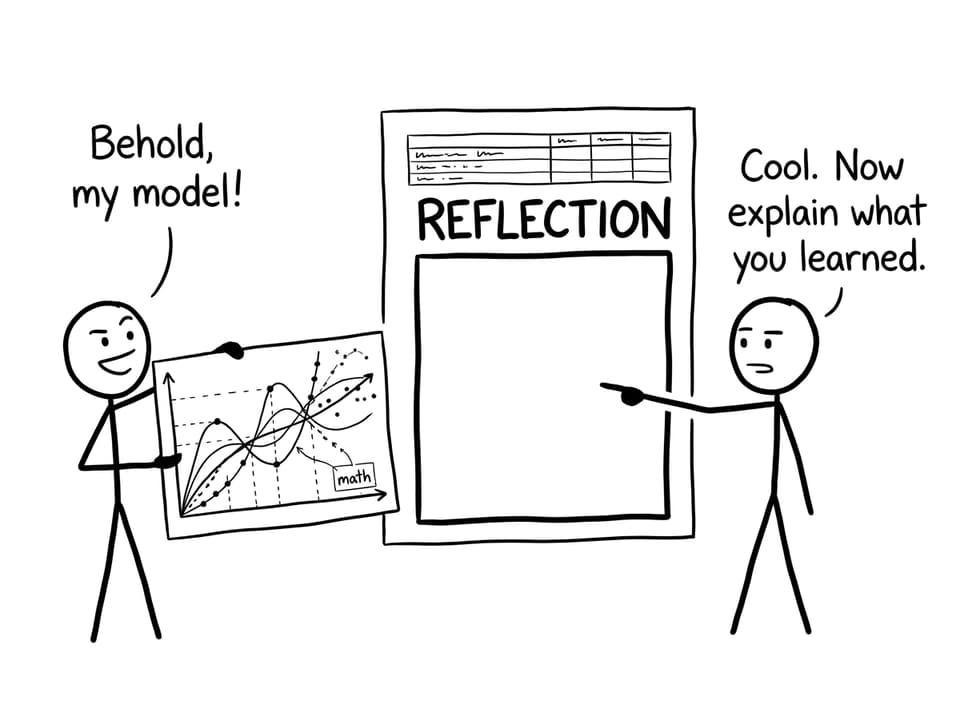
Reflection is about your reasoning
Reflection answers:
-
Why did I choose this method?
-
What surprised me?
-
What did I learn about the math?
-
What would I do differently next time, and why?
Evaluation is about your result quality
Evaluation answers:
-
How well does the model work?
-
Where does it break?
-
How sensitive is it to assumptions?
-
How could reliability be improved?
If you want a model evaluation structure you can copy (without copying wording), study the flow in How to Write an IB Math IA Evaluation That Impresses Examiners.
The highest-scoring move: reflect on choices, not steps
A summary tells the reader what you did.
An IB reflection tells the reader what you noticed.
Try this pattern for reflection sentences:
Choice, then Reason, then Evidence, then Consequence
Example (template you can adapt):
“I initially used a linear model because it matched the trend in the first five data points. However, the residual plot showed systematic curvature, suggesting the relationship was not linear. This led me to test an exponential model, which reduced residual magnitude and made parameter interpretation more meaningful within the real context.”
That single paragraph signals IB-level thinking: selection, testing, evaluation, revision.
For more sentence-level guidance, use Reflection Sentences for IB Math IA Criterion E.
How to evaluate your model like an examiner would
When you write IB evaluation, you’re essentially answering: “How much should we trust this?”
Here are four examiner-style angles to cover.
Fit and validity (in the domain you used)
Talk about fit measures you actually used (residuals, error analysis, comparison to known values). Avoid empty claims.
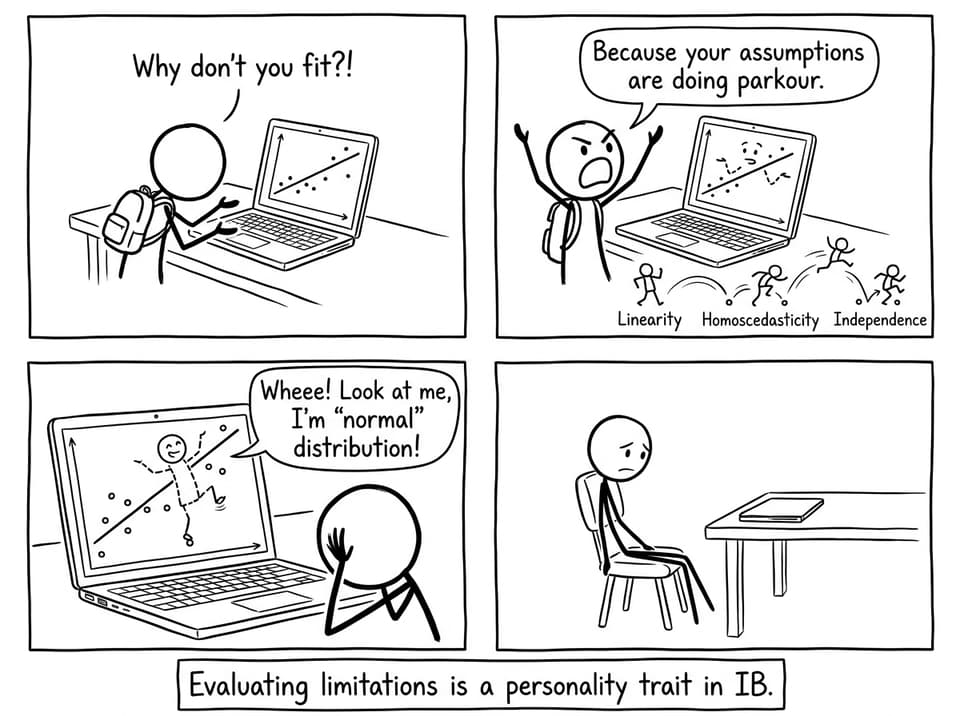
Assumptions (and their mathematical consequences)
Don’t just list assumptions. Link them to bias.
-
If you assumed constant rate of change, what happens when the real system accelerates?
-
If you assumed independence, what kind of dependency would break the model?
A deeper limitation guide is here: How to Reflect on Model Limitations in the IB Math IA.
Sensitivity (what changes the answer a lot?)
A strong IB evaluation often notices which parameters matter most.
Even a brief comment like “small changes in k produce large changes in long-term predictions” adds maturity.
Reasonable improvements (not fantasy upgrades)
Good improvements are specific and doable:
-
more data points in a critical interval
-
repeat measurements to reduce random error
-
compare two models and justify selection
-
validate with a second dataset
If you’re stuck, use the improvement patterns you see in How to Use Reflection to Strengthen Your IB Math IA Grade.
Integrate mini-reflections throughout (the “quiet advantage”)
The best IB IAs don’t dump all reflection at the end. They sprinkle it after key moments:
-
after defining variables: why these variables?
-
after choosing a method: why this method?
-
after results: what does it imply?
-
after noticing an issue: what changed?
This is also how you naturally signal personal engagement without sounding emotional. If you want that balance, read Personal Engagement in the IB Math IA.

How RevisionDojo helps you write stronger IB reflection and evaluation
When you’re tired, the biggest risk is writing generic lines that sound nice but earn nothing. This is where RevisionDojo becomes the “second brain” for your IB coursework.
-
Use the Coursework Library to compare your structure against real high-quality examples like Maths AI IA Examples.
-
Use the Grading tools to self-check your draft against the rubric with the IB Maths AI IA Grader.
-
Use AI Chat to test your reflection: paste a paragraph and ask, “Is this reflection or summary? What evidence am I missing?”
-
Use Study Notes and Flashcards to quickly revisit the math you used so your evaluation language is precise, not fuzzy: IB Flashcards.
-
Use the Questionbank and Mock Exams mindset for exams: reflection is practice in explaining reasoning, which is exactly what high-mark solutions require later.
If you’re also juggling exam prep, build consistency with The Ultimate IB Math Study Routine for Busy Students and keep your practice targeted with How to Use the Questionbank for Targeted Math Revision.
Closing: treat IB reflection as your final proof of understanding
In an IB Math IA, your calculations show competence. Your reflection and evaluation show judgment.
That judgment is what examiners remember: the student who tested assumptions, noticed limitations, and wrote like someone who understands that mathematics is powerful precisely because it is imperfect.
If you want to finish confidently, use RevisionDojo as your support system: the Coursework Library for exemplars, the Grading tools to benchmark your draft, AI Chat to sharpen your reflection language, and the Questionbank/Study Notes/Flashcards to keep your math precise while you prepare for exams. IB rewards the student who can explain not only what happened, but why it happened, and what to do next.