


If you have ever stared at an IB Math question and felt your brain politely leave the room, you are not alone. The strange part is that it often happens right after you revised the topic. You know the formula. You understand the notes. Yet the question still feels like it is written in a different language.
That gap is the real IB skill: problem-solving. Not speed, not memory, but the ability to translate unfamiliar wording into familiar structure. The good news is that IB problem-solving is trainable. It is not a personality trait. It is a loop you repeat until your thinking becomes predictable, even when the question is not.
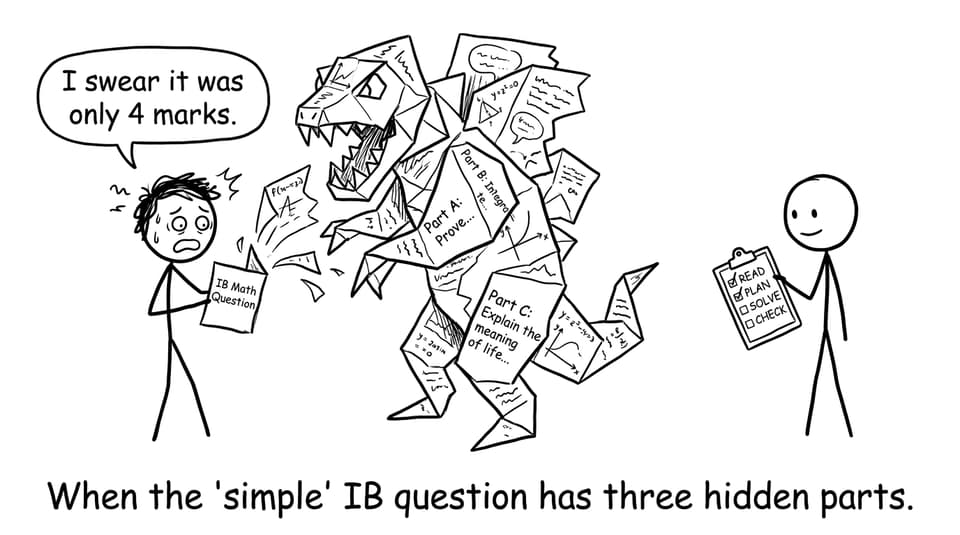
The IB Math problem-solving loop (quick checklist)
Use this simple loop every time you practice IB questions:
-
Read twice: once for the story, once for the task.
-
Label the topic: functions, calculus, probability, vectors, stats.
-
Plan in one sentence: what method will earn marks?
-
Solve in clean steps: write for method marks, not for your future self.
-
Check: units, domain, reasonableness, calculator slips.
-
Reflect: what pattern did this question belong to?
On RevisionDojo, this loop becomes easier to run because the tools connect: Study Notes for clarity, Questionbank for targeted practice, Flashcards for daily recall, AI Chat when you are stuck, and Grading tools to see exactly where marks were lost.
Step 1: Stop treating IB Math like a memory contest
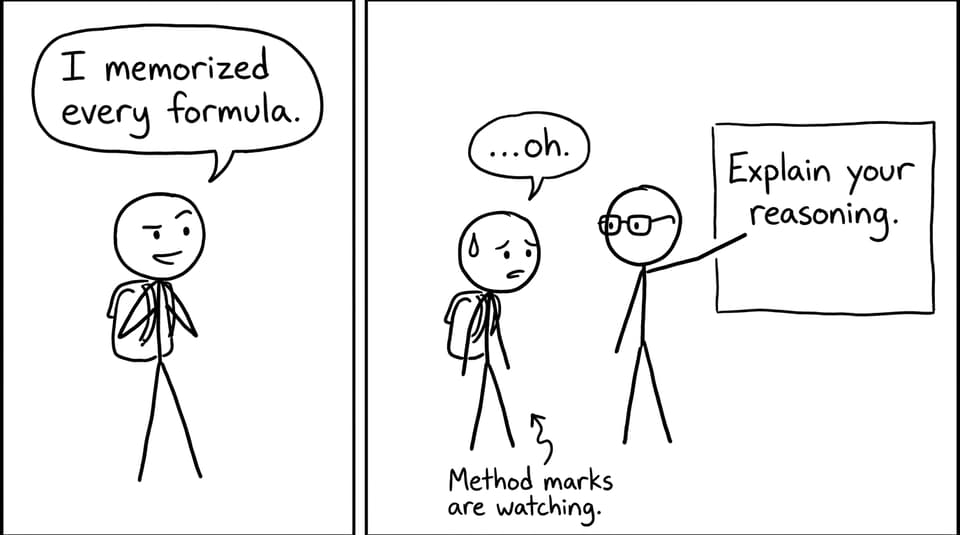
A quiet truth about IB Math is that memorization can make you feel safe right until the moment it matters. The exam rarely asks, “Do you know this?” It asks, “Can you adapt this?”
A student might memorize the area under a curve, then freeze when the question calls it “total change” or “accumulated profit.” Same concept, different clothing.
To build adaptation, start each revision block with understanding, not repetition. Use targeted topic pages like IB Mathematics Analysis and Approaches Resources to anchor your revision to the syllabus language. Then test yourself quickly to expose what you only half-understand.
Step 2: Decode the question before you calculate
High scorers in IB do something boring but powerful: they delay action by about 30 seconds.
Before you write algebra, write meaning:
-
What is the final answer supposed to be? (a value, an equation, an interval, a justification)
-
What information is given directly?
-
What is implied? (domain restrictions, “hence” links, context constraints)
-
What is the command term asking you to do? (show, verify, explain, find)
If you want a dedicated walkthrough of this reading skill, borrow the structure from How to Approach Problem-Solving Questions in IB Math SL. Even if you are AA HL, the decoding habit transfers.
Step 3: Use a simple planning framework: CUE
When an IB question looks unfamiliar, do not hunt for a trick. Use a framework.
CUE is reliable:
-
Concept: what idea is being tested?
-
Understanding: how does this connect to something you have seen?
-
Execution: what are the steps that earn marks?
The key is the middle step. Understanding is where most panic lives. It is also where RevisionDojo’s AI Chat is useful: ask it to identify the concept and the first move, then you do the execution yourself. That keeps you learning, not outsourcing.
Step 4: Build “problem families” instead of isolated memories
IB exams feel hard because they disguise the same ideas in different contexts. Your job is to see the family resemblance.
Start naming families as you practice IB:
-
Optimization: differentiate, critical points, interpret.
-
Model fitting: choose a function, use parameters, test against data.
-
Probability setups: identify events, choose distribution, justify.
-
Geometry proofs: define, relate, conclude with clear logic.
When you use the Questionbank, avoid doing 30 questions that are all clones. Mix difficulty and style within one family. For example, drill calculus questions from IB Math AA Calculus Questionbank, then add a geometry or functions twist using IB Math AA Geometry and Trigonometry Questionbank. The point is to practice transfer.
Step 5: Warm up with guided work, then remove the scaffolding
A practical way to improve IB problem-solving is to treat practice like weight training.
-
First set: guided examples (you see the method clearly).
-
Second set: exam-style questions (you choose the method).
-
Third set: mixed topics (you choose the method under uncertainty).
RevisionDojo supports this progression naturally: Study Notes and worked examples first, then Questionbank practice, then Mock Exams and Predicted Papers when you want realism. If you are in Math AI, you can also keep your reference habits clean with the IB Mathematics Applications & Interpretation Data Booklet.
Step 6: Write solutions like an examiner is tired
This sounds funny, but it is practical: assume your examiner has marked 200 scripts already. Make it easy to give you marks.
In IB Math, method marks often care about:
-
clear substitutions
-
correct notation
-
logical sequencing
-
appropriate technology use
So practice writing solutions that could be graded quickly. Use spacing, short justifications, and avoid leaps. RevisionDojo’s Grading tools reinforce this by showing where marks are awarded and where a missing line costs you.
Step 7: Review markschemes like a coach, not a judge
Most students use solutions to answer one question: “Was I right?”
High scorers use them to answer three better questions:
-
Where did the method start?
-
Which line earned the first mark?
-
What was the shortest valid path?
After each Questionbank set, do a brief audit. If you are building an exam routine, pair this with the mindset in How to Study for IB Mocks (Without Burning Out) and the longer-term perspective in IB Predicted Grades Don’t Define You (Here’s What Does).
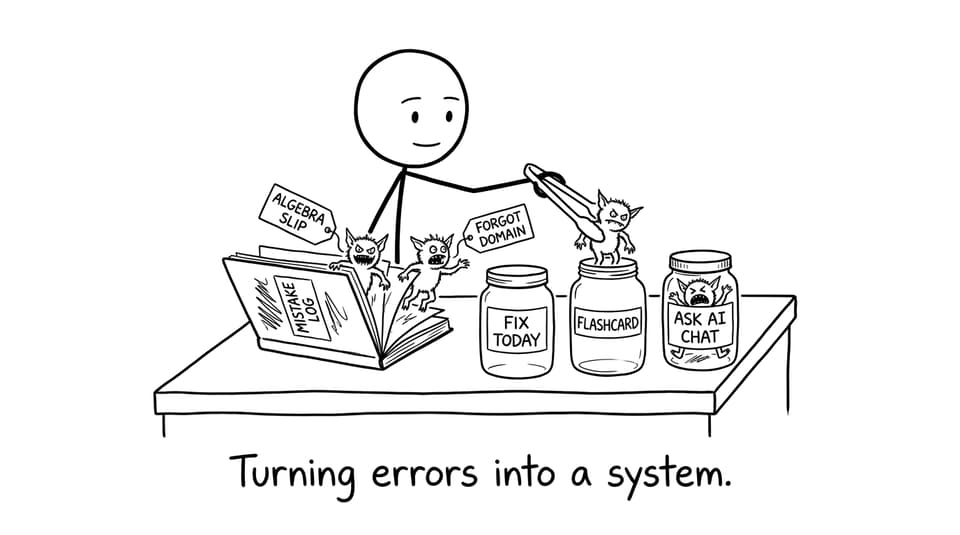
Step 8: Keep an error log that produces actions
A mistake log only works if each entry creates a next step.
Write each error in one line:
-
Type: concept gap, interpretation, algebra, calculator, time panic.
-
Trigger: what made you choose the wrong move?
-
Fix: note section, 5-question drill, flashcard, ask a tutor.
That last word matters: fix. RevisionDojo’s Flashcards help you turn recurring slips into daily recall. The Tutors feature is there for the stubborn mistakes that do not disappear with repetition.
Step 9: Practice mixed-topic sets and timed pressure
IB exams rarely keep topics in neat boxes. So your practice should not either.
Once or twice a week:
-
build a mixed set from the Questionbank (different families)
-
do it timed
-
mark it strictly
-
redo the hardest 3 questions two days later
Then graduate to full Mock Exams or Predicted Papers when you want stamina and pacing. If you are unsure how to interpret predicted material, read IB Predicted vs Specimen Papers: What They Mean so you use them as training tools, not fortune-telling.
Closing: make IB problem-solving boring on purpose
IB Math problem-solving looks like creativity, but it is usually structure practiced so often it becomes calm. You read with patience, plan with clarity, solve with method marks in mind, and reflect just long enough to learn the pattern.
If you want one place to run that entire system, RevisionDojo is built for it: Questionbank, Study Notes, Flashcards, AI Chat, Grading tools, Predicted Papers, Mock Exams, plus a Coursework Library and Tutors when you need human-level diagnosis. Pick one topic today, run the loop, and let the next IB question feel a little less mysterious.