
Outliers have a strange talent: they show up right when you start to feel proud of your dataset.
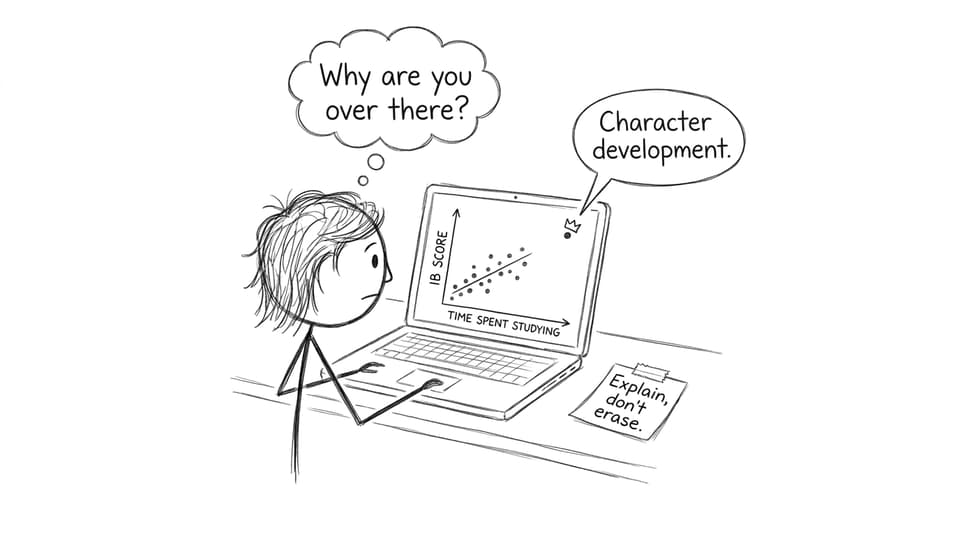
One minute, your IB Math IA looks clean. The next, one point sits alone at the edge of your scatter plot like it missed the group chat. Most students react the same way: panic, delete, move on. But in IB, that reaction is the real risk.
Examiners don’t punish you for having anomalies. They reward you for noticing them, testing them, and explaining what they mean for your model, your method, and your confidence in your conclusion. If you handle outliers well, you’re quietly showing the kind of mathematical judgment that separates “calculated” from “understood.”
A quick IB-ready checklist for outliers
Use this checklist before you write a single sentence about anomalies in your IB Math IA:
-
Identify the outlier visually (scatter plot, box plot, residual plot).
-
Confirm it numerically (IQR rule and/or z-score).
-
Investigate causes (entry error, measurement error, real-world event).
-
Compare your model with and without the outlier.
-
Decide to keep or exclude it, then justify that decision.
-
Reflect on what the outlier reveals about model limitations.
-
Document every change transparently.
If you want a structure that naturally fits IB criterion language, start with How to Write a Top-Scoring Math IA (2025 Guide) and keep it open while you edit.
What counts as an outlier in an IB Math IA?
In an IB context, an outlier is a data point that is unusually far from the overall pattern. The definition matters, because your justification needs to be mathematical, not emotional.
Two common approaches are expected in an IB Math IA:
-
IQR (interquartile range) rule: a point is often flagged if it lies below (Q_1 - 1.5,IQR) or above (Q_3 + 1.5,IQR).
-
z-score: a point with (|z| > 3) is often treated as extreme in many practical settings.
You don’t need to use both, but you should explain why you chose one. In IB writing, “I used the IQR method because the distribution is skewed and the median-based approach is robust” is the kind of sentence that signals control.
To keep your definitions and communication clean, it also helps to follow a consistent IA layout, like the one in How to Structure the IB Math IA for Maximum Clarity.
Show the outlier first, don’t hide it
A common mistake in IB write-ups is quietly removing an anomaly and only mentioning it later. That reads like you’re trying to protect the model instead of evaluate it.
Instead, make the outlier visible:
-
Scatter plots show pattern breaks.
-
Box plots show distribution anomalies quickly.
-
Residual plots show whether the model fails systematically or just at one point.
If you’re unsure what to say about your graphs beyond “it goes up,” use a framework like How to Analyze Graphs and Results in the IB Math IA. Strong IB analysis is descriptive first, interpretive second.
Investigate the cause: mistake, moment, or model?
When you find an outlier in your IB Math IA, you’re really asking a three-part question:
Was it a data entry or measurement error?
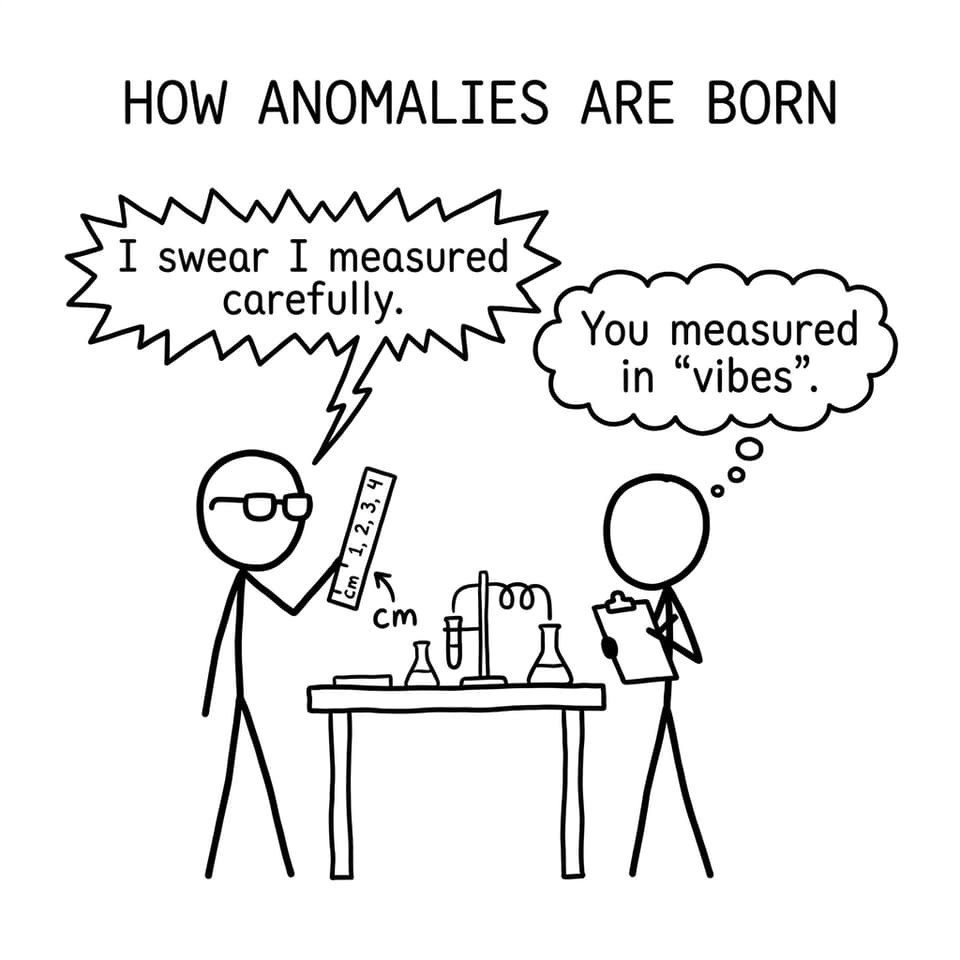
Check units, rounding, transcription, tool calibration, and whether one trial was recorded differently. If it’s an error, say so plainly and show evidence.
Was it a real-world event?
Sometimes the outlier is the most honest point you have. A gust of wind, a network outage, a sudden change in lighting, a one-off injury in sports data, a holiday spike in sales. In IB, contextual explanations matter because they connect mathematics to reality.
Is it telling you the model is too simple?
This is the most valuable possibility. A single outlier might be evidence that your “linear relationship” isn’t actually linear across the whole domain, or that a regression choice is masking a nonlinear pattern.
If you need language for discussing limitations without sounding like you’re apologizing, use How to Reflect on Model Limitations in the IB Math IA.
Keep it or exclude it? Make it an IB decision, not a vibe
In an IB Math IA, excluding data is allowed. But exclusion without justification is where marks quietly disappear.
A strong decision process looks like this:
-
Keep the outlier if it reflects genuine variation, an important edge case, or a limitation of your model that you can analyze.
-
Exclude the outlier if you can defend it as invalid measurement, incorrect recording, or data that does not belong to the same conditions as the rest of the set.
Then do what examiners actually want: show the impact. Run the model twice.
-
Compare regression parameters.
-
Compare (R^2) (with a short note on what it does and does not prove).
-
Compare residual behavior.
-
Compare conclusions.
This is where RevisionDojo becomes more than “practice.” Students often use the AI Chat to sanity-check their interpretation wording, the Study Notes to confirm the statistics method, and the Grading tools to see whether their explanation sounds like an IB response.
For targeted practice on regression, correlation, and statistics interpretation that tends to appear in IB exams, pair your IA work with the Questionbank from IB Mathematics Applications & Interpretation Resources or IB Mathematics Analysis and Approaches Resources.
Use residual analysis to prove you understood the anomaly
Residual plots are one of the cleanest ways to talk about outliers without overexplaining. In IB terms, residuals help you answer: “Does the model fail everywhere or only here?”
In your IB Math IA, a strong residual section often includes:
-
a residual plot with labeled axes,
-
a note identifying any point with unusually large residual magnitude,
-
a sentence connecting that point to context (if possible),
-
a sentence connecting it to model choice (if relevant).
If you want your graphs to look IB-professional rather than rushed, see How to Use Graphs Effectively in Your IB Math IA and How to Format and Present Your IB Math IA Professionally.
Document changes like a researcher (because IB rewards that)
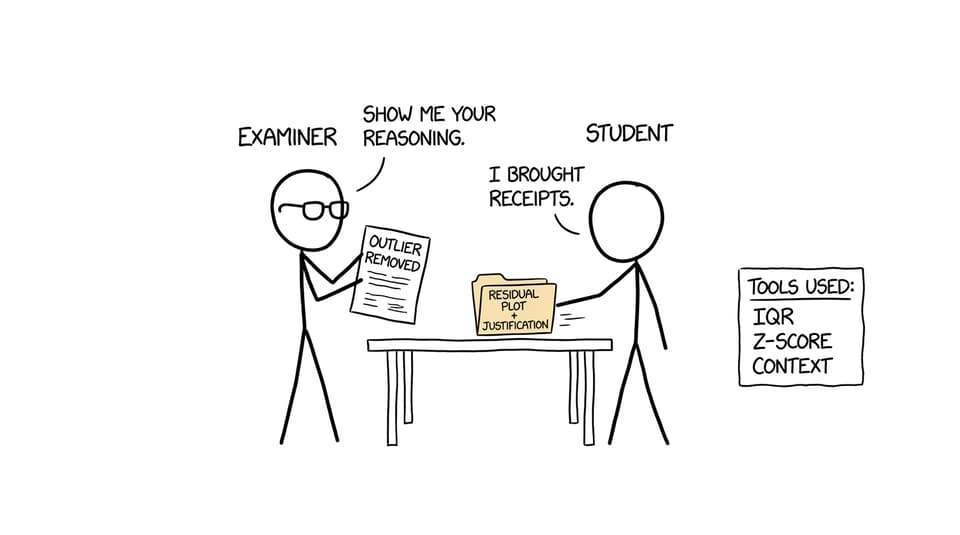
Transparency is the quiet language of credibility. If you remove a point, say exactly which point, why, and what changed.
A simple IB-friendly template:
“The data point at (x=\dots) was flagged as an outlier using the IQR rule. Rechecking the raw data showed a recording error (unit mismatch). It was excluded from the final model. Removing it changed (R^2) from (\dots) to (\dots) and reduced the maximum residual from (\dots) to (\dots).”
That paragraph does more than defend you. It shows you can evaluate evidence.
Closing: turn the “weird point” into your strongest paragraph
In the IB, an outlier is rarely a threat. It’s a prompt. It asks whether you’re willing to slow down, test your assumptions, and explain what changes when one point refuses to behave.
If you want to handle outliers with confidence, build a workflow: use RevisionDojo’s Study Notes for methods, the Questionbank for exam-ready stats practice, Flashcards for quick recall, AI Chat to refine your justification, and the Grading tools to check whether your reflection sounds truly IB. Add Mock Exams and Predicted Papers when exam season gets close, and use the Coursework Library plus Tutors when you want examples and feedback that save weeks.
Your IB Math IA doesn’t need perfect data. It needs honest reasoning. Handle anomalies well, and you’ll often write your most convincing section right where the data got messy.