


A week into your first university maths course, you might feel a quiet panic: the lecturer writes a definition, proves something you thought was “obvious,” and suddenly the same calculus you used confidently in IB feels like it has grown extra layers.
That feeling is normal. University maths doesn’t replace IB maths. It reveals what IB was pointing toward.
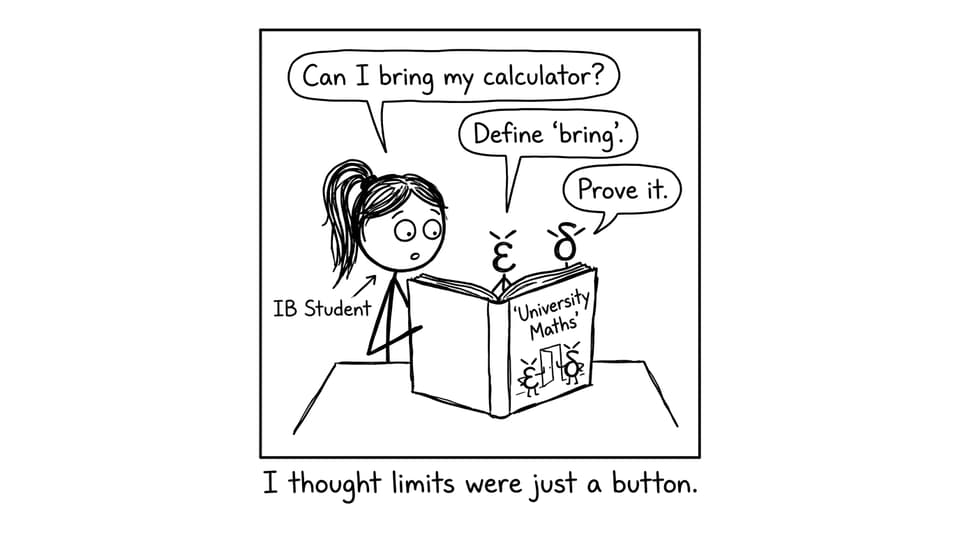
In IB, you learn how to compute. At university, you learn how to justify. The techniques are related, but the center of gravity shifts from “get the answer” to “explain why this is true.” This transition guide shows you how to connect what you already know from IB to university-level concepts, so exam revision becomes more meaningful and your first-year maths doesn’t feel like a new language.
Quick transition checklist for IB students
Use this checklist as your weekly calibration. If you can do most of these, your IB foundation is already doing its job.
-
Can I explain a method in words, not just perform it?
-
Do I know the definitions that sit behind the formulas?
-
Can I solve a question without relying on a calculator for every step?
-
Can I spot what a question is really testing (structure, not numbers)?
-
Do I review mistakes for patterns, not just corrections?
If you want a structured place to build these habits while you revise, start with the IB Mathematics Analysis and Approaches (AA) hub and align your practice to the exact topics you’re studying in IB.
The “Connect, Extend, Reflect” method (built for IB revision)
The easiest way to connect IB maths to university concepts is to treat every IB topic as a simplified doorway.
Connect: name the university course hiding inside the IB topic
Make a simple two-column map:
-
Functions and limits (IB) -> Real analysis (university)
-
Vectors and matrices (IB) to Linear algebra (university)
-
Probability and statistics (IB) to Mathematical statistics (university)
-
Differential equations intuition (IB) to Differential equations and modelling (university)
-
Sequences and series (IB) to Convergence theory (university)
This isn’t about studying ahead in a way that distracts from IB exams. It’s about recognizing that IB topics are not isolated chapters. They are early versions of bigger ideas.
Extend: ask one “proof-flavored” question
After you revise a skill, ask one deeper question:
-
“What definition makes this technique legal?”
-
“Under what conditions does this always work?”
-
“What would break if an assumption changed?”
This is the fastest way to build mathematical maturity while staying inside your IB syllabus.
Reflect: write the two-sentence bridge
End each session with:
-
“In IB, I used this to…”
-
“At university, this becomes…”
Reflection sounds soft, but it hardens understanding. It also makes your revision more transferable to new exam questions.
If you want to keep that loop tight, pair RevisionDojo Study Notes with targeted practice from the Questionbank so you always move from concept to application.

How key IB topics turn into university-level concepts
This is where the transition becomes comforting: the topics don’t disappear. They deepen.
Calculus in IB to real analysis at university
In IB, calculus is often taught as a reliable toolkit: compute derivatives, find stationary points, evaluate integrals, interpret areas.
In university real analysis, the questions shift:
-
What does it mean for a limit to exist?
-
Why do continuous functions behave predictably?
-
Which properties are assumed when we differentiate or integrate?
Your IB advantage is that you already have intuition from graphs and computation. That intuition becomes your compass when proofs get abstract.
To keep your IB calculus sharp while building that deeper thinking, drill the exact syllabus skills in the Math AA calculus Questionbank. When you review solutions, don’t only copy steps. Ask what definition each step depends on.
Algebra and matrices in IB to linear algebra at university
In IB, matrices can feel like a topic you “do”: multiply, invert, transform.
In linear algebra, matrices become representations of deeper objects:
-
Vector spaces (not just arrows, but sets with rules)
-
Linear independence (when information is truly new)
-
Eigenvalues (directions a transformation keeps stable)
IB students who are fluent with algebraic manipulation often do well early, but the jump comes when you must reason about general dimensions and properties.
A practical IB move: whenever you manipulate an expression, try to state what you are preserving (equality, domain restrictions, invertibility). That habit is basically linear algebra thinking.
Probability in IB to mathematical statistics at university
In IB, probability often lives in trees, binomial calculations, normal distribution work, and interpretation.
In university statistics, you start from definitions:
-
Random variables as functions
-
Expectation as a weighted average (defined, then used)
-
Distributions as objects you reason about, not just plug into
Your IB strength is interpretation: you’ve already practiced connecting numbers to meaning. University work adds rigor and more calculus.
If you’re on the Applications and Interpretation track, revision stays grounded by topic practice like the Math AI functions Questionbank and the Number and Algebra Questionbank, where the questions are structured the way IB expects.
Functions in IB to the language of mappings everywhere
In IB, functions are graphs, transformations, inverses, and modelling.
At university, functions show up in almost every course because they become the basic “machine” you study:
-
Inputs and outputs as sets
-
One-to-one and onto as properties you prove
-
Composition as structure, not just a step
A great bridge is to rewrite familiar IB function rules as statements. For example: instead of “the inverse exists,” write “a function has an inverse if it is bijective on the chosen domain.” That one sentence is university-flavored, and it improves your IB accuracy too.
If you want a clean place to consolidate this, use Functions study notes and turn the key definitions into Flashcards.
Study like a university student while still doing IB exams
You don’t need to add extra textbooks. You need to change what you do with a question.
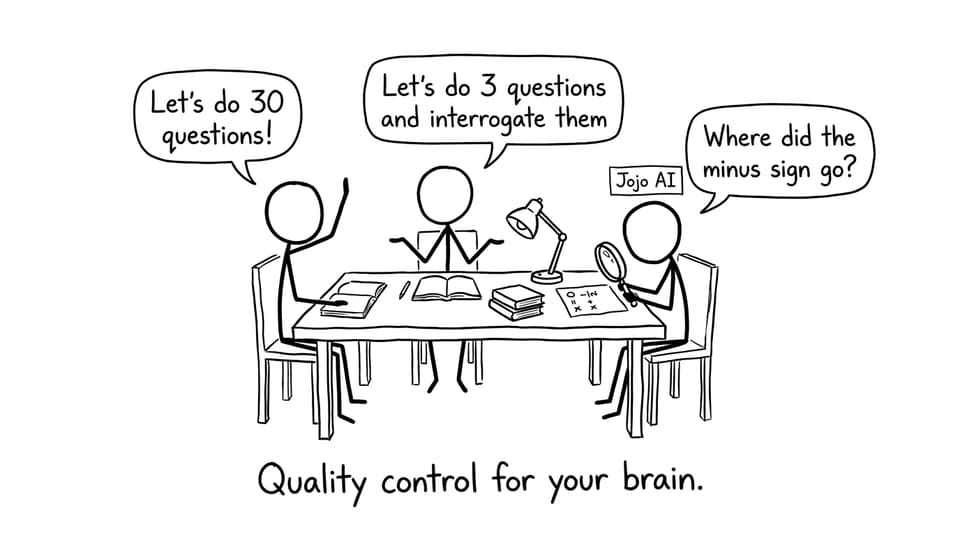
Replace “more questions” with “better questions”
A common IB trap is using volume as a form of reassurance. It works up to a point. But university maths punishes shallow repetition.
Try this: do fewer questions, but interrogate them.
-
Why did this method apply here?
-
What assumption did I use without noticing?
-
If the numbers changed, would the structure stay the same?
RevisionDojo makes this easier because you can practice with feedback loops. Use the Questionbank strategy guide to build sessions where every mistake turns into a small lesson.
Practice timing and clarity, not just correctness
University exams (and IB exams) reward clean reasoning under time pressure.
A simple weekly routine:
-
2 sessions: concept clarity via Notes + 5 focused problems
-
1 session: timed paper-style practice
-
1 session: review mistakes and write “bridge sentences”
For timed practice that still stays aligned to IB expectations, use RevisionDojo’s Predicted Papers as rehearsal material. Treat them like performance practice: timing, stamina, and decision-making.
Build “transition notes” alongside your IB notes
A transition note is one page per topic:
-
IB method summary (what you do)
-
Key definitions (what it means)
-
One extension question (what university asks)
-
Common error pattern (what you keep doing wrong)
-
Reflection sentence (the bridge)
This is where RevisionDojo’s ecosystem shines: Study Notes for structure, Flashcards for recall, Questionbank for application, AI Chat for explanations when you’re stuck, and Grading tools to tell you whether your reasoning is actually clear.
Connect the transition to your IB IA and future applications
The quiet benefit of thinking “university-style” during IB is that it upgrades your mathematical communication. That matters in exams, but it also matters in your IA.
If you’re exploring optimisation, modelling, sequences, probability, or calculus in an IA, you’re already touching the edges of university concepts. Seeing that connection helps you write more purposeful commentary and choose more meaningful extensions.
To calibrate what strong mathematical writing looks like, browse the IB Math AA exemplar library or explore the broader Maths AI IA examples. When you compare your draft to exemplars, you learn what “clear reasoning” actually looks like on the page.
Closing: make IB your advantage, not your ceiling
If university maths feels intimidating, it’s usually because it asks for depth where IB asked for fluency. But that’s good news: you already have the starting fluency. Your job now is to connect IB topics to the definitions and reasoning that power them.
Build the bridge one topic at a time. Map the connection, extend it with one deeper question, and reflect so the idea sticks.
When you want that process to feel organized (and still laser-focused on IB exams), RevisionDojo is the place to run it: Study Notes for clarity, Flashcards for recall, the Questionbank for targeted practice, AI Chat for explanations, Grading tools for feedback, Predicted Papers and Mock Exams for timing, the Coursework Library for IA models, and Tutors when you need a human reset.
IB is not just preparation for an exam. IB is training for the kind of thinking that university rewards. Start using it that way now.