



Choosing an IB Music exploration topic can feel like standing in front of an infinite streaming library with one question in your head: Which track will define my work?
At first, it seems like a purely creative decision. Pick what you love. Follow your taste. Trust your instincts.
But IB Music is never just about taste. It’s about evidence, craft, and meaning. The topic you choose quietly decides how easy it will be to show musical analysis, cultural context, and reflection without forcing it. The right topic turns your exploration into a conversation with the music. The wrong topic turns it into a desperate summary of “facts” with no clear musical point.
This guide will help you choose an IB Music exploration topic that is interesting and examinable, personal and rigorous, ambitious and manageable.
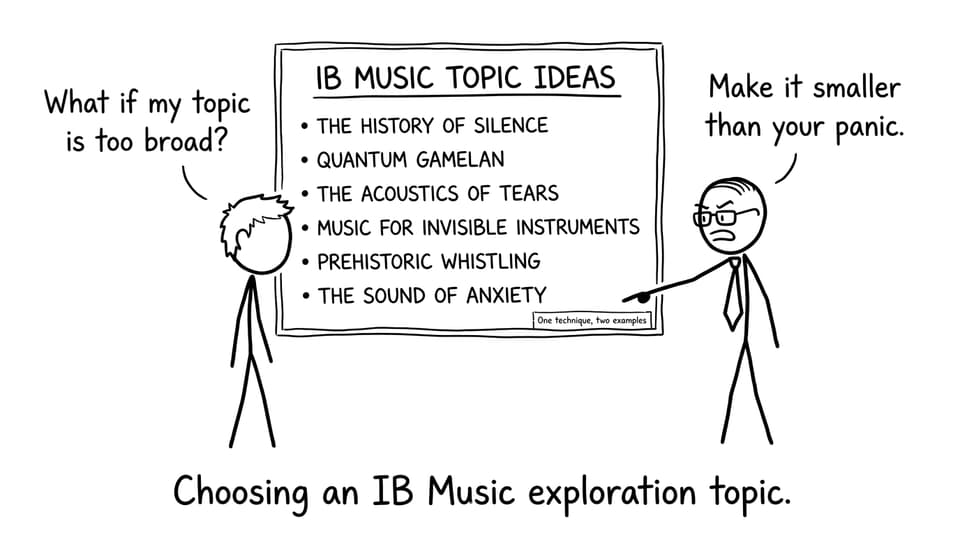
A quick checklist for choosing an IB Music exploration topic
Before you commit, run your idea through this fast filter. A strong IB Music topic usually passes all six.
-
You genuinely want to listen to the music 10+ times.
-
You can access reliable recordings (ideally multiple performances).
-
You can access a score or trustworthy transcription (or you can create workable annotations).
-
The topic invites musical analysis (not just “history” or “biography”).
-
Cultural and contextual connections are clear and specific.
-
You can narrow the scope to one technique, question, or comparison.
If you’re building your portfolio strategy across the course, it also helps to understand how exploring fits into the bigger picture of IB Music components. Keep this overview handy: IB Music syllabus breakdown.
Start where your listening already lives (then add one brave step)
Most students overthink topic choice because they think the best IB Music exploration must be rare, obscure, or impressive on paper. That impulse usually backfires.
A better starting point is simple: begin with music you already return to. The music you replay is the music you notice. And noticing is the first step of analysis.
Then take one brave step outward: choose a second angle that stretches your listening world. IB Music rewards curiosity across cultures and contexts, but it also rewards clarity. Your goal isn’t to collect exotic examples. Your goal is to show that you can hear how music works, and explain why that matters.
If you want ideas that naturally create breadth without chaos, browse: Best IB Music exploration themes for depth and variety.
The “one technique, two examples” rule (your secret weapon)
Here’s the most reliable way to narrow an IB Music exploration topic:
Choose one technique
This could be rhythm, texture, harmony, timbre, form, production choices, improvisation rules, ornamentation, modality, call-and-response, sampling logic, or how an ensemble is layered.
Use two tightly chosen examples
Pick two pieces, performances, or excerpts where the technique is clearly audible and meaningfully different.
When students choose topics like “The History of Jazz,” they’re trying to summarize a universe. In IB Music, universes don’t score. Decisions score.
A narrowed topic sounds more like:
-
“How swing ratio changes between two eras of jazz recording, and what that does to feel.”
-
“How leitmotifs transform across scenes in one film score.”
-
“How a tala cycle shapes phrase lengths in two performances of the same raga.”
This structure also makes your writing examiner-friendly because it naturally invites comparison, precision, and reflection. If you want a framework for comparing works without sounding vague, use: Best strategies for IB Music comparative analysis.
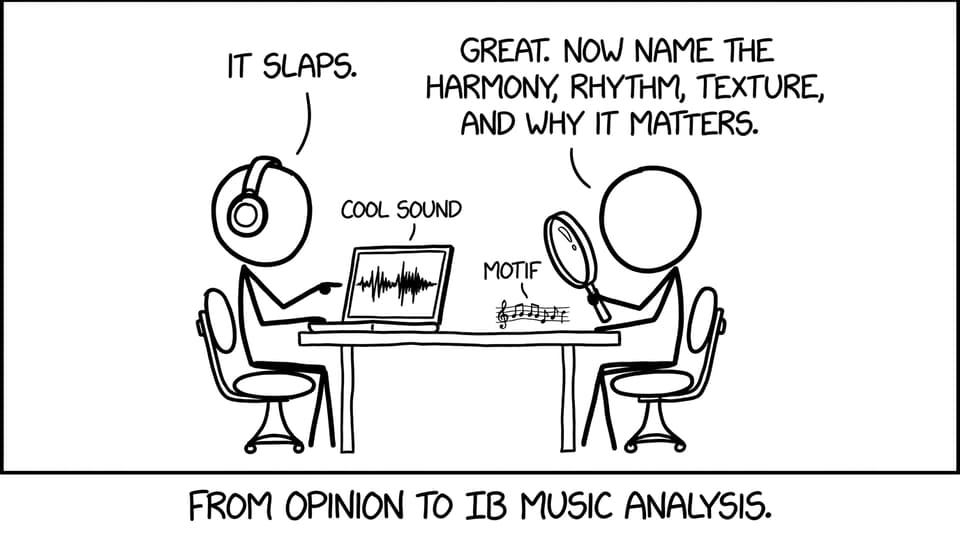
Choose a topic you can prove (resources decide your grade more than your taste)
Every IB Music exploration is built from proof. Not opinions. Not vibes. Proof.
That proof usually comes from:
-
recordings you can cite with timestamps,
-
notated evidence (score, transcription, annotated excerpt),
-
and credible context (books, articles, program notes, interviews, museum archives, liner notes).
A topic can be fascinating and still be a trap if you can’t access the materials needed to analyze it. If you’re relying on one shaky recording and a Wikipedia paragraph, your topic is not “unique.” It’s unsupported.
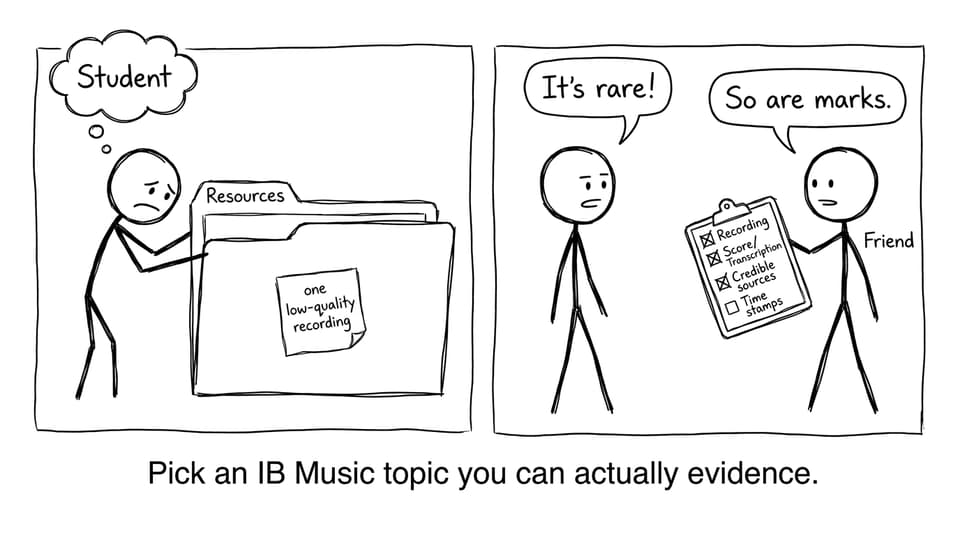
A practical resource test
Try this before you commit:
-
Can you find two reliable recordings?
-
Can you find a score/transcription or create an accurate listening transcription of a short excerpt?
-
Can you write 8 musical observations in 15 minutes (rhythm, texture, harmony, timbre, form, dynamics, articulation, production)?
-
Can you find at least two credible sources that explain cultural function or performance practice?
If you can’t, change the topic or narrow it until you can.
Make culture and context do real work (not decorative paragraphs)
In IB Music, “context” is not a background slideshow. It’s part of the explanation.
The strongest explorations treat cultural context like a lens that sharpens what you hear. Instead of saying “this tradition is important,” show how the tradition shapes sound:
-
If the music is participatory, how does that affect texture and call-and-response?
-
If it’s ritual music, how does repetition function differently than in pop?
-
If it’s dance-linked, what rhythmic patterns are necessary for movement?
-
If it’s studio-produced, how do mixing decisions become musical features?
A useful check is this sentence:
“Because this music is used for __, it tends to feature __, which creates __.”
If you can complete that sentence with specifics, your IB Music topic has a clear cultural-to-musical link.
For more guidance on building exploration themes with real cultural connection, start here: Best IB Music exploration themes for depth.
Link exploration to performing and creating (cohesion is a multiplier)
A quiet truth about IB Music portfolios: examiners notice when everything feels connected.
Your exploration topic becomes more powerful when it feeds your other components:
-
If you’re performing a jazz standard, explore improvisation language (motifs, chord-scale choices, articulation).
-
If you’re composing with modes, explore a tradition where modes carry cultural meaning.
-
If you’re producing electronic music, explore timbre design or sampling ethics and technique.
This doesn’t mean you reuse the same piece everywhere. It means your thinking becomes coherent. And coherence makes reflection easier to write with honesty.
If you’re planning those links intentionally, use: Best ways to link performing, creating, and exploring in IB Music.
A simple workflow to lock your topic in within 48 hours
When students get stuck in topic choice, it’s often because the decision lives in their head. Move it onto paper fast.
Day 1: Create three topic drafts
Write three options using this format:
-
Technique: (e.g., polyrhythm, sampling, modes, ornamentation)
-
Two examples: (piece/performance A and B)
-
Context link: (function, audience, setting, identity)
-
Possible research question: (one sentence)
Day 2: Stress-test with evidence
For each draft, gather:
-
two recordings,
-
one score/transcription source,
-
two credible context sources,
-
10 timestamps of musical events.
Whichever topic produces the cleanest evidence fastest is usually the best IB Music exploration topic. Not because it’s “easier,” but because it’s analyzable.
To stay calm while deadlines approach, you can also adopt a weekly routine built for IB Music coursework pressure: Best study routines for IB Music coursework deadlines.
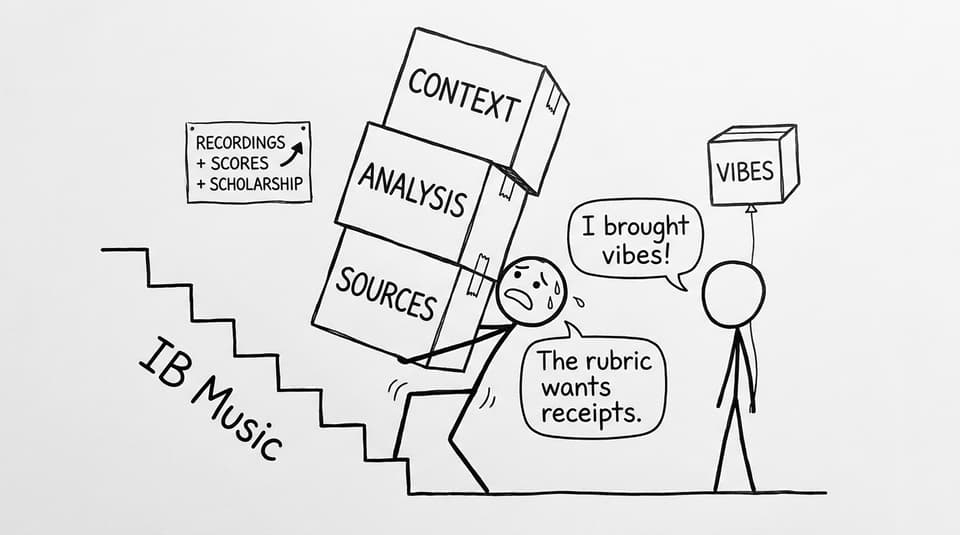
Using RevisionDojo to build a stronger IB Music exploration
A good topic is the start. Scoring well in IB Music comes from what you do next: repeated listening, precise vocabulary, structured comparison, and reflection that shows growth.
RevisionDojo is designed to make that process feel manageable:
-
Use Study Notes to lock in analysis vocabulary and context quickly.
-
Turn key terms into daily recall with Flashcards.
-
Practise examiner-style thinking with the Questionbank.
-
Ask specific “is this too broad?” questions in AI Chat when you feel stuck.
-
Use Grading tools to get rubric-aware feedback on your writing and reflections.
-
Build confidence under time pressure with Mock Exams and Predicted Papers.
-
When you need real examples to calibrate quality, use the Coursework Library.
-
If you want human guidance, RevisionDojo Tutors can help you narrow, structure, and strengthen your exploration.
If you want the full platform workflow in one place, see: RevisionDojo app for IB exam prep.
Conclusion: pick the IB Music topic that keeps giving you evidence
The best IB Music exploration topic is not the one that sounds the most impressive at first glance. It’s the one that keeps giving you something to notice: a technique you can track, examples you can compare, cultural meaning you can explain, and resources you can cite.
Choose the topic that makes you curious enough to listen again, disciplined enough to narrow it, and practical enough to prove it.
When you’re ready to turn that topic into a high-scoring exploration, build your system inside RevisionDojo using the Questionbank, Study Notes, Flashcards, AI Chat, Grading tools, Predicted Papers, Mock Exams, the Coursework Library, and Tutors. Your idea matters, but your process decides the markband.
For more targeted guidance, explore the full collection of IB Music support here: All IB Music posts.