


Percent yield is one of those IB Chemistry skills that feels easy until you’re under time pressure, your units are messy, and your calculator display looks like a warning sign. In the lab, it’s the quiet moment after the reaction when you realize your “perfect” plan produced… a suspiciously small amount of product. In exams, it’s the same story in a different costume: theoretical vs actual, and the marks live in the gap.
This guide shows you how to calculate percent yield in IB Chemistry with a clean, repeatable method you can use in Paper 2-style stoichiometry questions and in your IA analysis.
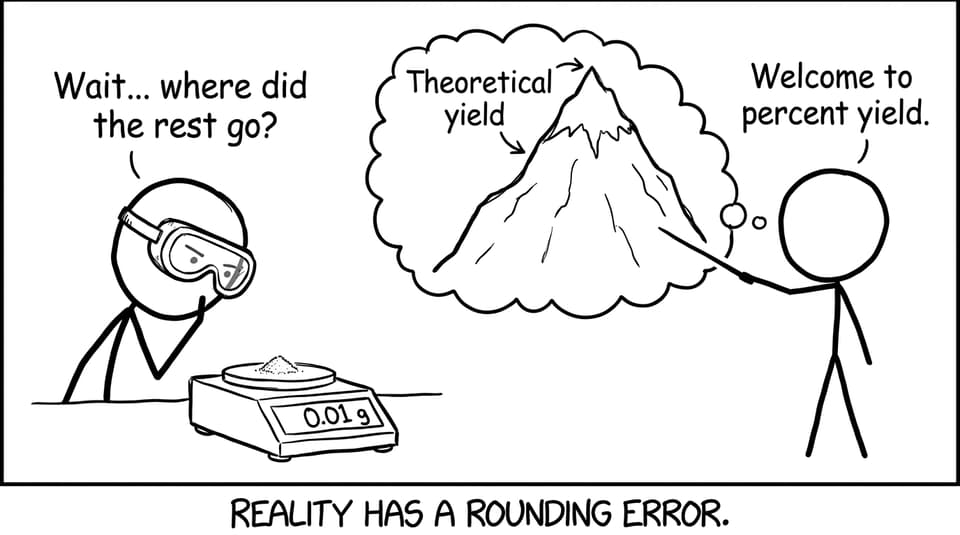
Percent yield in IB Chemistry (the one-line meaning)
In IB Chemistry, percent yield measures reaction efficiency by comparing what you actually obtained to what you should obtain under ideal conditions.
-
Actual yield = the measured amount of product you collected (from data)
-
Theoretical yield = the maximum predicted amount (from stoichiometry)
If you want the official syllabus-aligned definition and quick examples, keep IB Chemistry Key Definitions bookmarked.
The percent yield formula you must memorize
Percent yield = (actual yield ÷ theoretical yield) × 100
Write it exactly like that in IB Chemistry. Most mistakes come from calculating the theoretical yield from the wrong reactant or mixing units.
For a focused subtopic recap, see R2.1.4 Percentage yield and the matching R2.1.4 Notes.
A quick checklist before you calculate percent yield
Use this as your 15-second pre-flight check (very IB Chemistry, very examiner-friendly):
-
Balanced equation written correctly
-
All given amounts converted to moles
-
Limiting reagent identified (if more than one reactant is given)
-
Theoretical yield calculated from the limiting reagent
-
Actual yield taken from the question or your lab measurement
-
Final answer is a percentage, sensible to 2-3 significant figures
If your stoichiometry foundations feel shaky, revise reacting mass steps in Reacting masses and volumes Notes.
How to calculate percent yield step by step (exam method)
Write the balanced chemical equation first
In IB Chemistry, every yield problem is secretly a mole ratio problem. If the equation isn’t balanced, the rest is guesswork.
Tip: If you’re rushing, don’t “fix it later.” Your theoretical yield depends on the coefficients.
Identify the limiting reagent (the step that decides everything)
If both reactants are given, you must find the limiting reagent before theoretical yield. Otherwise your percent yield might be numerically neat and completely wrong.
A great refresher is Limiting Reagent Explained for IB Chemistry (and the why behind it: Why Do Limiting Reagents Determine the Amount of Product Formed).
Calculate theoretical yield using stoichiometry
The standard IB Chemistry chain looks like this:
-
Convert given quantity to moles (mass ÷ molar mass, or c×V for solutions)
-
Use mole ratio to get moles of product
-
Convert moles of product to mass (or volume) if required
This theoretical yield is your “best possible world” number.
Use the measured actual yield
Actual yield is taken from:
-
the mass collected in a lab
-
a value given in the exam question
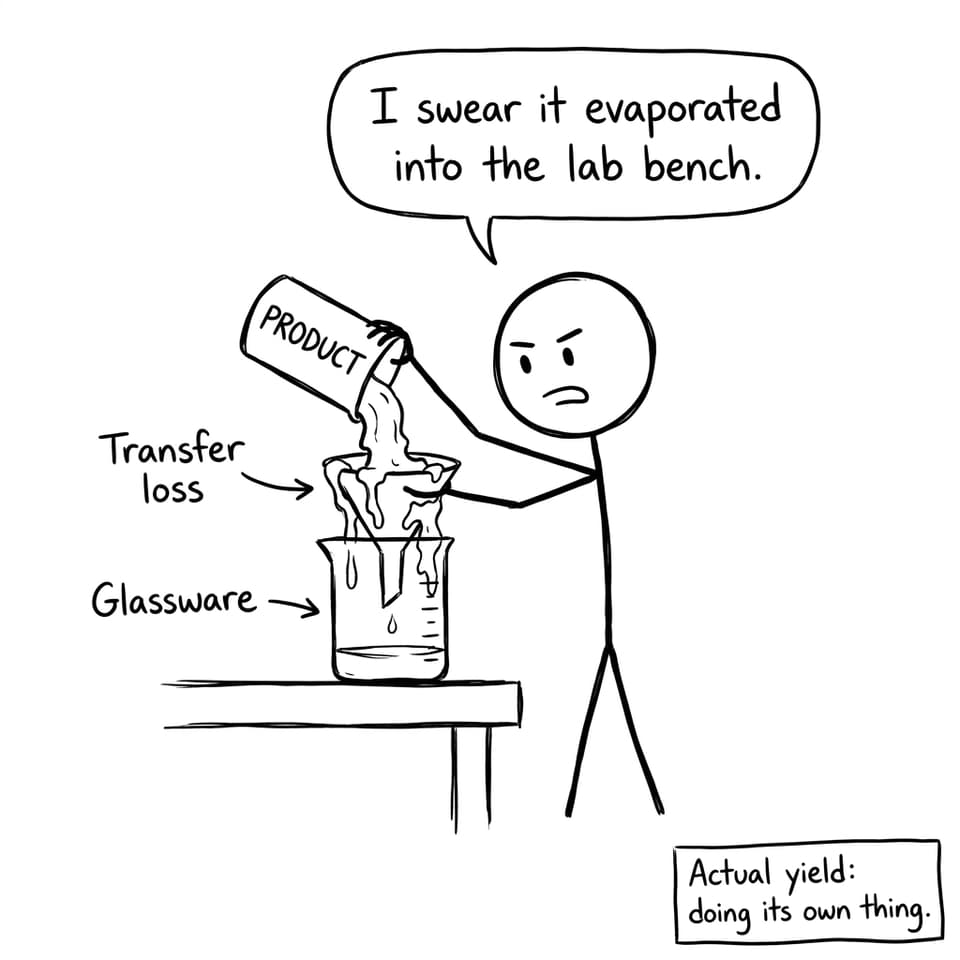
If the product is wet, impure, or lost in transfers, your actual yield changes. That’s not just chemistry; it’s what your evaluation should talk about.
Plug into the formula and interpret
Percent yield = (actual ÷ theoretical) × 100.
Interpretation matters in IB Chemistry: the number is never the end, it’s the start of the explanation.
Worked example (IB Chemistry style)
A reaction predicts 8.50 g of product (theoretical yield). You isolate 6.80 g (actual yield).
Percent yield = (6.80 ÷ 8.50) × 100
= 80.0%
Meaning: your process converted reactants into the desired product with 80% efficiency.
To drill this skill with examiner-style structure, try a yield question like Percentage yield practice question and then do a short timed set from R2.1 Questionbank.
Why your percent yield is usually below 100%
In real IB Chemistry labs, a perfect 100% is rare because:
-
product sticks to glassware (transfer losses)
-
side reactions create other products
-
reactants don’t fully react (kinetics, mixing, equilibrium)
-
filtration and washing remove some product
-
reversible reactions don’t go to completion
A strong IA links these reasons to your method, not generic bullets. That’s where RevisionDojo’s AI Chat can help you turn raw observations into a clear evaluation paragraph, and the Grading tools can check whether your reasoning actually answers the prompt.
When percent yield goes above 100% (and what it really means)
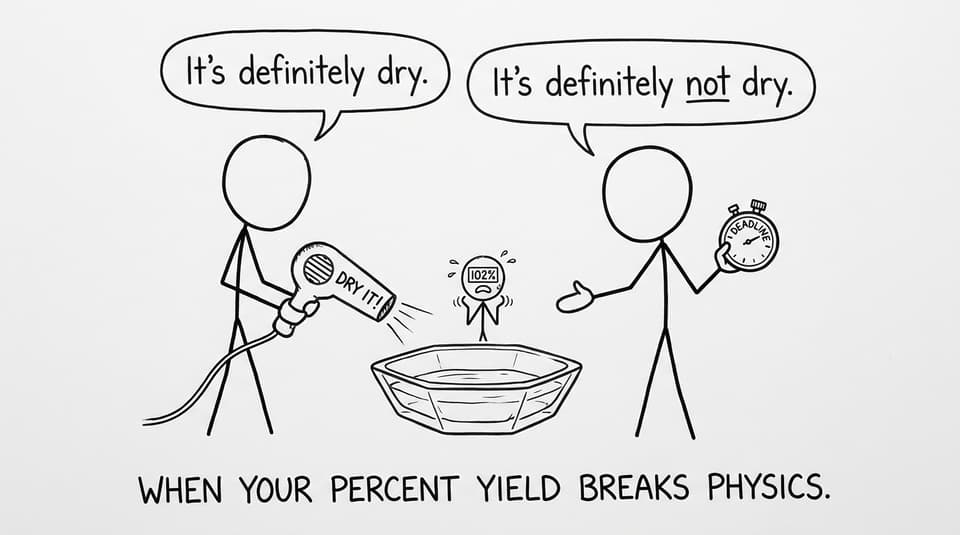
A yield above 100% usually means your “product” contains extra mass.
Common causes:
-
crystals not dried fully
-
solvent trapped in the product
-
contamination (unreacted reactant, filter paper fibers, salts)
-
balance or reading errors
In IB Chemistry, you don’t claim you broke the conservation of mass. You explain the most likely experimental reason and propose a fix (dry longer, rinse properly, weigh to constant mass).
Conclusion: make percent yield a reliable IB Chemistry mark source
Percent yield is simple in theory, but IB Chemistry rewards the students who treat it like a process: correct equation, limiting reagent, theoretical yield, then the percent yield calculation and interpretation. Once that sequence is automatic, you stop losing marks to avoidable errors.
If you want this to become second nature, use RevisionDojo’s Study Notes, Flashcards, and Questionbank to build accuracy, then add Mock Exams, Predicted Papers, and Tutors when you’re ready to train under pressure. Percent yield is not just a number; it’s a habit you can practice into certainty.


