
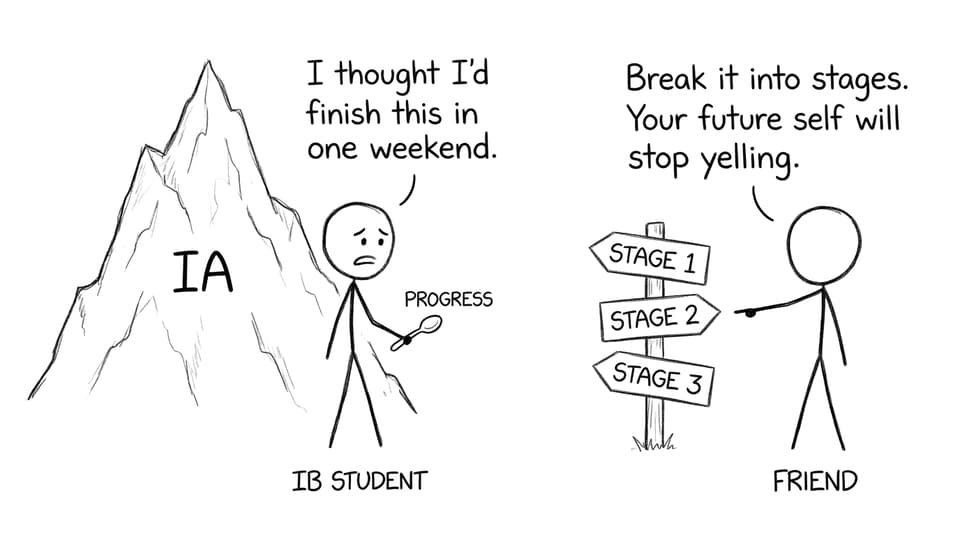
The night you finally open your IA document, it can feel less like coursework and more like standing at the base of a cliff with a toothbrush.
That feeling isn’t laziness. It’s scale.
An IA (and the EE) becomes stressful when your brain files it as “one huge task.” The fix isn’t grinding harder. The fix is staging: turning one intimidating project into a sequence of small, finishable wins.
The IA stage plan (quick checklist)
Use this as your simple roadmap for any IA or EE:
-
Lock a focused aim or research question
-
Do targeted research (only what you can use)
-
Draft analysis (where marks are earned)
-
Build evaluation continuously (not as an afterthought)
-
Refine for clarity, structure, and criterion alignment
If you want a fuller framework, start with RevisionDojo’s Coursework Guide and browse the subject hubs in IB IA Guides.
Why “one big IA” creates chaos
When an IA is treated like a single monster assignment, three things happen:
-
You procrastinate because there’s no clear first step.
-
You bounce between sections (intro, graphs, conclusion) without real progress.
-
You rewrite too early, because editing feels productive even when the thinking isn’t finished.
Staging works because it tells you what “done” means today.
Stage 1: Clarify the focus (before you write)
The first stage of an IA is clarity, not paragraphs.
Your goal is to be able to answer, in one sentence: What exactly am I trying to find out or show? If that sentence keeps changing, everything downstream will wobble.
A practical move is to pressure-test your research question using RevisionDojo’s guidance in How to Write a Strong IA Research Question. If you’re unsure what strong work looks like in your subject, the IB Internal Assessment overview is a helpful reset.
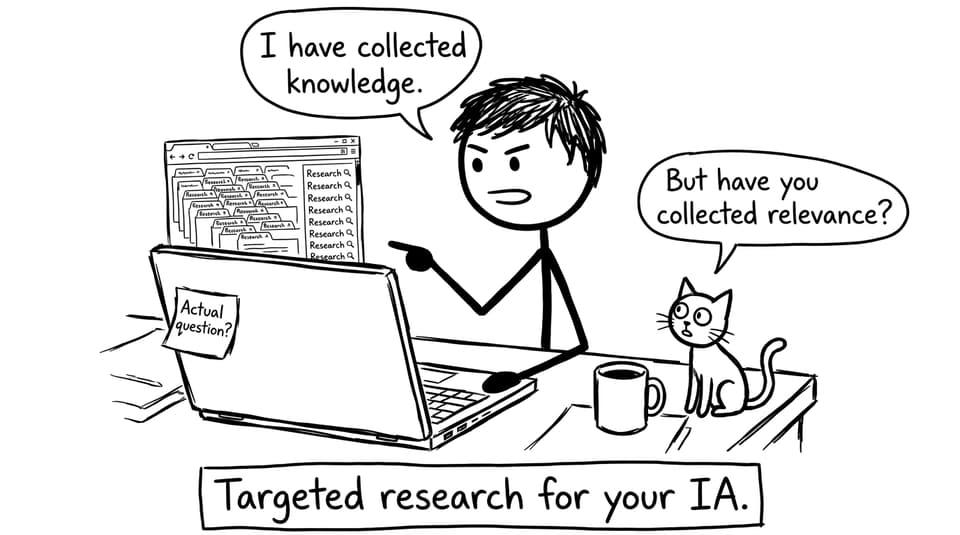
Stage 2: Targeted research (not “tab collecting”)
Most students don’t research too little. They research too widely.
In a high-scoring IA, research is a tool, not a hobby: every source should earn its place by supporting a decision you’ll make in the writing (method, argument, interpretation, or evaluation).
A quick rule: if you can’t point to the paragraph where you’ll use it, it’s not research yet.
For data-heavy coursework, pair this stage with RevisionDojo’s How to Use Data Effectively in Your IA Analysis so you’re collecting evidence you can actually interpret.
Stage 3: Analysis and development (the marks stage)
This is where your IA stops being a report and becomes assessed thinking.
In practice, analysis means you do more than describe what happened. You explain what it suggests, why it matters, and how it links back to your aim.
A helpful way to keep momentum is to draft in small blocks:
-
One finding (or one paragraph claim)
-
One piece of evidence
-
Two lines of interpretation
-
One link back to the research question
If you want examples of what “analysis + evaluation” looks like in a real subject, see a worked model like Psychology IA IB Example or the broader strategies in IB Biology IA: 8 Essential Tips to Score a 7.
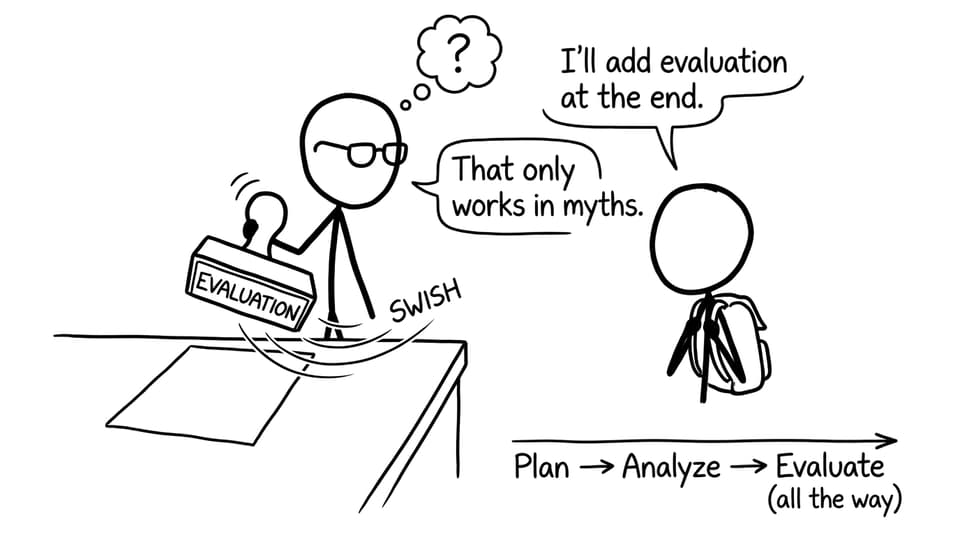
Stage 4: Build evaluation throughout your IA
Evaluation is not a final-section decoration. It’s a thread.
The easiest way to write strong evaluation is to add it while you analyze:
-
What limitation could change your conclusion?
-
What improvement is realistic (not “use a bigger sample” with no plan)?
-
What alternative explanation should you acknowledge?
If you’re feeling behind, don’t restart. Stabilize the draft and prioritize analysis/evaluation using What Happens If Your IA Is Late?.
Stage 5: Refinement (tighten, don’t rebuild)
Refinement is where good IAs become clearly good.
This stage is not “rewrite everything.” It’s:
-
Tighten topic sentences so every section serves the aim
-
Make graphs/tables readable and referenced in the text
-
Remove background that doesn’t earn marks
-
Check the criteria and adjust the highest-impact sections first
RevisionDojo helps here because you can keep your exam prep alive while polishing coursework: use Study Notes and Flashcards for daily recall, the Questionbank for exam-style practice, AI Chat to unblock specific next steps, Grading tools for rubric-aligned feedback, plus Mock Exams and Predicted Papers to protect timing and stamina. When you want examples and calibration, the Coursework Library and Tutors turn vague feedback into a plan.
A calmer ending: your IA is a sequence, not a cliff
A strong IA isn’t written in one heroic weekend. It’s built in stages you can finish, one by one, even while exam prep is happening in the background.
If you want the fastest way to turn “overwhelmed” into “moving,” start with RevisionDojo’s IB IA Guides and use the Coursework Guide as your staging map. Your IA gets smaller when your next step gets clearer.