


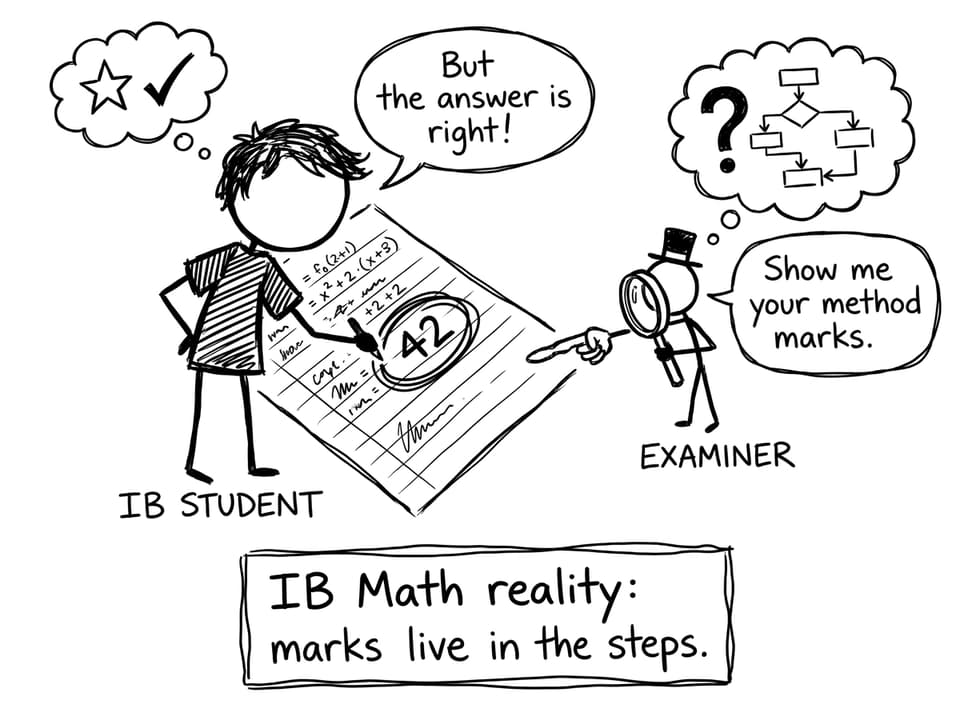
If you have ever walked out of an IB Math practice session thinking, “I knew this topic… why did I still lose marks?”, the answer is usually hiding in plain sight.
Not in the textbook. Not in another video. Not even in the question.
It is in the markscheme.
For IB Math AA and AI, the markscheme is less like an answer key and more like a mind-reading device. It shows what examiners reward, what they tolerate, and what they quietly ignore even when you feel you “basically did it.” Once you learn to analyze markschemes properly, your revision changes shape. You stop collecting questions and start collecting marks.
The IB markscheme mindset (a quick checklist)
Use this short routine every time you do IB Math AA or AI practice. It keeps markscheme analysis from becoming passive reading.
-
Do the full question first under timed, exam-like conditions
-
Mark in two passes: first for correctness, then for markscheme alignment
-
Label each lost mark as one of: method, accuracy, reasoning, communication
-
Write a one-line “error rule” you can reuse (example: “Always state domain before solving logs”)
-
Retest one similar question within 48 hours
If you want your practice to be easier to structure, pair this loop with RevisionDojo’s subject hubs for IB Mathematics Analysis and Approaches (AA) Resources and targeted practice in the Number and Algebra Questionbank for IB Math AI.
Why markscheme analysis works so well for IB Math AA and AI
Most IB students think marks are awarded for being correct.
In reality, marks are awarded for being correct in the way the paper can recognize quickly.
That difference matters more in Math than almost anywhere else, because:
-
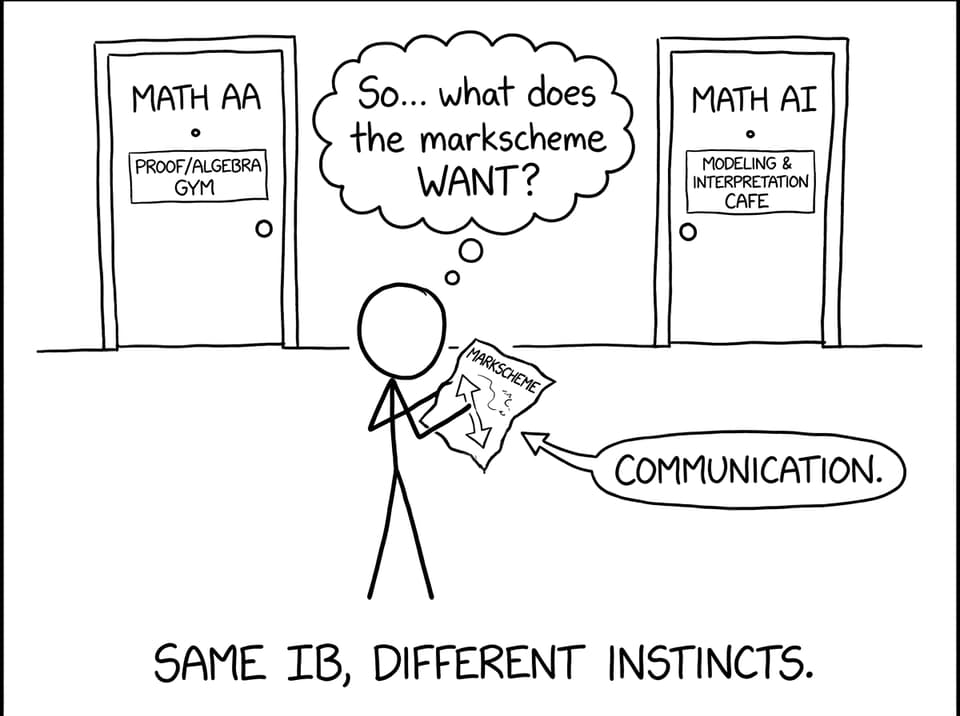
AA often rewards algebraic structure, exactness, and clean mathematical justification
-
AI often rewards interpretation, modeling choices, and context-based conclusions
-
Both courses reward method marks even when the final answer is wrong
This is why markscheme analysis feels like cheating (the ethical kind). You are learning the scoring system, not just the content.
To keep this consistent across revision, many students combine markscheme review with topic drilling in RevisionDojo’s IB Mathematics AA Calculus Questionbank and mixed-topic practice using the platform-wide Questionbank strategy described in Comprehensive IB Question Bank: Thousands of Practice Questions.
How an IB markscheme is actually built
A typical IB Math AA or AI markscheme is organized around what the examiner can award quickly.
Look for four repeating elements:
Mark allocation and step value
The markscheme is essentially saying: “This step is worth something.”
A three-mark question is rarely “one big moment.” It is usually a chain of small, awardable decisions.
A canonical pathway (plus alternatives)
There is usually a main solution outline, and then alternative methods the examiner can accept.
This matters because it gives you freedom: you do not need the same method, but you must show a method that produces awardable steps.
Examiner notes (the quiet rules)
Notes like “accept”, “ignore”, “follow-through”, or “penalize once only” are where real marks are saved.
They explain why two students with the same numerical answer can get different scores.
Presentation expectations
The markscheme often implies what needs to be written: a definition, a justification, a diagram label, a unit, a rounding instruction, or a statement in context.
When you train this skill, you begin to see markschemes as templates for your own writing.
A, M, and R marks: the IB scoring language you must speak
Most IB Math markschemes use three core mark types. Learn them and you will stop “mysteriously” losing points.
Method (M)
Method marks reward a valid approach.
You can lose the final answer and still earn marks if your process is recognizably correct.
Accuracy (A)
Accuracy marks reward correct results: the root, the value, the final simplified expression, the correct probability.
Accuracy marks tend to be the last link in the chain.
Reasoning (R)
Reasoning marks reward justification.
This is where AA proofs, calculus explanations, and AI interpretation often live.
A useful habit: when you lose a mark, ask which type it was. If it was M, you need a better routine. If it was A, you need checking habits. If it was R, you need clearer explanations.
How to compare your work line-by-line (without wasting time)
Markscheme analysis can become slow if you read everything. Instead, do a structured “audit.”
Start with your first divergence
Find the first line where your solution meaningfully differs from the markscheme.
That line is often the cause of everything after it.
Check whether your line still earns marks
Even if your method differs, ask: would an examiner still see an awardable method step here?
If yes, you might only be missing a communication detail.
Tag the loss correctly
Use four labels:
-
Concept gap (you did not know what to do)
-
Method gap (you knew, but your steps were not exam-robust)
-
Communication gap (you did not show what the markscheme rewards)
-
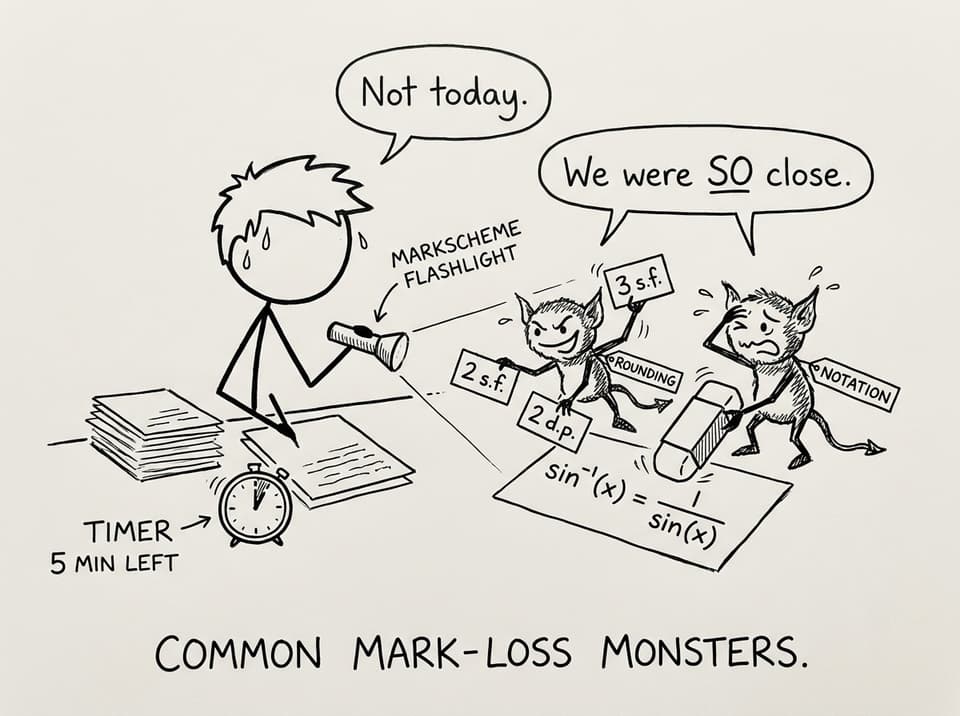
Careless gap (algebra, arithmetic, rounding, notation)
Then choose one fix: a note, a flashcard, or a short retest.
This is where RevisionDojo becomes useful as a system, not just a resource library. Students often run the loop: Questionbank practice, then targeted rebuilds with Test Builder, then timed simulation using the workflow in How to Use RevisionDojo's Mock Exam Builder to Simulate IB Conditions.
Learn the examiner phrases that change your score
Markschemes include small phrases that function like rules of the game. In IB Math AA and AI, these show up constantly.
“Accept equivalent forms”
You are allowed to be algebraically different, as long as your form is mathematically equivalent.
This is especially common in AA exact answers.
“Allow follow-through”
A mistake early does not have to destroy the rest of your marks.
If later steps use your earlier value correctly, marks can still be awarded.
“Penalize once only”
This is mercy built into the system.
For example, an incorrect rounding might be punished once, not repeatedly, if you are consistent.
“Ignore”
Sometimes extra work does not harm you.
Sometimes it does.
Train yourself to notice when the markscheme is tolerant and when it is strict.
If you want a broader exam preparation framework beyond markschemes, connect this to your full revision workflow with Custom IB Exams: Create Personalized Practice Tests for Target Topics.
Pattern mining: the fastest way to improve across AA and AI
One markscheme is helpful. Five markschemes create a pattern.
Here is what to track across your last 5-10 IB Math papers or paper-style sets:
-
Where do you lose method marks? (setup, substitution, form, justification)
-
Where do you lose accuracy marks? (signs, factoring, calculator misuse, rounding)
-
Where do you lose reasoning marks? (missing “therefore”, missing constraints, missing context)
-
Which command terms cause confusion? (show that, hence, justify, interpret)
AA patterns often cluster around algebraic structure and exact forms.
AI patterns often cluster around interpretation and model choice.
To make pattern mining easier, many students mix markscheme review with realistic paper rehearsal using RevisionDojo’s predicted resources, such as IB Predicted Papers by IB Examiners (Free) and subject-specific sets like Mathematics Applications and Interpretation (Math AI) Papers.
Common mistakes students make when reading an IB markscheme
Even motivated IB students can waste markschemes by using them the wrong way.
Only checking the final answer
This teaches you nothing about mark allocation.
You end up practicing luck instead of practicing method.
Copying the method without understanding the mark purpose
The goal is not to imitate the markscheme.
The goal is to learn what features of your work trigger marks.
Ignoring alternatives
Alternative solutions teach flexibility.
They also rescue you when you blank under time pressure.
Not turning insights into a repeatable rule
If you cannot write a one-sentence “next time I will…” rule, you did not extract the learning.
Closing: turn IB markschemes into your advantage
Most IB students do more practice when they feel stuck. The higher-scoring students do something quieter: they learn the rules of marking, then practice in a way that collects marks reliably.
So the next time you finish an IB Math AA or AI question set, do not just ask, “Was I right?” Ask, “Which parts of my work were awardable?” That is what markschemes teach.
If you want a single place to run that improvement loop, RevisionDojo is built for it: practice with Questionbank, strengthen weak topics with Study Notes and Flashcards, ask AI Chat when you are blocked, run timed Mock Exams and Predicted Papers for realism, and use grading tools to spot patterns. When you treat the markscheme as a teacher, not an answer key, IB Math stops feeling mysterious and starts feeling trainable.