
The moment your IB Math IA becomes real
There’s a specific moment in every IB Math IA where the work stops feeling like “I collected data and made a graph,” and starts feeling like mathematics.
It’s when you look at your figure and ask a slightly uncomfortable question: If I had to defend this graph in front of someone who doesn’t trust me, what would I say?
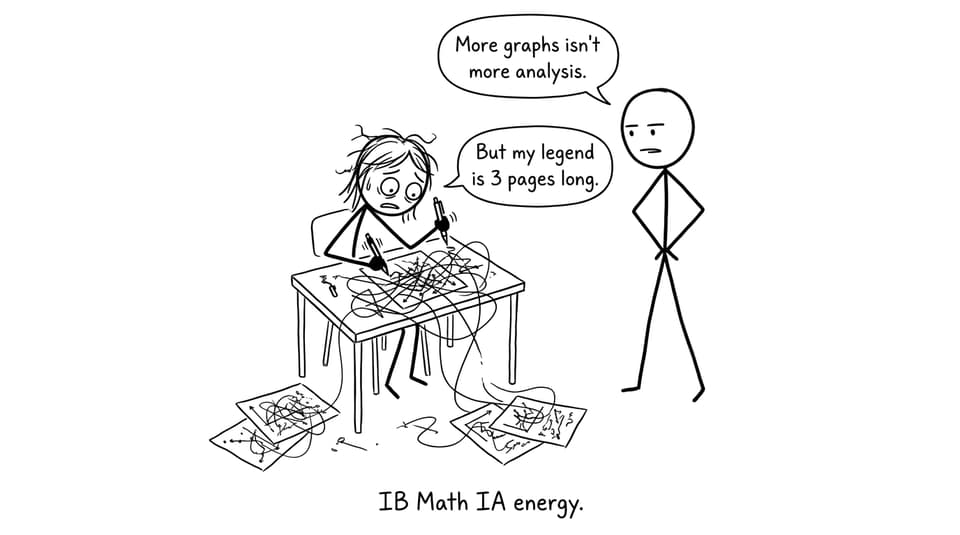
That’s the skill the IB rewards. Not the number of graphs. Not the fanciest regression. The ability to turn a visual into an argument.
In this post, you’ll learn how to analyze graphs and results in an IB Math IA so your examiner can’t miss the meaning. We’ll build a repeatable routine, show what strong commentary sounds like, and finish with a checklist you can reuse across your whole draft.
A quick IB-ready checklist (use this before you write)
Before you write a single sentence of graph commentary in your IB IA, check that you can do most of the following:
-
State what the graph shows in one objective sentence (variables, direction, shape).
-
Name 2-4 mathematical features (intercept, turning point, gradient, asymptote, periodicity).
-
Explain what those features mean in context.
-
Compare results to your expected/theoretical model.
-
Evaluate the fit (residuals, R², error, reasonableness).
-
Notice anomalies and say what they imply (not just that they exist).
-
End with one takeaway that links back to your aim.
If you need examples of how top students structure this, browse Using IA/EE Exemplars to Improve Your IB Math IA.
Start with the “camera voice” description
A reliable IB habit: describe first, interpret second.
Think of your first sentence as a camera recording the scene. No opinions. No explanations yet. Just what’s on the page.
Good IB description usually includes:
-
What figure number you’re referring to
-
What’s on each axis (with units)
-
The overall pattern (increasing, decreasing, leveling off, oscillating)
Example stem you can reuse:
“Figure 3 shows the relationship between (x) (units) and (y) (units), with (y) increasing approximately linearly until (x\approx\dots), after which the rate of increase slows.”
If your visuals still look messy, fix the communication before you fix the math. How to Format and Label Graphs Professionally in the IB Math IA is a fast way to standardize axes, titles, scales, and captions.
Identify features the IB examiner can mark
The IB wants mathematical communication that proves you understand the function or model, not just the story around it.
Look for features an examiner can point to and say: Yes, they knew what to notice. Common high-value features include:
-
Intercepts and what they represent
-
Maximum/minimum points and what causes them
-
Gradient and changing rate of change
-
Concavity and inflection points
-
Asymptotes, bounds, and limiting behavior
-
Period and amplitude (if trig is involved)
Then write commentary that ties the feature to the question you’re exploring.
A useful rule in any IB Math IA: if you can circle it on the graph, you should probably explain it.
For broader guidance on choosing the right figure types and using them with purpose, see How to Use Graphs Effectively in Your IB Math IA.
Convert “shape” into meaning (context is not optional)
This is where many IB drafts stall. Students name a feature, then move on.
Instead, translate the math into what it means in your investigation.
-
A turning point isn’t just “a maximum”; it’s the best-case moment in your system.
-
A flattening curve isn’t just “leveling off”; it might be saturation, diminishing returns, or a limiting factor.
-
A steep gradient isn’t just “increasing fast”; it implies sensitivity: small changes in (x) produce large changes in (y).
If you’re unsure how to phrase this in an examiner-friendly way, build your IA structure first so every graph has a job. How to Structure the IB Math IA for Maximum Clarity helps you match figures to claims.
Compare results to a theoretical expectation
Strong IB analysis often reads like this:
-
Here’s what I expected mathematically.
-
Here’s what my result shows.
-
Here’s the gap between them.
-
Here’s a plausible reason for the gap.
That comparison signals understanding of both model and reality.
Practical ways to do this in an IB Math IA:
-
Overlay model vs data in one figure and refer to where they diverge.
-
Compare parameter values to what you predicted.
-
Explain why your model form (linear/exponential/logistic) made sense, then admit where it fails.
If you’re still deciding which model is justified, How to Build Mathematical Models for the IB Math IA is a good companion read.
Evaluate fit like a mathematician (not a salesperson)
In IB writing, “the graph looks good” is not analysis.
Instead, pick at least one quantitative fit tool and interpret it:
-
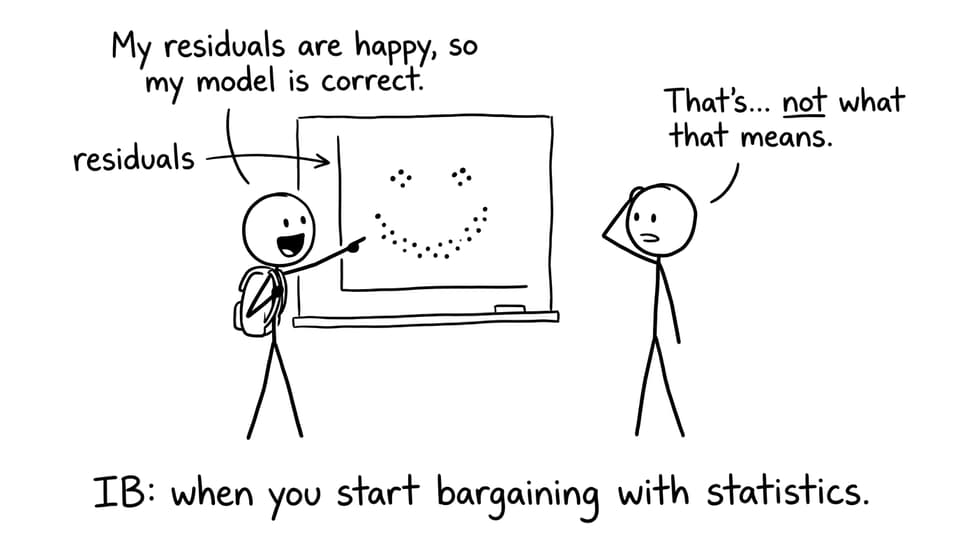
Residual plot: Are residuals random around 0, or do they curve (suggesting the wrong model form)?
-
R²: Does it support strong association, and is that meaningful given your context and sample size?
-
Error bars / uncertainty: Does the uncertainty change your confidence in the conclusion?
The goal is not perfection. The goal is honesty with reasoning.
For a broader workflow on handling data and interpretation, How to Use RevisionDojo to Prepare for IB Math IA Data Analysis is built around the same IB criteria your teacher grades.
Treat anomalies like opportunities, not problems
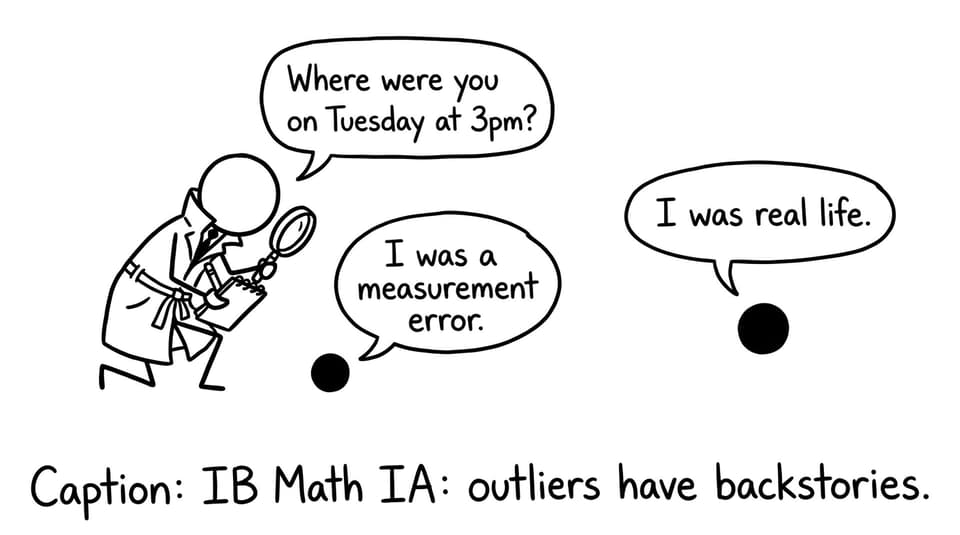
Outliers scare students because they feel like mistakes. But for the IB, they’re often where reflection becomes real.
When you see an anomaly, write in this order:
-
Identify it precisely (where it occurs and how far it deviates).
-
Offer at least two plausible explanations (one measurement-related, one real-world/variable-related).
-
State what you did about it (kept it, removed it, investigated it) and justify that choice.
-
Explain how it changes your conclusion, even slightly.
That last step is what turns an outlier into IB-level reflection.
If you want a dedicated guide, read How to Handle Outliers and Anomalies in the IB Math IA.
Quantify at least one claim per graph
A simple upgrade for almost every IB graph paragraph: add one number.
Instead of:
“The function increases quickly.”
Try:
“Between (x=2) and (x=6), (y) increases by 14.2 units, giving an average rate of change of (3.55) units per (x)-unit.”
Numbers make your interpretation checkable, which is exactly what mathematics is.
To keep your skills sharp for exams while you’re doing coursework, use RevisionDojo’s Questionbank to drill graph features and interpretation topics (functions, calculus, statistics). Start with the IB Math AA Calculus Questionbank or revise functions with the Math AI Functions Questionbank.
End each graph with a one-sentence “so what”
Your IB Math IA should never leave a figure hanging.
Close every graph discussion with a sentence that does one of these:
-
Answers part of your research question
-
Justifies the next step in your method
-
States a limitation that affects your conclusion
Example endings:
-
“Therefore, the linear model is reasonable only for (0\le x\le 5), which is the domain I will use for prediction.”
-
“This supports the aim by showing the strongest relationship occurs when… , suggesting the key variable is…”
If you’re unsure how many graphs is enough to build a convincing argument, How Many Graphs Should an IA Include? gives a practical benchmark that aligns with IB expectations.
Bringing it back to RevisionDojo (and to your exams)
Graphs and results are where your IB Math IA stops being a collection of outputs and becomes a coherent argument. When you learn to describe clearly, extract mathematical features, compare to theory, evaluate fit, and reflect on anomalies, your writing starts to feel inevitable.
RevisionDojo is built for that entire loop: sharpen skills in the Questionbank, clarify concepts with Study Notes and Flashcards, pressure-test your understanding with Mock Exams and Predicted Papers, and use AI Chat plus Grading tools to turn “I showed a graph” into “I proved a point.” When you’re ready, the Coursework Library and IA guides help you calibrate your analysis to true IB standards.
If you want your next IB draft to read like a top scorer, pick one graph today and rewrite its paragraph using the checklist above. Then run the same routine for the rest of your IA. Consistency is what makes the work feel professional in the IB.