


Lattice energy is one of those IB Chemistry ideas that feels obvious right after your teacher explains it… and then mysteriously disappears the moment you try to write a Paper 2 explanation under time pressure.
You look at two ionic compounds. You remember there’s a trend with ion size. You even remember the direction. But the exam isn’t asking for a trend. It’s asking for why. And in IB Chemistry, why is where the marks live.
This guide shows how lattice energy is affected by ion size, how to explain it with IB-accurate reasoning, and how to turn that reasoning into the kind of sentence examiners reward.
Quick checklist: ion size vs lattice energy (exam-ready)
Keep this mental checklist for IB Chemistry energetics and bonding questions:
-
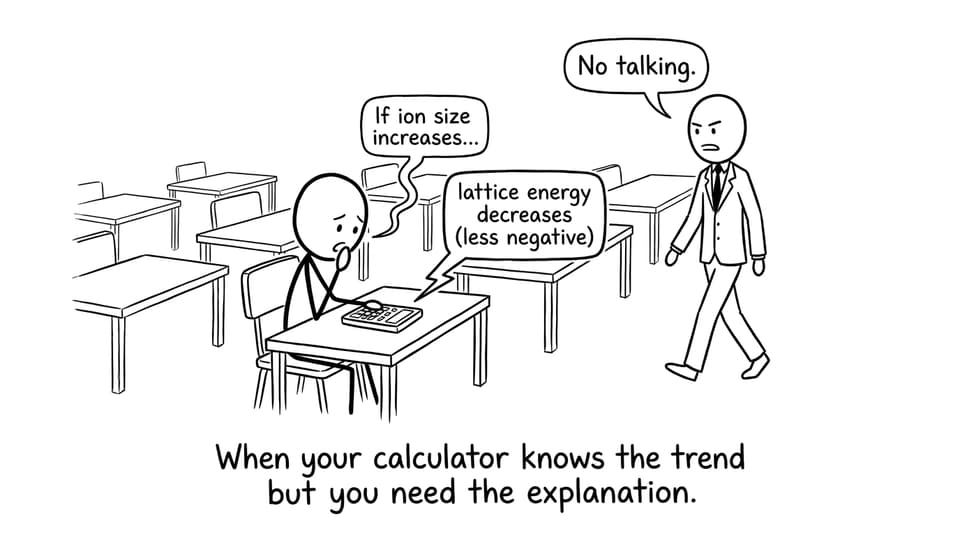
As ion size increases, lattice energy decreases in magnitude (becomes less negative for the formation definition).
-
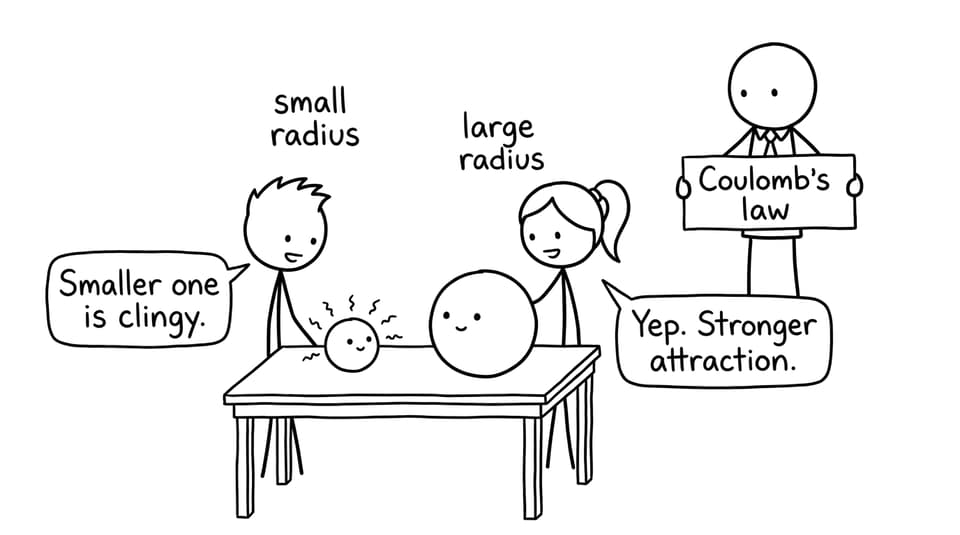
Bigger ions mean a larger distance between ion centres.
-
Larger distance means weaker electrostatic attraction.
-
Weaker attraction means less energy released when the lattice forms.
If you want more practice turning trends into full explanations, pair this topic with data-handling skills from How to Prepare for IB Chemistry Paper 1B: Tips and Tricks.
What is lattice energy in IB Chemistry?
In IB Chemistry, lattice energy (often called lattice enthalpy) is typically defined as the enthalpy change when 1 mol of an ionic solid forms from its gaseous ions. That means it is exothermic, so values are negative.
A more negative lattice energy means:
-
stronger ionic bonding
-
a more stable lattice
-
stronger attractions holding ions together
If you ever get confused because a textbook uses the reverse definition (separating the lattice into gaseous ions, endothermic), read Lattice Enthalpy Explained for IB Chemistry to align your sign conventions.
Why ion size affects lattice energy (the IB Chemistry logic)
There are two clean ideas you can use in IB Chemistry. You don’t need fancy wording. You need causal links.
Ion size increases the distance between charges
Ionic attraction is electrostatic. The closer the opposite charges, the stronger the force.
When ions are larger, the distance between the nuclei of neighbouring ions increases (the ion centres are further apart). That increased separation weakens attraction.
This is Coulomb’s law in words: force decreases as distance increases.
Larger ions have lower charge density
Charge density is a simple phrase that does real work in IB Chemistry explanations:
-
same charge spread over a larger volume
-
weaker electric field around the ion
-
weaker attraction to the opposite ion
So as ion size increases, charge density decreases, electrostatic attraction weakens, and lattice energy becomes less negative.
To connect this to periodic trends (which is where many exam questions sneak in the reasoning), review ionic radius patterns in Periodicity of Properties Notes.
Trend summary you can apply instantly
IB Chemistry questions often ask for comparisons. Here’s how to read them fast.
Down a group: ion size increases, lattice energy decreases
Example style comparison:
- LiF vs CsF
As you go down Group 1, the cation radius increases. Bigger cation means greater distance between charges, so CsF has a less negative lattice energy than LiF.
Isoelectronic comparisons: smaller ion wins
In an isoelectronic series, the ion with the greater nuclear charge tends to be smaller. Smaller ion means stronger attraction, so lattice energy is more negative.
Charge still matters (often more than size)
IB Chemistry loves testing your judgment here:
- MgO vs NaCl
Even if you only half-remember the sizes, the +2 and -2 charges in MgO create a much stronger attraction than +1 and -1 in NaCl. So MgO has a far more negative lattice energy.
To drill these comparisons with markscheme-style feedback, use S2.1 The ionic model Questionbank and 4.1 Ionic bonding and structure Questionbank.
How to write a full-mark explanation (copy the structure)
A high-scoring IB Chemistry explanation usually has three parts: trend, cause, conclusion.
Use this template:
As ion size increases, the distance between oppositely charged ions in the lattice increases, so electrostatic attraction decreases (Coulomb’s law). Therefore less energy is released when the lattice forms, and lattice energy becomes less negative.
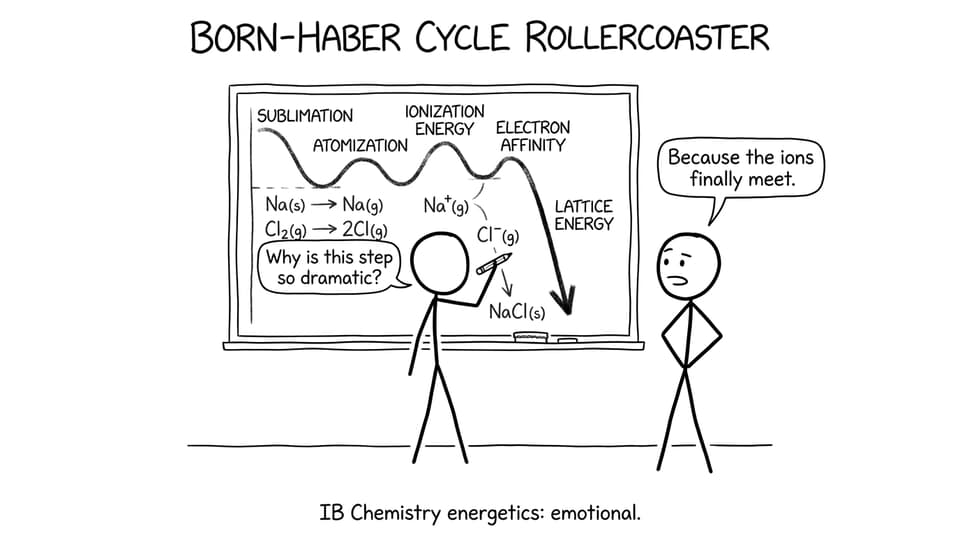
If you’re practicing this inside energetics, it helps to understand where lattice energy sits inside a Born-Haber cycle. RevisionDojo’s HL notes here are clear and exam-aligned: Born-Haber Cycle (Higher Level Only) Notes.
Common exam pitfalls (and how to avoid them)
-
Only stating the trend: IB Chemistry wants mechanism-style logic. Include “distance” and “electrostatic attraction.”
-
Forgetting the sign: If using the formation definition, stronger attraction means more negative lattice energy.
-
Mixing size and charge without weighing them: Mention both, then decide which dominates for the comparison.
For broader exam technique, pair this with How to Avoid Common Mistakes in IB Chemistry Exams.
Closing: turn one trend into easy marks
In IB Chemistry, “as ion size increases, lattice energy decreases” is only the beginning. The marks come from the reasoning: bigger ions create greater separation, lower charge density, weaker electrostatic attraction, and therefore a less negative lattice energy.
If you want this to feel automatic by exam day, RevisionDojo is built for exactly that: lock in the concept with Study Notes and Flashcards, test it with the Questionbank, and use AI Chat and grading tools to polish explanations until they sound like markscheme language. When lattice energy questions show up, you won’t just remember the trend in IB Chemistry, you’ll be able to explain it.