Long before IB exams begin, something quieter happens in the background: knowledge starts to leak.
A student can ace a quiz on Monday and feel completely blank by Friday. Not because they are careless. Not because they are “not an IB person.” But because memory is a living thing, and if you don’t revisit it, it fades.
For IB teachers, the goal is not just “covering content.” It is building a repeatable system where students can keep what they learn, then pull it out under pressure. For IB students reading this, the goal is the same: understand what your teachers are trying to measure, so you can study in a way that sticks.
A quick retention checklist (teacher-led, student-friendly)
Use this as a shared IB routine you can actually sustain during busy weeks:
-
Schedule spaced review touchpoints (not one huge “revision week”).
-
Prefer retrieval practice over rereading.
-
Mix topics on purpose (interleaving) so recall becomes flexible.
-
Use cumulative questioning to keep old units alive.
-
Track retention data over time, not just the last test.
-
Use one platform to connect notes, flashcards, questions, and feedback (so nothing falls between tools).
A practical way many departments do this is by centralising resources through RevisionDojo for Schools, then running small but consistent retention checks that don’t eat the whole lesson.
Why IB students forget (and why that’s normal)
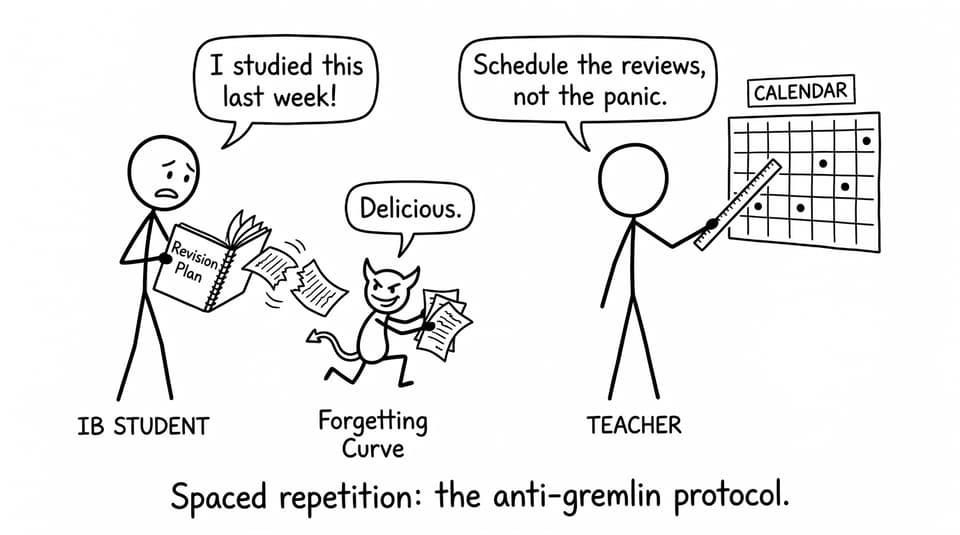
The brain is economical. If you learn something once and never use it again, your mind assumes it is not worth keeping. That “forgetting curve” effect is not a personal flaw. It is the default.
What changes the curve is strategic reactivation.
In IB, reactivation works best when it has three features:
-
Spacing: you return to ideas after time has passed.
-
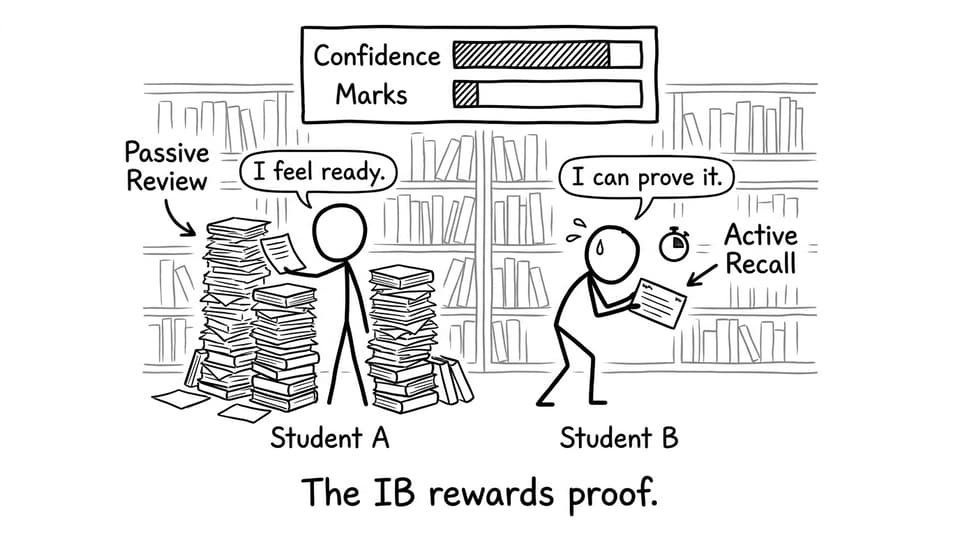
Retrieval: you pull information out from memory, not just recognise it on a page.
-
Feedback: you learn exactly what was missing or misapplied.
That is why a strong retention approach looks less like highlighting and more like a loop: review briefly, test yourself, fix mistakes, repeat.
Build spaced repetition into IB teaching (and student homework)
Spaced repetition sounds like a study trick, but it is really a planning philosophy.
For IB teachers, it can be as simple as:
-
Starting class with 3 “throwback” questions from the previous unit.
-
Ending class with a 90-second “brain dump” (students write what they remember without notes).
-
Running a short cumulative quiz every two weeks.
For IB students, the same logic applies: short daily recall beats a weekend marathon.
If you want the science-backed method in a student-friendly format, point your class to Spaced Repetition for IB: Scientific Study Method. If you want a built-in workflow, RevisionDojo’s IB Flashcards are designed around spaced repetition so reviews come back at the right time.
Use retrieval practice: the most honest kind of studying
There is a difference between “this looks familiar” and “I can produce it on demand.” IB exams only reward the second one.
Retrieval practice can be low-stakes and fast:
-
Closed-book mini quizzes
-
Flashcard rounds (definition and application cards)
-
Short explain-it-out-loud prompts
-
One-question exit tickets
When teachers make retrieval normal, students stop treating it like punishment and start treating it like training.
If you are a student, it helps to understand the tool choices:
-
Flashcards train fast recall.
-
Question sets train application and exam phrasing.
-
Timed practice trains pacing and calm.
RevisionDojo makes that loop easier because the pieces connect: Study Notes for clarity, Questionbank for exam-style practice, Flashcards for retention, plus AI Chat and grading support to explain marks.
Track retention over time (without turning class into a spreadsheet)
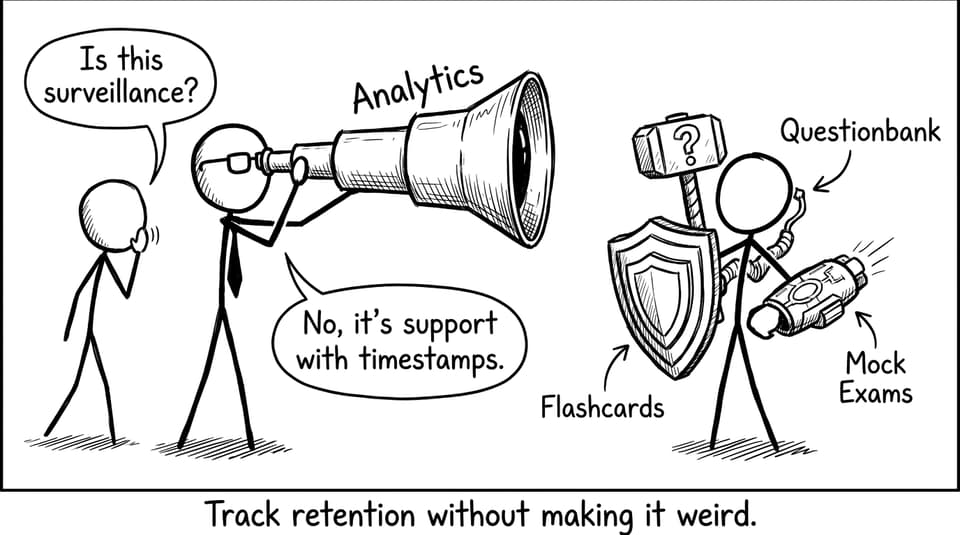
Tracking long-term retention in IB is not about collecting more grades. It is about spotting drift.
A simple teacher approach:
-
Pick 8-12 “core” micro-concepts per unit (the things students must still know in 8 weeks).
-
Re-test 2-3 of them every week in small ways.
-
Record results as trends, not one-off verdicts.
That trend view matters. A student who scores 80% once and then slides to 50% later is giving you a gift: a clear signal of what to re-teach.
This is also where platforms help. With RevisionDojo for Schools, teachers can assign practice, observe patterns, and nudge the next review cycle based on evidence rather than instinct.
Connect topics so IB knowledge becomes durable
Students retain isolated facts poorly, but they remember webs of meaning. In IB, webs win marks because questions often require transfer.
Teachers can build these webs by asking:
-
“What earlier topic does this depend on?”
-
“Where else have we seen this pattern?”
-
“How would this idea show up as a command term question?”
Students can do the same with their notes. If your notes feel like a dictionary, reorganise them into triggers for recall and connection. Two practical guides:
Use realistic practice to protect retention under pressure
A hidden problem in IB is that students can recall information in calm conditions but lose access to it when time pressure hits.
So retention should graduate into realism:
-
Untimed recall first (accuracy)
-
Then mixed-topic sets (flexibility)
-
Then timed sections (pressure)
RevisionDojo supports that progression with the Questionbank, Mock Exams, Predicted Papers, and Grading tools that show where marks were lost and what to do next. If you want a student-facing explanation of why this matters, see Best IB Mock Exam Platform: Why Students Pick RevisionDojo.
FAQ
How can IB teachers fit retention checks into lessons without losing teaching time?
A retention system works best when it is small and frequent, not large and rare. A three-minute starter quiz can reactivate last month’s content without derailing today’s objective. Over a week, those minutes add up to a meaningful amount of spaced retrieval. Students also become calmer because review stops feeling like an emergency. If you track only a few “core” concepts per unit, the workload stays light. Many IB teachers also reduce marking time by using auto-marked question sets and quick analytics, then saving deeper feedback for written tasks.
What is the best way for IB students to know whether they truly remember something?
The most reliable signal is whether you can retrieve it without prompts, then apply it in a new context. If you can only recognise it while rereading, you do not own it yet. A good test is to write a short explanation from memory, then check it against high-quality notes. Another test is to do a small set of exam-style questions and see if you can earn marks consistently. That is why the IB tends to reward practice that feels slightly uncomfortable. Tools like flashcards, targeted question sets, and AI feedback can make this process faster and less confusing.
How can teachers and students use RevisionDojo to improve long-term retention in IB?
The simplest workflow is a three-step loop: learn, recall, apply. Students can clarify content quickly using IB Notes, then lock it in with IB Flashcards built around spaced repetition. After that, they prove understanding with the Questionbank and get feedback that turns mistakes into specific fixes. Over time, this creates retention data: which topics stay strong and which ones decay. For schools, RevisionDojo for Schools makes it easier to assign these loops consistently across classes and track improvement patterns. And when students need extra help, RevisionDojo’s AI Chat, Tutors, Coursework Library, Grading tools, Mock Exams, and Predicted Papers add support without fragmenting the study process.
Closing: make IB retention the default, not the last-minute rescue
The students who look “naturally good” at IB often have something less glamorous: a system that keeps old learning alive. They revisit. They retrieve. They apply. They get feedback. Then they repeat, calmly, while everyone else waits for motivation to arrive.
If you are a teacher, build the system into the week so retention becomes automatic. If you are a student, ask for that system and run it yourself. And if you want one place where IB Study Notes, Flashcards, the Questionbank, AI Chat, Grading tools, Mock Exams, Predicted Papers, the Coursework Library, and Tutors connect into a single routine, start with RevisionDojo and make retention measurable this week.