


When a “good” answer still loses IB marks
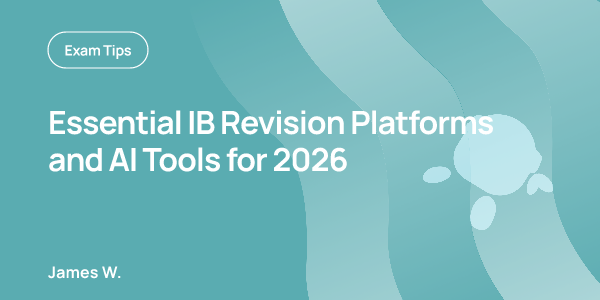
You can feel it the moment you get your script back: the writing is neat, the ideas are real, and yet the score looks like it belongs to someone else. That gap is the quiet drama of the IB. Not because you didn’t study, but because you didn’t write in a way the markscheme can reward.
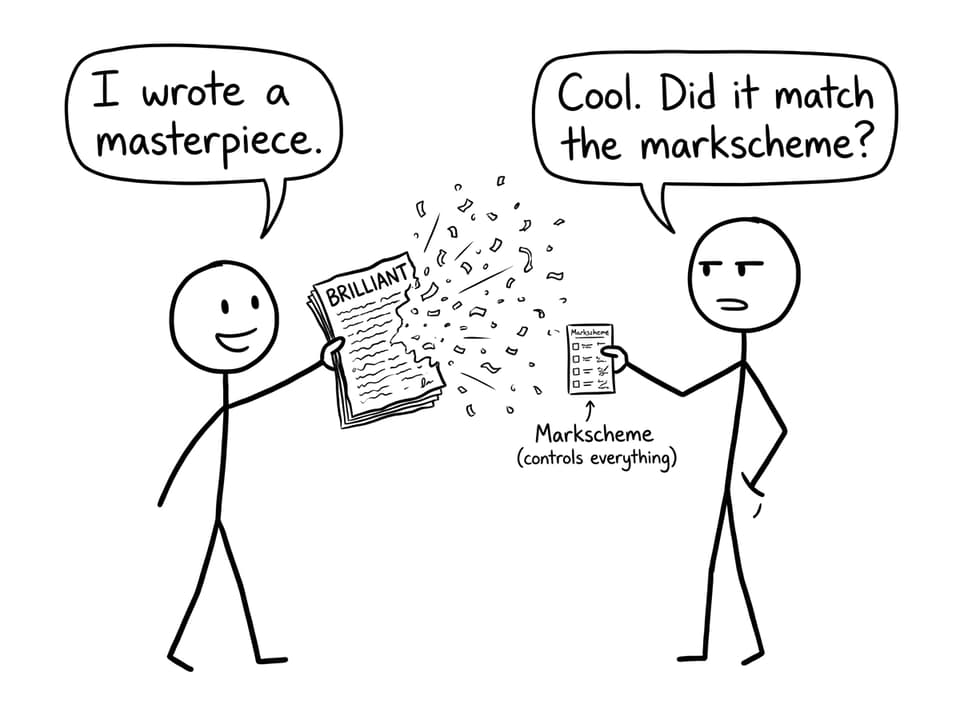
The tricky part is that markschemes don’t just judge what you know. They judge what you make visible: the exact points, steps, and evaluation moves an examiner can credit quickly. This is where great IB teachers change everything. They don’t only teach content; they teach the rules of the game.
A quick checklist IB teachers use to build markscheme fluency
If you want a simple way to study like your teacher is trying to train you to, use this mini routine:
-
Identify the IB command term and rewrite it in your own words.
-
Predict what the markscheme must be awarding (points, steps, justification, evaluation).
-
Write in “mark-ready units” (one point per sentence, clear working, explicit judgement).
-
Self-mark using criteria language (not vibes).
-
Rewrite one paragraph or one method step to make marks easier to award.
You can practise this with RevisionDojo’s Questionbank and tighten the loop by pairing it with the broader RevisionDojo for IB workflow.
Why IB markschemes feel confusing (even to smart students)
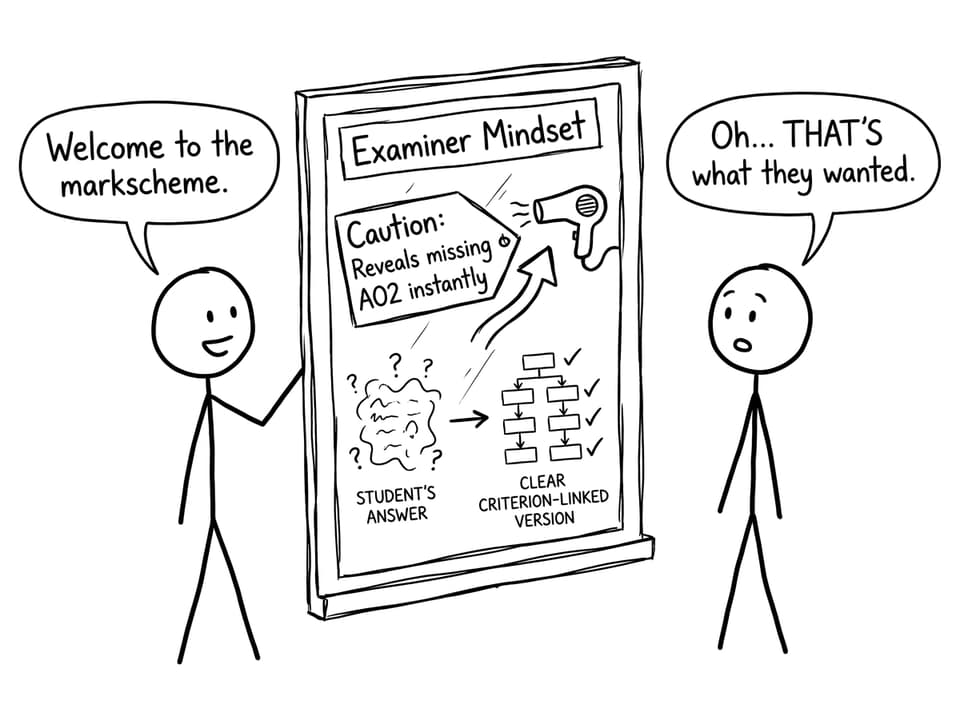
Markschemes look objective, but they often read like a different dialect of English. IB teachers see the pattern because they’ve marked hundreds of scripts; students see a list of fragments and wonder how any of it becomes a grade.
Common friction points include:
-
Abstract phrasing: “substantiated judgement” sounds like a compliment, but it’s actually an instruction.
-
Hidden structure: many marks are tied to how you organize your thinking (steps, links, evaluation), not just facts.
-
Command term drift: “discuss” and “evaluate” can feel identical when you’re rushing.
-
Feedback overload: comments like “more depth” don’t help until they’re mapped to a criterion.
This is why good IB teaching often feels repetitive: your teacher keeps pulling you back to the same few levers because those levers move the markscheme.
How IB teachers translate markschemes into student language
They teach “examiner eyesight,” not just exam content
A strong IB teacher will read your answer the way an examiner reads it: quickly, looking for scorable units. That’s why teachers push you to signpost:
-
“One reason is…”
-
“This leads to…”
-
“However, a limitation is…”
Those phrases aren’t filler. They are handles the markscheme can grab.
If you want to build this instinct alone, use AI Chat support as a second set of eyes: paste a paragraph and ask what an examiner could actually award marks for.
They build command term reflexes
In the IB, command terms are like steering wheels. Turn the wrong way and you might still drive fast, but you’ll end up in the wrong place.
Teachers help by forcing consistency:
-
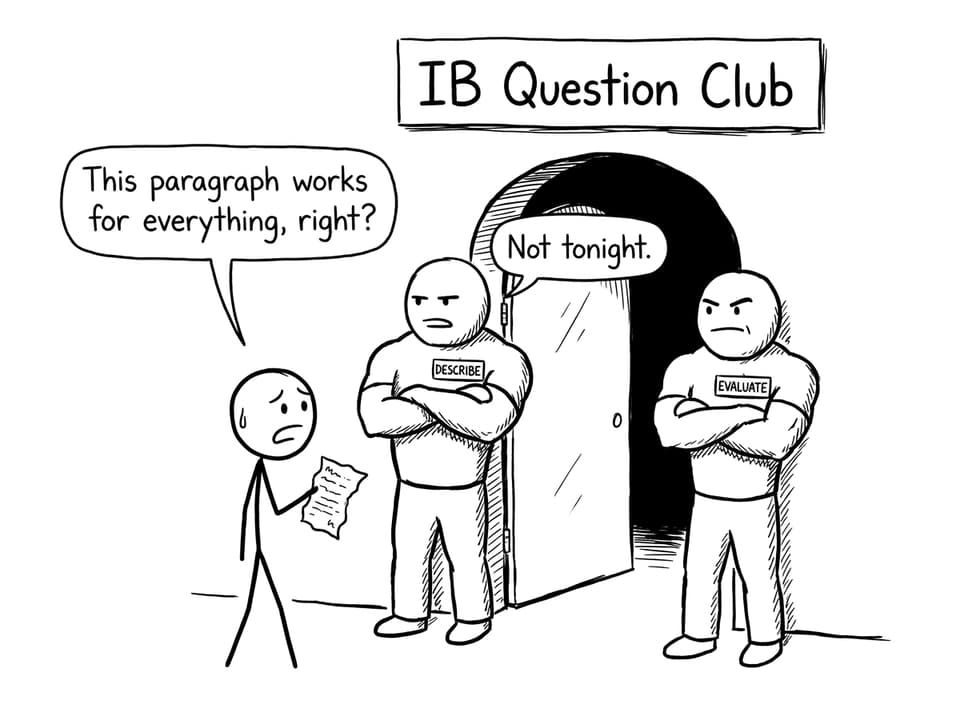
“Describe” = what you see, clearly, no judgement.
-
“Explain” = cause and effect, a chain.
-
“Evaluate” = judgement plus evidence plus limitation/counterpoint.
To practise this systematically, use short, focused sets from the IB Question Bank guide and tag mistakes so you revisit the same command term under new topics.
They make you compare real samples (not idealized answers)
Many IB students think a model answer is a perfect essay. Teachers know it’s more useful to compare bands.
Ask your teacher for this exercise: one low-mark response, one mid, one high. Then write two sentences explaining why the markscheme rewards the high response. That single habit teaches you more than rereading notes for an hour.
How RevisionDojo helps IB teachers make markschemes tangible
Teachers can do all of the above on a whiteboard. The problem is scale: doing it consistently for every topic, every student, every week.
RevisionDojo helps the IB markscheme become something you can practise daily, not something you briefly glimpse after a test.
-
Questionbank practice with markscheme-aligned expectations: Questionbank
-
Study Notes that are written to match how marks are earned, not just how content is explained: Study Notes and IB subject note collections
-
Flashcards to keep command terms and key phrasing automatic (so you can spend thinking time on evaluation)
-
Grading tools that map feedback back to criteria-style expectations
-
Mock Exams and Predicted Papers to practise under timing pressure without guessing what “good” looks like
-
Coursework Library and Tutors for the parts of the IB that are hardest to self-calibrate
If your class uses RevisionDojo through school, the RevisionDojo for Schools hub is where teachers typically start.
A short IB classroom story (and what to copy)
A Geography class kept losing marks on “evaluate” prompts. Students were writing long, smart paragraphs that sounded persuasive, but didn’t clearly weigh evidence or acknowledge limits. The teacher ran a simple two-week routine: every evaluate answer had to include one explicit counterpoint and one limitation sentence.
Then students practised the same pattern at home in RevisionDojo: a small Questionbank set, instant feedback, and a rewrite. The change wasn’t mystical. The writing became easier to mark. And in the IB, “easier to mark” often means “more marks earned.”
FAQ
How can my IB teacher help me understand markschemes faster?
Your IB teacher helps most when they turn markschemes into actions you can repeat. That usually means modelling what an examiner sees first: clear points, clear steps, and clear judgement. Ask them to mark one question out loud, sentence by sentence, explaining what earns credit and what doesn’t. Then ask for one “rewrite target,” like adding a limitation or tightening a chain of reasoning. Finally, repeat the same question type again within a week so the feedback becomes a habit rather than a one-off comment. Over time, you start hearing the examiner voice while you write.
What should I do if IB markscheme language feels vague?
Treat vague markscheme wording as a translation task, not a personal failure. In the IB, phrases like “detailed explanation” or “substantiated judgement” hide a structure underneath. Your job is to uncover that structure by asking: “How many distinct points are needed?” and “What evidence pattern would prove this?” A good move is to rewrite the descriptor into a checklist you can follow in an exam. Then practise with short sets, not marathon sessions, because clarity comes from repetition. Tools like the Questionbank feature help because the feedback loop stays tight: attempt, review, fix, reattempt.
How does RevisionDojo help with IB markschemes without overwhelming me?
RevisionDojo helps by keeping IB markscheme practice small and specific. You can learn a concept in Study Notes, lock key phrasing with Flashcards, then immediately apply it in the Questionbank while feedback is still fresh. That sequence prevents the common trap of “I understood it yesterday but couldn’t use it today.” When you’re ready for pressure, Mock Exams and Predicted Papers let you rehearse timing and structure without guessing what the examiner expects. If written feedback is your main bottleneck, the Grading tools make the criteria language clearer and more actionable. And when you want a human diagnosis, Tutors can quickly identify the one habit that is leaking marks.
Make the IB markscheme your teammate
The markscheme isn’t there to catch you out. In the IB, it’s more like a spotlight: it illuminates what you made obvious, and ignores what you only implied.
So take the teacher’s lesson seriously: don’t just learn more. Learn to show more, clearly, in markscheme language. Build the habit with RevisionDojo’s Questionbank, Study Notes, Flashcards, AI Chat, Grading tools, Predicted Papers, Mock Exams, Coursework Library, and Tutors.
If you want your school to support this consistently, start here: RevisionDojo for Schools.