

The IB revision trap that feels productive (but isn’t)
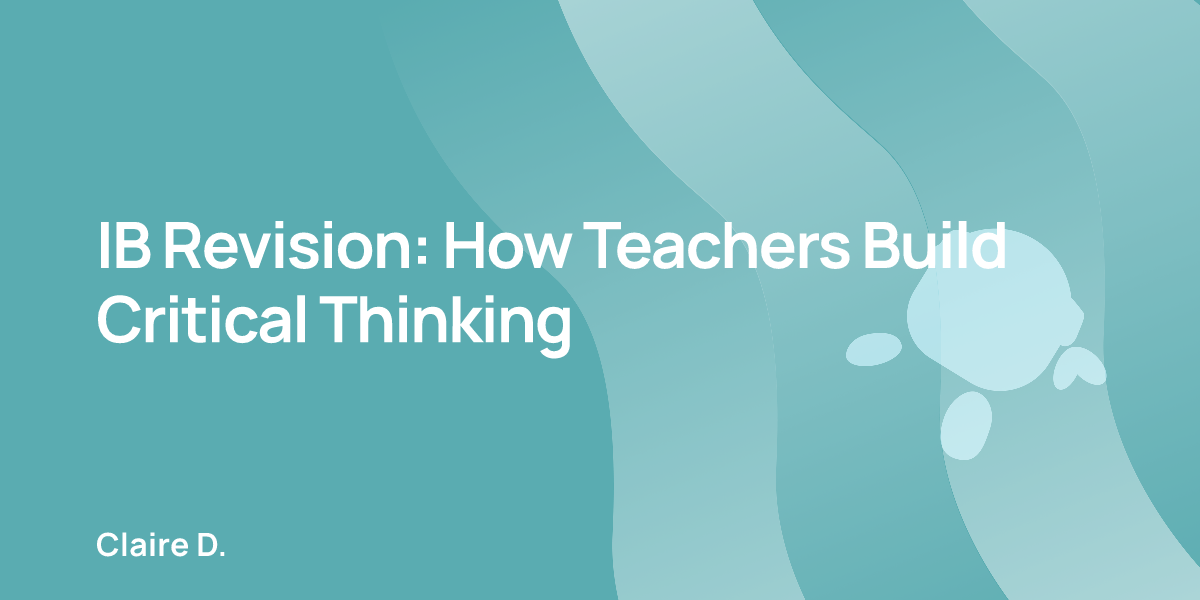
Two weeks before exams, a familiar scene plays out. Notes get rewritten. Highlighters run dry. Someone announces they’re “doing revision” because they spent three hours rereading a chapter.
It feels safe. It feels controlled. And for IB students, it often feels like the only option when the syllabus is huge and time is small.
But the IB doesn’t reward comfort. It rewards thinking. The jump from mid-band to top-band answers is rarely about “knowing one more fact.” It’s about seeing implications, weighing limitations, connecting ideas, and choosing evidence with intention.
That’s why the best IB teachers don’t let revision shrink into rote review. They turn revision into a rehearsal for judgement.
A quick checklist teachers can use tomorrow
If you’re an IB student reading this, treat this as a “what to ask your teacher for” list. If you’re teaching, treat it as a planning filter.
-
Shift revision from recall to inquiry (“what’s the best explanation and why?”)
-
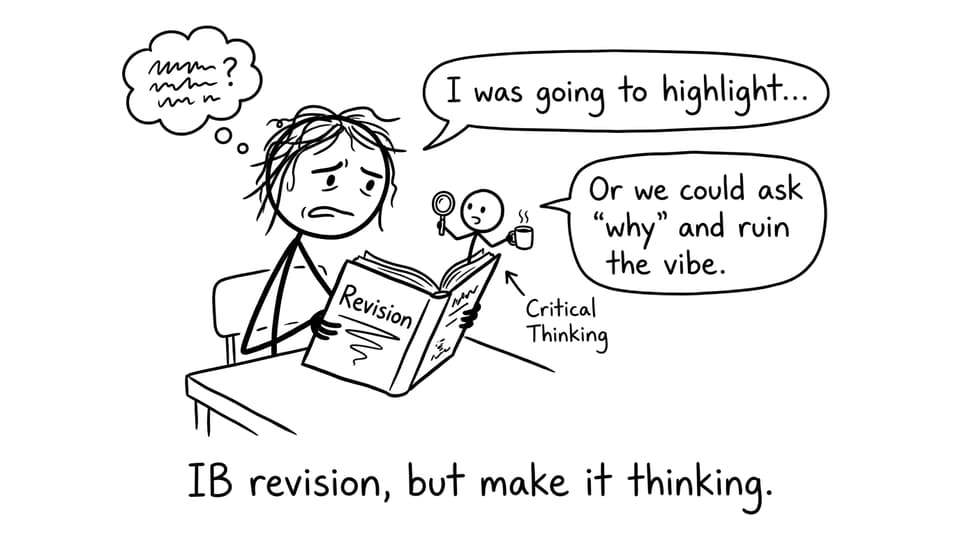
Anchor tasks to IB command terms (analyze, evaluate, discuss, to what extent)
-
Build one habit of reflection into every session (what changed in my thinking?)
-
Use short, structured debate to force evidence-based reasoning
-
Model your thinking out loud so students can copy the process
-
Track skill gaps with a platform that shows patterns (like RevisionDojo for Schools)
Why critical thinking matters in IB revision (even when you’re tired)
Critical thinking sounds like a luxury when exams are close. But in IB assessments, it’s often the most efficient route to marks.
Here’s the quiet truth: memorisation scales poorly. You can spend hours trying to store every detail, and still freeze when a question twists the context.
Critical thinking scales better. It helps you:
-
Transfer knowledge to unfamiliar prompts
-
Select evidence instead of dumping it
-
Evaluate sources, models, and perspectives
-
Synthesize across topics (the IB loves this)
If your revision trains judgement, you don’t just “know more.” You know what to do when you don’t.
Reframe revision questions so they demand thinking
A simple teacher move changes everything: rewrite “What is…” into “Which is best…” or “Why does it matter…”
For IB students, this feels harder at first because there’s no single safe sentence to copy. But it’s closer to the exam.
Examples across subjects:
-
Economics: not “State causes of inflation,” but “Which cause of inflation is most persistent in the long run, and what evidence would you use?”
-
Biology: not “Define osmosis,” but “Why is osmosis essential for homeostasis, and what would fail without it?”
-
History: not “Describe the policy,” but “To what extent did the policy achieve its aims, and what are its limitations as evidence?”
If you want a direct guide to what command words really demand, pair this approach with How to Use IB Command Terms Effectively in Exam Responses.
Make command terms the spine of revision sessions
IB students often lose marks not because they’re wrong, but because they answer a different question than the one asked.
Command terms are the examiner’s steering wheel. “Describe” and “evaluate” are not cousins. They’re different sports.
A high-impact teacher routine is:
-
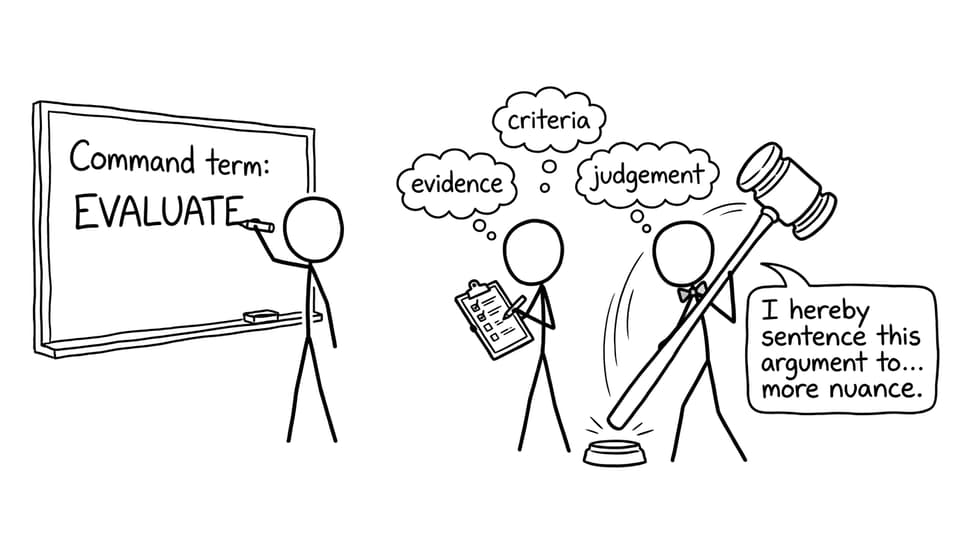
Put one command term on the board
-
Show two sample answers: one that matches, one that misses
-
Ask students to label what the better answer did differently
This works because it turns exam technique into something visible.
For extra support, students can read The Importance of Understanding Command Terms in IB Exams and practise technique-driven drills using the free Questionbank.
Use inquiry-first revision: start with a question, not a summary
Inquiry-based revision sounds like a classroom philosophy. Near exams, it becomes a practical tool.
Instead of “today we revise Topic 3,” a teacher starts with a problem:
-
“How reliable is this data for making policy?”
-
“When does a model stop being useful?”
-
“Which interpretation is strongest, and what would weaken it?”
Then students pull what they need from their knowledge, notes, and discussion.
This is where RevisionDojo can make revision feel less scattered: students can quickly patch gaps using Study Notes and then test the idea with targeted questions rather than rereading everything.
A useful companion read for students is Digital IB Study Notes: Access Anywhere, Anytime.
Turn “knowing” into “connecting” with concept mapping
The IB rewards connections: between units, themes, and ways of thinking. Concept mapping is a teacher-friendly way to make that visible.
But the critical thinking comes from one extra rule: every connection must be labelled with because.
Not just “A links to B.”
Instead:
-
“A links to B because it changes the assumptions.”
-
“A links to B because it explains the mechanism behind the trend.”
Students can build maps after reviewing a short section of notes, then convert the strongest connections into active recall using Flashcards or the full IB Flashcards with Spaced Repetition (SRS).
Debate as revision: make students defend, not repeat
Debate sounds time-consuming. In practice, the best revision debates are short and structured.
Try:
-
90 seconds to prepare
-
2 minutes per side
-
60 seconds of “cross-examination” where students must challenge evidence
The point isn’t performance. It’s forcing students to:
-
choose criteria
-
anticipate counterarguments
-
justify a conclusion
That’s the IB skill underneath “discuss” and “to what extent.”
Teach students to review answers like examiners
Practice only becomes improvement when students learn to diagnose.
A strong teacher move is to give a model response and ask:
-
Where is the reasoning, not just the claim?
-
What evidence is used, and why that evidence?
-
Where is the limitation or counterpoint?
-
Does the conclusion actually match the command term?
Then students rewrite one paragraph to make it more top-band.
To support this at home, students can follow a structured method from Structure IB Answers to Maximize Marks and run targeted drills with instant feedback using Making the Most of IB Question Banks and Practice Papers (RevisionDojo-style practice, not mindless repetition).
Build metacognition into every session (the 3-question exit ticket)
Critical thinking improves fastest when students can explain their own thinking.
A simple end-of-session routine:
-
What did I assume without noticing?
-
What evidence would change my conclusion?
-
What is the smallest next step that would improve my answer?
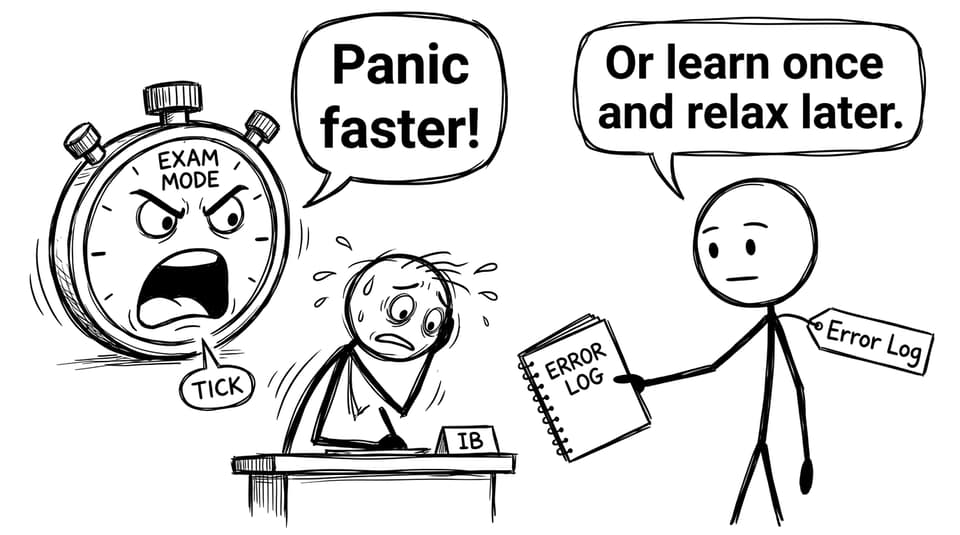
This is where tools matter. Platforms like RevisionDojo support these loops with AI Chat for clarification, Grading tools for feedback patterns, and analytics that show where reasoning breaks down. Teachers can also pair classroom revision with student-facing features like Mock Exams and Predicted Papers to simulate pressure and then reflect on mistakes with purpose.
If you want a student-friendly routine that makes reflection stick, this pairs well with Guiding Students to Independent Study with RevisionDojo Resources.
Bringing it back to the IB student in front of you
The best IB revision doesn’t feel like endless coverage. It feels like practice making decisions under pressure.
If your teacher helps you revise through inquiry, command terms, debate, and reflection, you end up with something better than confidence. You end up with judgement.
And if you want that judgement to compound at home, build a simple loop on RevisionDojo: learn fast with Study Notes, lock key ideas with Flashcards, apply with the Questionbank, then stress-test with Mock Exams and Predicted Papers, using AI Chat and Grading tools to understand mistakes.
That is how IB revision stops being repetition and starts becoming thinking.