
The first time IB really changes your brain, it rarely feels inspirational.
It happens on an ordinary night when you are trying to answer a question you kind of understand. You have the content. You even have the examples. Yet your response still feels… wrong. Not incorrect, just unfinished. Like a chair with three legs.
That discomfort is the quiet signature of IB thinking. IB trains you to notice gaps you used to ignore: the missing assumption, the weak justification, the unsupported leap. For some students, that is empowering. For others, it can become a habit of overthinking.
This article is about both sides. How IB changes the way you think for better or worse, and how to steer that change toward better exam performance.
Quick overview: the thinking shifts IB builds
Use this as a checklist. If you recognize yourself in these, IB is already rewiring your habits:
- You start thinking in command terms (explain vs evaluate vs discuss).
- You treat writing like a sequence: claim, evidence, reasoning.
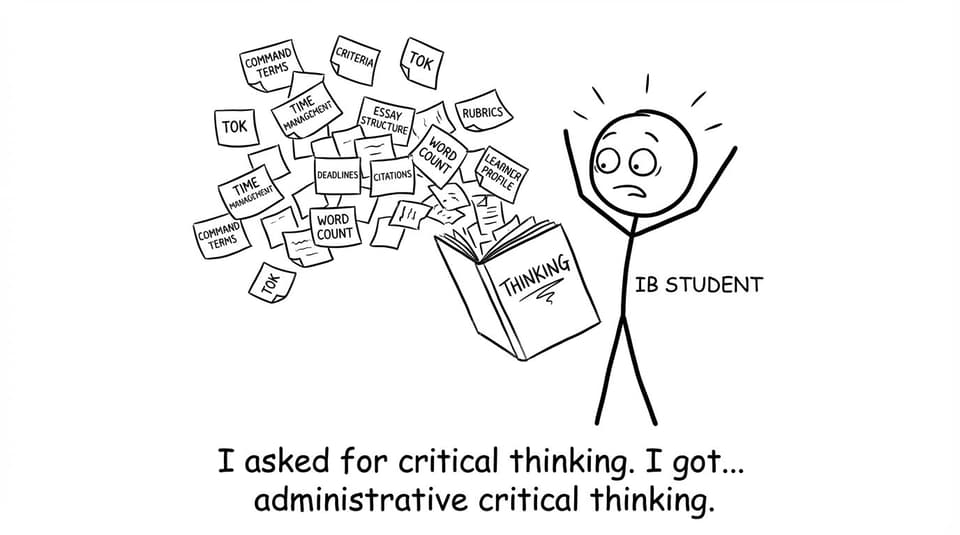
- You become more sensitive to criteria, rubrics, and mark allocation.
- You rely less on "knowing" and more on "showing."
- You notice trade-offs and limitations automatically.
- You sometimes get stuck chasing a perfect answer instead of a good, complete one.
If you want to turn these shifts into points on exam day, it helps to practice them deliberately using the RevisionDojo ecosystem: the Questionbank, Study Notes, and Flashcards make the thinking repeatable under pressure.
How IB trains "structured thinking" (and why it feels unnatural)
Most school systems reward recognition. You see a familiar question. You recall a familiar paragraph. You reproduce it.
IB rewards reconstruction. You see a question. You identify what it demands. You build an answer that fits the command term, the context, and the mark scheme logic.
That is why IB can feel like it is "not about content." It is about using content.
In practice, structured thinking in IB looks like three moves:
You translate the question before you answer it
A good IB student does not start with knowledge. They start with interpretation.
- What is the command term asking me to do?
- What is the scope? One factor or multiple?
- How many marks, and what level of depth does that imply?
This is also why targeted practice works better than rereading. With RevisionDojo's Questionbank, you can drill the same topic through different command terms, so your brain learns the translation step automatically.
You think in "mark-worthy units," not paragraphs
Under IB, your answer is not judged as a vibe. It is judged as evidence of understanding.
So you begin to package your thinking into small, checkable pieces:
- definition
- mechanism
- example
- implication
- limitation
That is why concise notes can beat beautiful notes. If you want a model of fast, exam-aligned clarity, RevisionDojo's Study Notes and the guide on digital IB Study Notes are built around the same idea: small units you can retrieve and apply.
You rehearse "thinking under constraints"
Time limits change the quality of thought. IB exams are not philosophy seminars. They are decision-making exercises under pressure.
To get comfortable there, use tools that simulate constraint: realistic timed sets, review loops, and feedback. RevisionDojo's broader IB hub is a good starting map: All your IB revision needs, in one place.
The "better" side: what IB thinking gives you
There are real cognitive upgrades baked into IB. You can feel them before you can name them.
IB makes you precise
Precision is not fancy vocabulary. It is choosing the exact relationship between ideas.
In sciences, precision looks like explaining the mechanism not just the outcome. In humanities, it looks like building a line of reasoning rather than stacking quotes. In math, it looks like communicating method marks clearly.
Practically, this is where daily spaced retrieval matters. A short Flashcards session makes definitions and processes available on demand, so you can spend exam time on reasoning instead of recall.
IB makes you better at "why," not just "what"
IB forces causality. It trains you to answer: why does this happen, and why does it matter?
This is the hidden advantage of doing exam-style practice with feedback. When you get something wrong, you do not just learn the right answer. You learn the missing link.
If you want that loop as a system, the article RevisionDojo App: The Smarter Way to Prep for IB Exams outlines a repeatable cycle: learn, remember, apply, fix mistakes, simulate.
IB makes you comfortable with uncertainty
The best IB answers often include a controlled form of doubt: limitations, assumptions, alternative explanations.
That habit can feel like hesitation, but in IB it is sophistication. Done well, it shows the examiner you see the full shape of the problem.
The key is balance: uncertainty should strengthen your conclusion, not replace it.
The "worse" side: when IB thinking turns into overthinking
IB can also build habits that feel productive but quietly reduce scores.
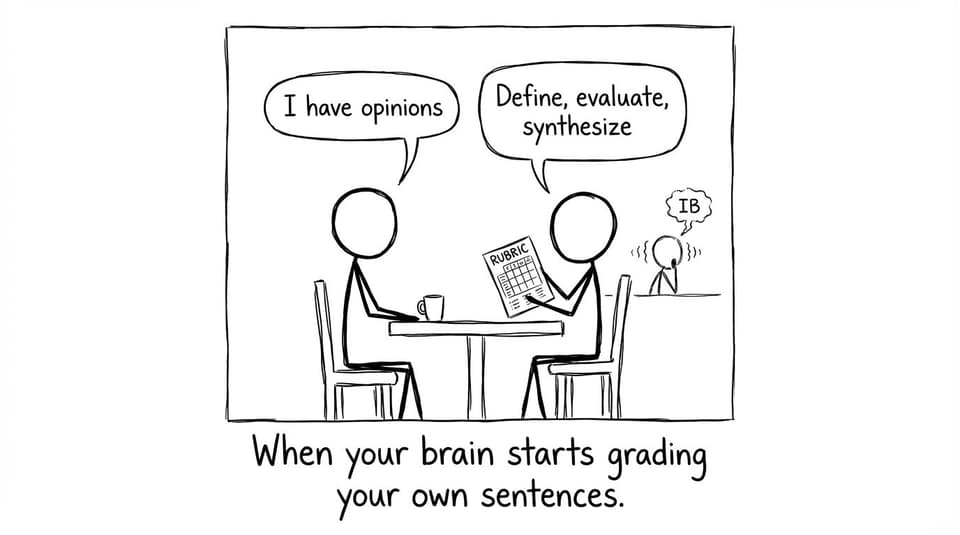
You start grading your thoughts while you are having them
Rubric awareness is powerful. But some students internalize it too early in the process.
Instead of drafting an answer, they run a constant internal audit:
- "Is this evaluative enough?"
- "Do I need a counterclaim?"
- "What if the examiner wants a different angle?"
That mental noise steals time.
A practical fix is to separate phases:
- Phase 1: produce a complete answer fast.
- Phase 2: upgrade it using the criteria.
RevisionDojo supports this because you can do a first attempt in the Questionbank, then immediately compare your logic to feedback, then redo. It turns self-criticism into iteration.
You confuse complexity with depth
IB depth is not adding more. It is connecting what matters.
In exams, complexity without control becomes:
- too many examples, not enough explanation
- too many perspectives, no conclusion
- too much context, no answer to the question
A good rule: if you cannot state your main claim in one clean sentence, you are not ready to expand.
You become risk-averse
Some students fear losing marks so much that they stop making strong claims.
But IB examiners often reward clear stance plus justification. A safe answer that avoids commitment can read like vague knowledge.
To rebuild confidence, simulate pressure in small doses. Use timed mixed sets and review your error patterns. The goal is evidence: you want proof that you can take a position and still stay accurate.
How to use IB thinking to score higher in exams
Here is a short plan you can run for the final weeks. It is designed to harness IB thinking without letting it spiral.
Build your "command term reflex"
Pick one subject per day.
- Do 10-15 minutes of Study Notes on a single subtopic.
- Then do 20-30 minutes in the Questionbank, filtering for different question types.
- For each question, write the command term at the top of your response as a reminder of the task.
Over time, IB questions stop feeling like riddles and start feeling like familiar moves.
Turn mistakes into flashcards, not guilt
When you miss a question, you usually missed one of three things:
- a definition
- a step in a process
- a reason why something is true
Convert that into a flashcard prompt and review it daily. Use Flashcards to keep your weak points alive until they stop being weak.
Use AI the right way: momentum, not shortcuts
If you get stuck, do not disappear into ten tabs.
Use a constrained helper to get unstuck, then return to practice. RevisionDojo's tools are designed for this loop, with Jojo AI embedded across practice and feedback. If you are curious how it is meant to be used safely, the guide Inside Jojo AI: How RevisionDojo's Curriculum-Tuned Tutor Grades is worth reading.
Simulate the exam experience early
Stamina is a thinking skill.
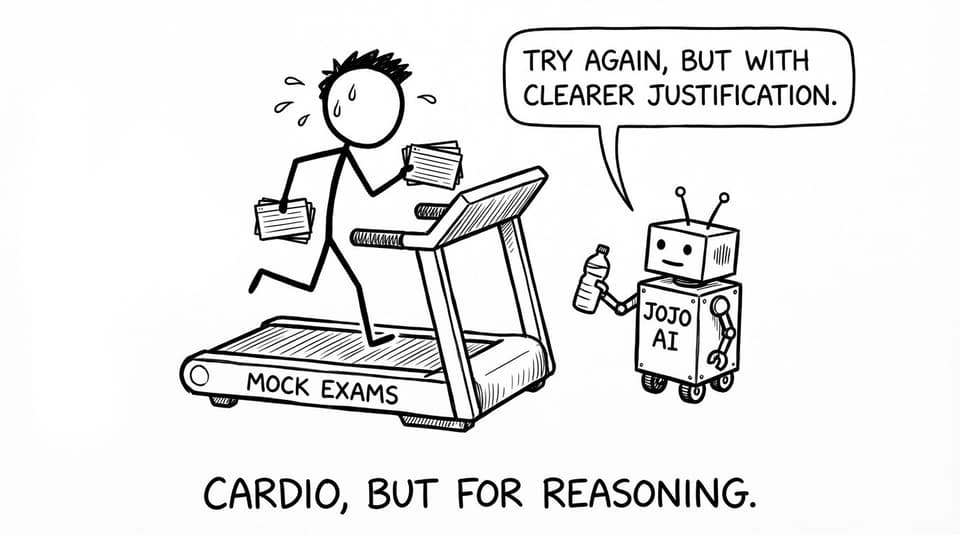
Do one timed session each week using full-length practice sets like Predicted Papers in your subject and then review for patterns. You are not only learning content. You are learning how your brain behaves under time.
A calm reminder: IB is a thinking course, but exams are still exams
It is possible to respect what IB is trying to build while also being strategic.
You are allowed to:
- prefer clarity over cleverness
- choose one strong argument over three weak ones
- write answers that are complete, even if they are not perfect
That is not lowering standards. It is understanding the game you are playing.
If you want to see how RevisionDojo organizes everything around that reality, start with the main IB hub: International Baccalaureate (IB) and the platform overview: RevisionDojo | IB & MYP Resources.
Closing: let IB change your thinking on purpose
IB will change the way you think whether you plan for it or not. It can make you sharper, more articulate, more comfortable with nuance. It can also make you second-guess simple answers and confuse anxiety with depth.
The difference is whether you build a routine that turns IB thinking into points: active recall, exam-style practice, fast feedback, and timed simulations. If you want all of that in one place, make RevisionDojo your daily loop: start with Study Notes, lock it in with Flashcards, prove it with the Questionbank, then finish each week with a timed set.
Do that consistently, and IB stops being a force that happens to you. It becomes a skill you control.