
When people talk about the IB, they usually talk about finals. The two-hour papers. The adrenaline. The quiet panic of realizing you know the concept but not the command term.
But the part that often decides your final grade happens earlier, in slower motion: your Internal Assessment.
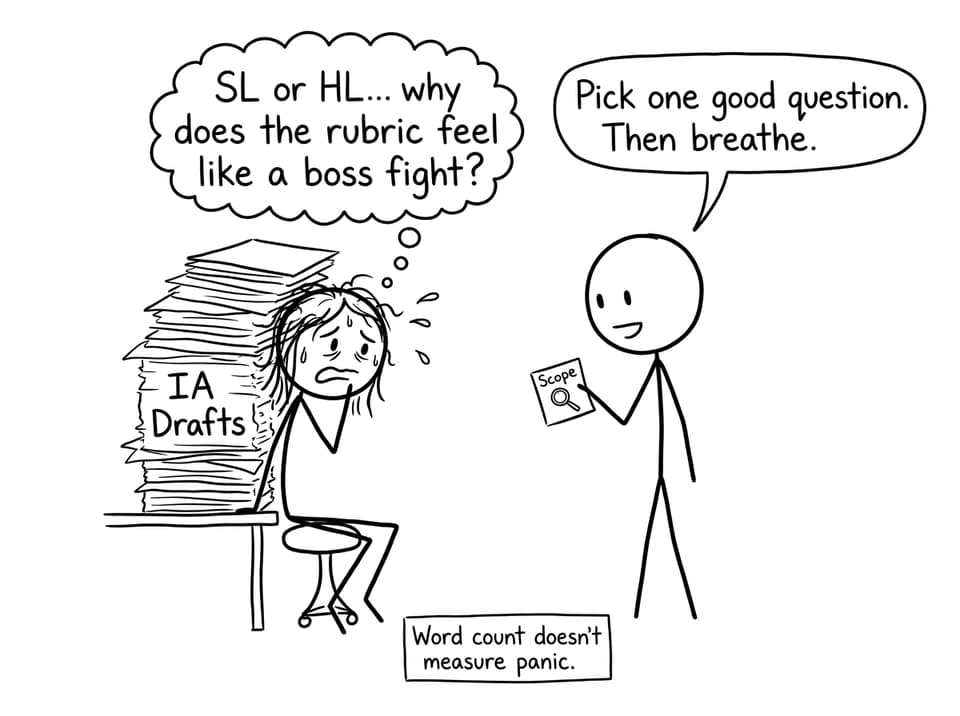
An IB IA doesn’t just test what you know. It tests how you work when no one is watching: how you choose a question, control your scope, build an argument, and revise when the first draft is messy. And that’s exactly why the differences between SL and HL IAs matter. The percentage might look similar. The expectations rarely are.
Quick checklist: SL vs HL IA differences (at a glance)
Before you go deep, use this quick IB checklist to orient yourself:
-
Scope: SL is usually narrower; HL expects broader or more layered exploration.
-
Depth of analysis: HL typically requires more sophisticated evaluation and justification.
-
Complexity: HL often involves more variables, more sources, or more nuanced interpretation.
-
Reflection and evaluation: HL tends to reward sharper critical thinking about limitations and improvements.
-
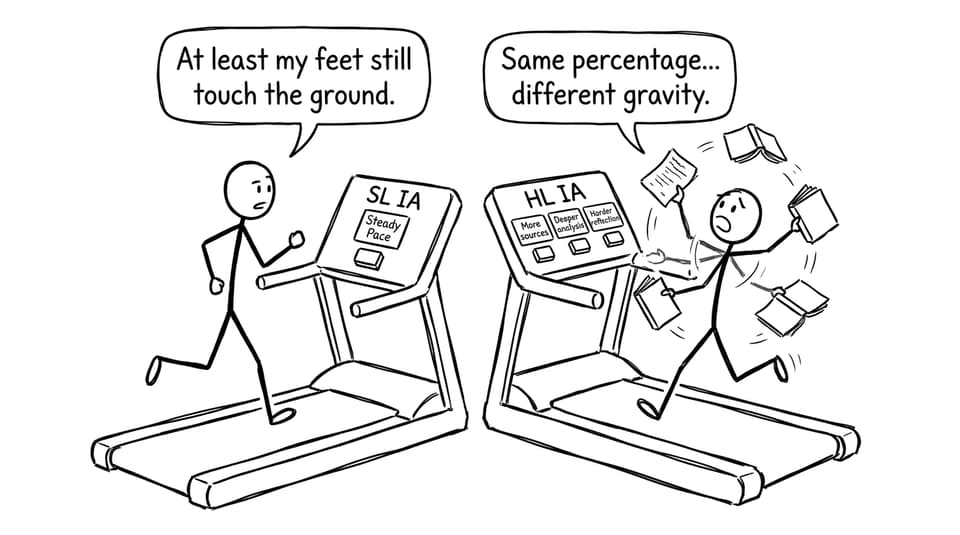
Time cost: HL IAs usually take longer, even if the word count or weighting looks similar.
If you want subject-specific structure and rubric clarity, start with IB IA Guides.
The real difference: scope vs depth (and why the IB cares)
Most students assume SL vs HL is just “shorter vs longer.” In the IB, it’s more accurate to think in two dimensions:
SL IAs: controlled scope, clear execution
An SL IA is often designed to be achievable with tighter boundaries. The best SL work feels clean: a focused research question, a manageable method, and analysis that does not overreach.
In practice, SL tends to reward students who:
-
pick a question they can answer well,
-
show the correct method clearly,
-
interpret results without exaggerating.
HL IAs: similar structure, heavier thinking
HL IAs usually use the same overall framework (question, method, analysis, conclusion), but the IB expects more intellectual weight.
HL tends to reward students who:
-
justify choices with stronger reasoning,
-
evaluate limitations more rigorously,
-
connect findings to wider theory or context,
-
demonstrate sophisticated synthesis.
A useful mindset shift: SL often wins by being precise. HL often wins by being precise and reflective.
Length and complexity: what changes in the work you actually do
Even when official limits look similar, HL complexity often grows quietly:
-
More decision points: extra sources, more nuanced datasets, or additional interpretations.
-
More justification: why this method, why this model, why this sample, why this claim.
-
More evaluation: stronger discussion of reliability, validity, bias, or alternative explanations.
If you’re unsure whether your draft sounds like analysis or summary, run one section through the IB Coursework Grader. It’s built to mirror IB rubric language, so it can flag where your writing is descriptive instead of evaluative.
Examples: how SL and HL IAs differ by subject
These examples won’t replace your subject guide, but they capture the pattern the IB tends to reward.
Mathematics
-
SL: a straightforward exploration of one concept or model, with clear math and coherent interpretation.
-
HL: the same concept, but pushed further: deeper reasoning, more complex modeling, or more careful discussion of assumptions and limitations.
If your math exploration is drifting, use RevisionDojo’s IB Subject Note Collections to re-anchor the theory before you rewrite.
Sciences (Biology/Chemistry/Physics)
-
SL: one main investigation, controlled variables, clean processing, and sensible conclusions.
-
HL: more ambitious design choices and more careful evaluation, often with richer data handling or stronger theoretical framing.
For practice that strengthens your analysis language (especially for uncertainty, trends, and evaluation), build targeted drills in the Questionbank.
English and individuals & societies (History/Geography/Econ)
-
SL: a narrower claim, fewer moving parts, and a clearer line of argument.
-
HL: usually more synthesis: more context, more comparative insight, and more explicit engagement with perspectives or competing explanations.
A high-scoring HL piece often reads like it can anticipate objections, then answer them calmly.
How much do IAs count in the final IB grade?
In most IB subjects, the IA contributes a significant portion of your final grade, often around 20-30% depending on the subject. SL and HL frequently share similar percentage weightings, which is why students get confused: “If it’s the same percentage, why is HL harder?”
Because the IB is not only measuring output. It’s measuring capability at level.
For a full IA overview (including moderation and common formats across subjects), see IB Internal Assessment: A Complete Guide.
A simple strategy that works for both SL and HL IAs
If you remember one thing, make it this: your IA score is rarely saved by an elegant conclusion. It’s saved by a strong question and disciplined scope.
Try this IB workflow:
Start with the research question, then shrink it
Use the method from How to Write a Strong IA Research Question: begin broad, then narrow until the investigation is feasible and genuinely analytical.
Build your “rubric map” before you write
Open the rubric and create a one-page plan: what evidence will prove each criterion? If you can’t answer that, you’re not ready to draft.
Draft quickly, revise slowly
Your first draft should exist to be edited. Then use feedback cycles. Revision is where the IB points live.
If you want an end-to-end system that ties revision together, the RevisionDojo App workflow is built around the same loop: learn, apply, get feedback, repeat.
Closing: make the IB IA work for you, not against you
The IB IA is a strange assignment: you’re asked to be independent, but graded by criteria you didn’t write. SL and HL both reward the same core habits: clear questions, careful method, honest evaluation, but HL asks you to carry those habits further.
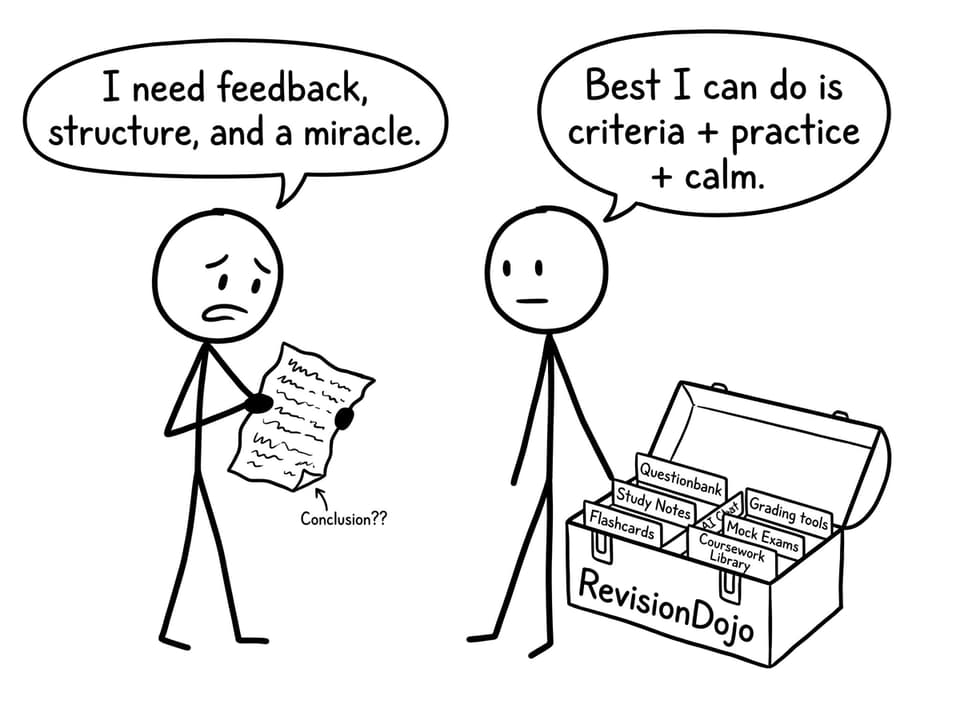
If you want your IA to feel less like guessing and more like building, use RevisionDojo as your backbone: Study Notes to clarify content, Flashcards to lock in key language, AI Chat to unblock confusion, Grading tools to align with criteria, and targeted practice through the Questionbank. Then, when exams arrive, you’re not just hoping your IA went well, you know you earned the marks.