


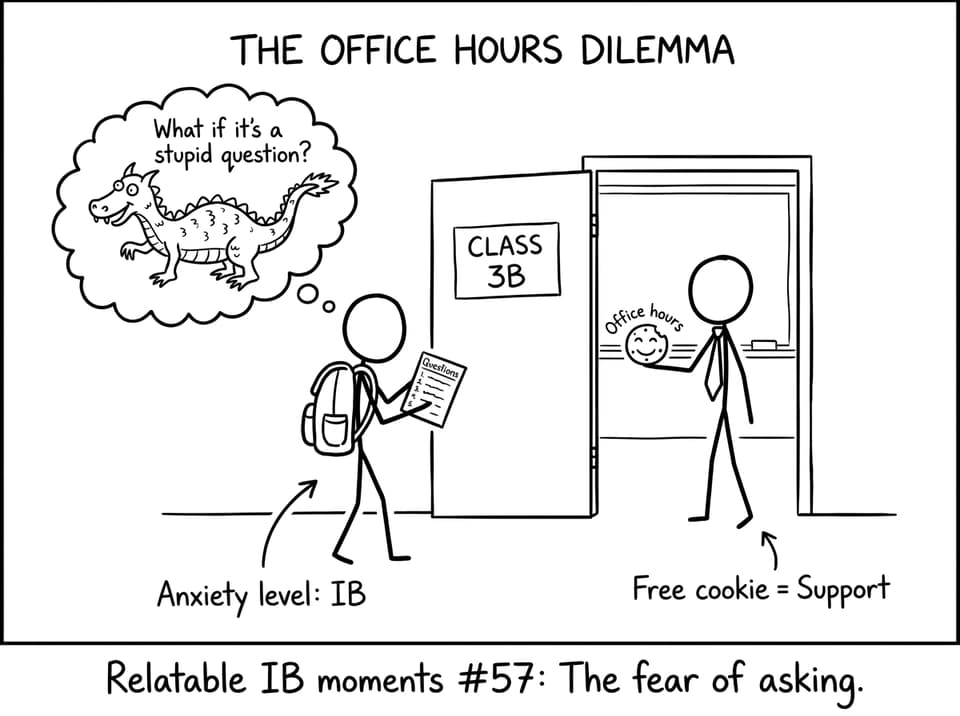
Asking a teacher for help sounds simple. But in the middle of the IB, it can feel like walking onstage without a script.
One student I spoke to described it perfectly: “I don’t mind being confused. I mind being confused in public.” That fear is common. And it’s quietly expensive. In IB exam prep, small misunderstandings compound into bigger gaps, and the student who waits “until it clicks” often discovers it never clicks on its own.
If you’re a parent, your job isn’t to manage the classroom. It’s to help your teen build a skill they can reuse forever: knowing when they’re stuck, and calmly reaching for the next rung.
Quick checklist for IB help-seeking (parent-friendly)
-
Normalize that questions are part of IB-level thinking, not a sign of weakness.
-
Help them choose the lowest-pressure channel (after class, email, office hours).
-
Practise a 20-second “help script” once, then let them own it.
-
Praise the action of asking, not just the grade outcome.
-
Use RevisionDojo to turn confusion into specific questions.
Why IB students avoid asking teachers for help
Most IB students don’t avoid help because they’re lazy. They avoid it because they’re managing identity.
They worry they’ll look unprepared. They worry the teacher will be annoyed. They worry classmates will remember the question longer than anyone remembers the answer. Perfectionism plays a role too: when your teen is used to being “the capable one,” asking for help can feel like admitting the story has changed.
There’s also a practical barrier: many students don’t know what to ask. “I don’t get Biology” isn’t a usable request. Teachers respond best to precision, and precision requires a little preparation.
That’s the parent’s opening: help them turn vague stuckness into a clear next step.
How to encourage your child to ask teachers for help in IB
Normalize questions as exam strategy (not personality)
In IB, asking for help is less about confidence and more about reducing uncertainty before it shows up on an exam.
Try language like:
-
“If you can’t explain it clearly yet, that’s a signal to ask early.”
-
“Strong students ask questions sooner, not later.”
-
“Your teacher is part of your study system.”
Pair this with an IB-specific routine: after any timed practice, they must identify one thing they’d ask their teacher. RevisionDojo makes this easy because practice naturally reveals patterns. A student can drill a topic in the Questionbank and notice the same mistake repeating, then bring that pattern to a teacher.
Start small: one question, one moment
Many teens imagine “asking for help” means a big conversation. It doesn’t.
A good first step is a micro-question after class:
-
“Can you confirm if my approach to this is valid?”
-
“Which command term is this really testing?”
If they need structure, have them read the relevant section in RevisionDojo’s Study Notes first, then write one sentence about what still doesn’t make sense. The point is to arrive with something concrete.
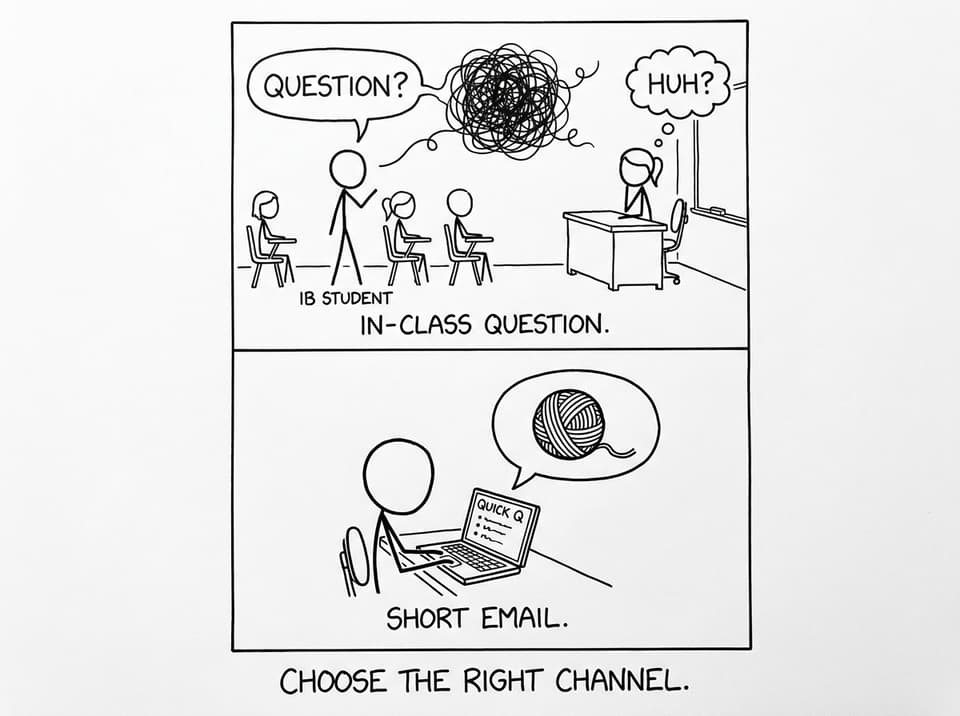
Use email as a bridge (especially for shy students)
Email lowers the social pressure and improves clarity. A helpful IB email is short, specific, and respectful of time.
A simple template:
-
Greeting
-
One sentence of context (topic + what they tried)
-
Two specific questions
-
Ask for a quick pointer (not a full private lesson)
If they freeze when speaking, encourage them to send the email first, then follow up in person later. Over time, email becomes training wheels.
Role-play once, then step back
The goal is independence, so keep role-play brief.
Do one practice run where you act as the teacher. Let your teen test a script like:
-
“I’m stuck on this step. Could you show me what you would do next?”
-
“I understand the concept, but I lose marks in how I write it. What would you fix first?”
Then stop. Let them adjust it to their voice.
If they want extra support beyond school, remind them that help can be layered: teacher first, then a targeted session with a specialist. RevisionDojo’s Tutors can be a good “second opinion” when a student needs calm, 1:1 guidance.
Celebrate initiative, not just outcomes
If your child asks for help and the next quiz still goes poorly, don’t let the narrative become “asking didn’t work.” In IB, progress often shows up as fewer repeated mistakes before it shows up as higher grades.
Praise what you can actually control:
-
They sent the email.
-
They stayed after class.
-
They brought specific questions.
That’s real resilience. It’s also the habit that makes final exam revision feel manageable.
Use RevisionDojo to generate better questions (and reduce friction)
Sometimes the biggest obstacle is not courage, it’s confusion.
RevisionDojo can help your teen convert “I don’t get it” into “I don’t get this part” using:
-
the RevisionDojo for IB hub to organize what to study next,
-
IB Flashcards to reveal which definitions/processes won’t stick,
-
the IB Question Bank guide to practise in the exact style IB expects,
-
IB Predicted Papers and how to study for IB mocks to simulate pressure and discover gaps early,
-
and IB exam panic help when they freeze mid-question.
When students can name the gap, asking a teacher becomes a normal next step, not a personal failure.

What parents should avoid (even with good intentions)
-
Don’t email the teacher for them (except in serious safeguarding or administrative cases). It removes the growth moment.
-
Don’t turn help-seeking into a moral issue (“You’re not trying hard enough”).
-
Don’t compare them to a louder classmate. IB rewards thinking, not volume.
-
Don’t over-focus on grades. Focus on the system: ask, practise, get feedback, repeat.
Closing: make “asking for help” part of the IB plan
In the IB, the students who do best aren’t the ones who never get stuck. They’re the ones who treat stuckness like data.
Help your teen build a simple loop: attempt a problem, notice the gap, ask a precise question, then practise again. That habit makes teachers allies instead of judges. And it makes exam season calmer because confusion gets handled early.
If your child wants a system that supports that loop daily, RevisionDojo brings it together in one place: Questionbank practice, Study Notes, Flashcards, AI Chat, Grading tools, Predicted Papers, Mock Exams, Coursework Library, and Tutors. In IB, momentum is everything. Asking for help is often where it starts.