Comparison is the quiet skill that decides a lot of outcomes in IB History.
Most students feel they are doing it. They mention two leaders, two crises, two movements. They write “similarly” once or twice. Then the marks arrive, and the feedback is strangely consistent: descriptive, separate narratives, limited analysis.
Under the new IB DP History course (first assessment 2028), IB History pushes comparison from a nice add-on to a core way of thinking. The course is built to reward students who can put two contexts into dialogue and explain what that dialogue reveals.
This guide breaks down how comparison actually works, what examiners look for, and how to practise it until it feels natural.
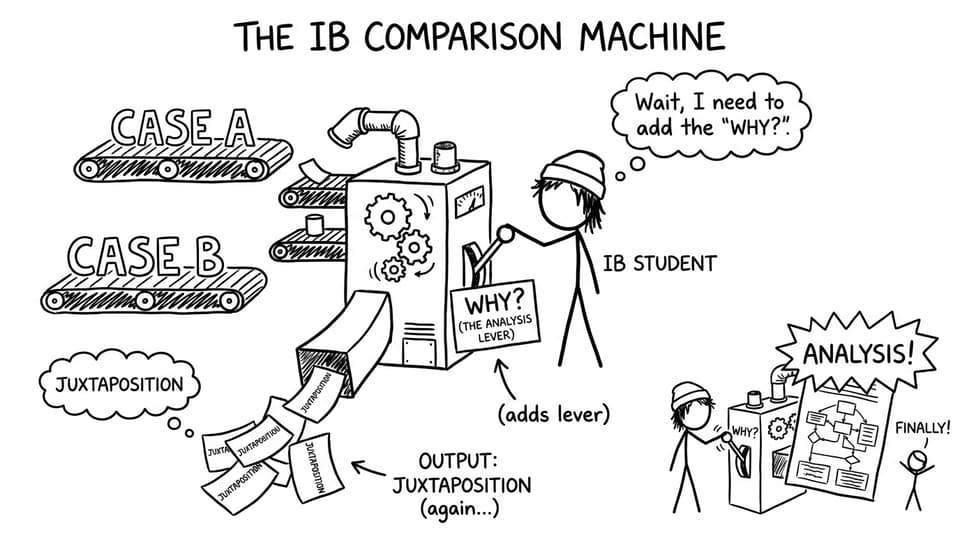
A student builds a comparison machine that keeps printing 'juxtaposition' until they pull the 'WHY?' lever
A quick checklist for strong IB History comparison
Use this as your pre-write scan before any comparative response in IB History:
Am I comparing through a concept (cause, consequence, change, perspectives, significance) rather than topic summaries?
Do my paragraphs integrate both cases, instead of splitting into Case A then Case B?
Do I explain why a similarity or difference exists?
Do I make at least one (which factor mattered more, which outcome was deeper, which explanation is stronger)?
Why comparison matters more in IB History (FA 2028)
A useful mental shift: IB History is not asking you to show that you know two stories. It is asking you to show you can think historically across stories.
Comparison helps you:
Spot patterns that a single case would hide
Avoid one-cause explanations (“it happened because of X”)
Apply the same historical language to different contexts (which proves control)
Make evaluation easier, because you have something to weigh against something else
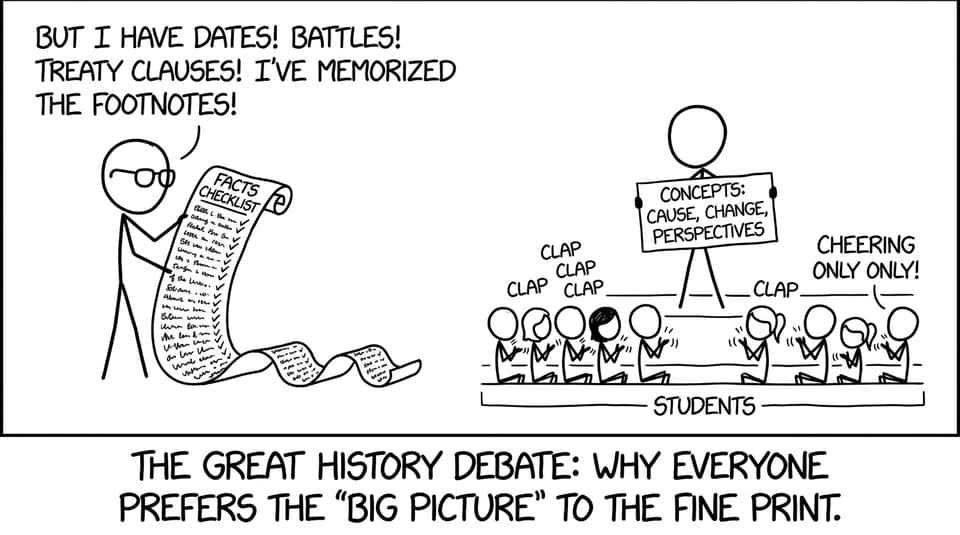
Two historians debate: facts checklist vs a small 'concepts' sign that gets all the applause
Where comparison shows up across IB History exams
Even when the question does not say “compare,” comparison is often the shortest route to a high-mark response in IB History.
Paper 1: comparing sources
You are often asked to compare and contrast two sources, then use multiple sources plus your knowledge to build a synthesis. Tight comparison here means focusing on message, purpose, and context, not just content.
Paper 2 rewards integrated comparison across case studies because it is fundamentally thematic. If you want a practical exam-specific playbook, use How To Ace IB History Paper 1 And Paper 2 Exams.
HL Paper 3: synthesis with judgment
At HL, comparison often becomes synthesis: not just “how are they different,” but “what does that difference suggest about the nature of the period or region?” See IB History Paper 3 notes for the depth expectation.
The paragraph move that lifts your markband
A high-scoring comparative paragraph in IB History usually follows this rhythm:
Point (concept-driven): “Both regimes relied on coercion, but the institutional sources of coercion differed.”
Case A evidence (selective): one or two precise facts
Case B evidence (selective): one or two precise facts
Because (explanation): institutions, ideology, constraints, timing
So what (judgment): which mattered more, what was more sustainable, what had wider consequences
The key is that you do not “finish” one case before starting the other. You keep them in the same paragraph so the comparison stays alive.
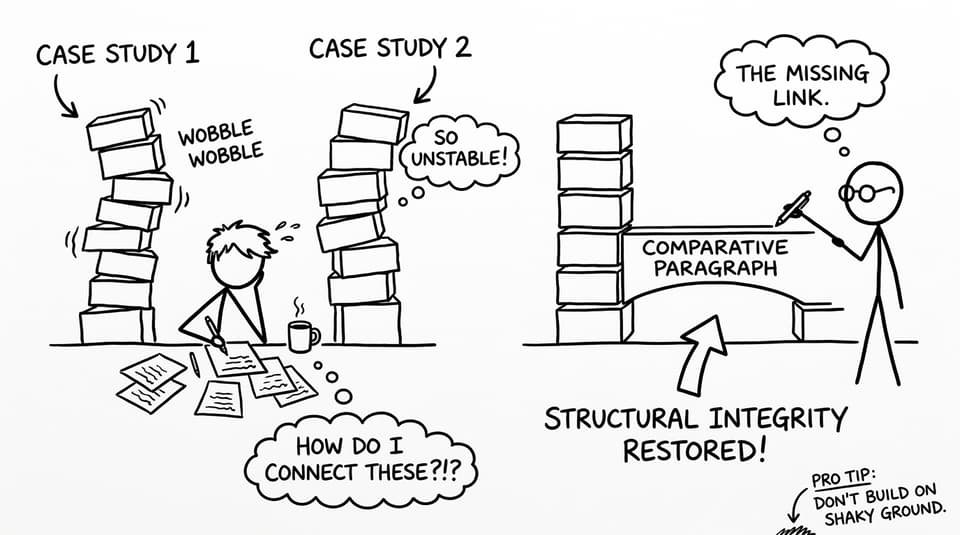
Two case-study towers wobble until a tutor draws a 'comparative paragraph' bridge between them
Common IB History comparison mistakes (and quick fixes)
Separate narratives
Mistake: Case A paragraphs, then Case B paragraphs. Fix: Force a “switchback” structure inside each paragraph: A then B then explanation.
Surface-level points
Mistake: Comparing obvious features (“both used propaganda”). Fix: Compare mechanisms and constraints (“propaganda mattered, but its reach depended on media control and literacy rates”).
No evaluation
Mistake: You explain differences but never judge significance. Fix: Add one sentence of ranking: “However, economic constraints were more decisive than ideology because…”
How to practise comparison without burning out
The fastest way to improve IB History comparison is to practise in small, repeatable loops:
Take one prompt.
Write two comparative points only (not a full essay).
For each point, add one piece of evidence per case.
Add one “because” explanation.
Add one evaluative sentence.
On RevisionDojo, you can make that loop efficient by combining:
The students who score highest in IB History are rarely the ones who know the most facts. They are the ones who can hold two contexts in their mind at once, ask “why,” and make a calm judgment that stays tied to the question.
If you want comparison to feel automatic by exam season, build it into your daily practice: a couple of integrated points, one “because,” one evaluative line. Then scale that into timed work.
RevisionDojo is built for exactly this kind of growth: use the Questionbank for targeted comparative prompts, Study Notes and Flashcards to keep concepts sharp, AI Chat and Grading tools to improve your explanations, and Mock Exams plus Predicted Papers to make exam comparison feel familiar. That is how IB History comparison stops being confusing and starts becoming your advantage.
David holds a PhD in History from the University of Manchester and has taught IB History for 20 years. His focus is the IB History Paper 1 source questions, Paper 2 comparative essays, and Paper 3 depth study, teaching students to argue from evidence rather than narrate.