

Organic chemistry can feel like walking into a library where every book looks the same until you notice the titles.
In IB Chemistry, a homologous series is that title system. It’s the quiet pattern that turns hundreds of molecules into a few understandable families. Once you see the pattern, you stop memorizing random facts and start predicting what exam questions are really asking.
Homologous series in IB Chemistry: the one-sentence definition
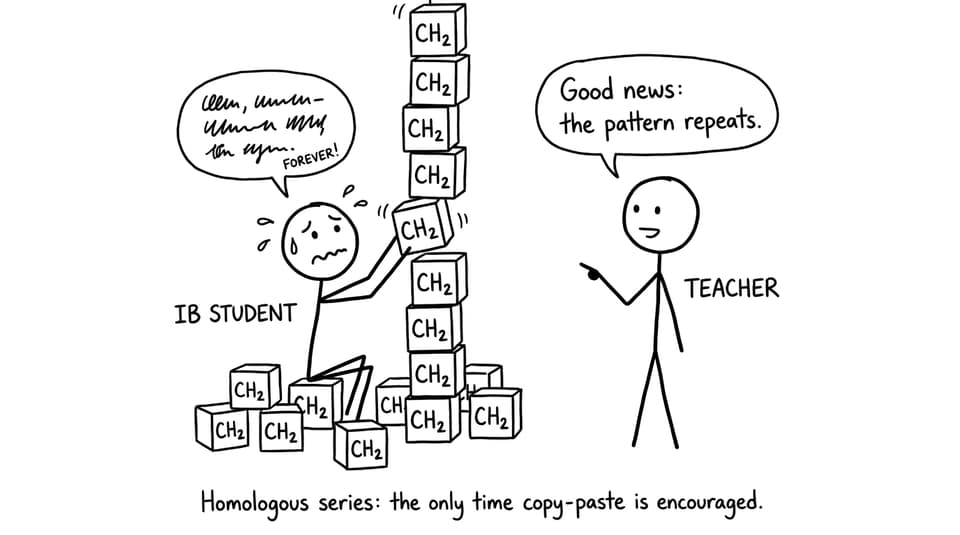
A homologous series is a family of organic compounds with the same functional group and same general formula, where each successive member differs by one –CH₂– unit.
That short definition powers a lot of IB Chemistry organic questions because it implies four things at once:
-
The functional group stays the same (so chemical reactions stay similar).
-
The carbon chain changes step-by-step (so physical properties shift gradually).
-
You can use a general formula to check if a molecule fits the family.
-
You can compare members to predict boiling point, solubility, and even likely reaction pathways.
For a solid foundation, pair this with RevisionDojo’s explanation of Functional Groups Explained for IB Chemistry.
Fast checklist: how to spot a homologous series in an exam
When an IB Chemistry question gives you a set of compounds and asks what belongs together, run this checklist:
-
Do they share the same functional group (–OH, –COOH, C=C, etc.)?
-
Can they be written with the same general formula?
-
Do they differ by –CH₂– steps when lined up by chain length?
-
Would you expect similar reactions across them?
To practise the exact wording and style of classification questions, use the S3.2 Functional groups: Classification questionbank.
Why “difference by CH2” matters (and what it does not change)
The –CH₂– unit is like adding one more link to a chain. You increase the carbon backbone without rewriting the molecule’s identity.
In IB Chemistry, adding one –CH₂– typically:
-
increases molar mass
-
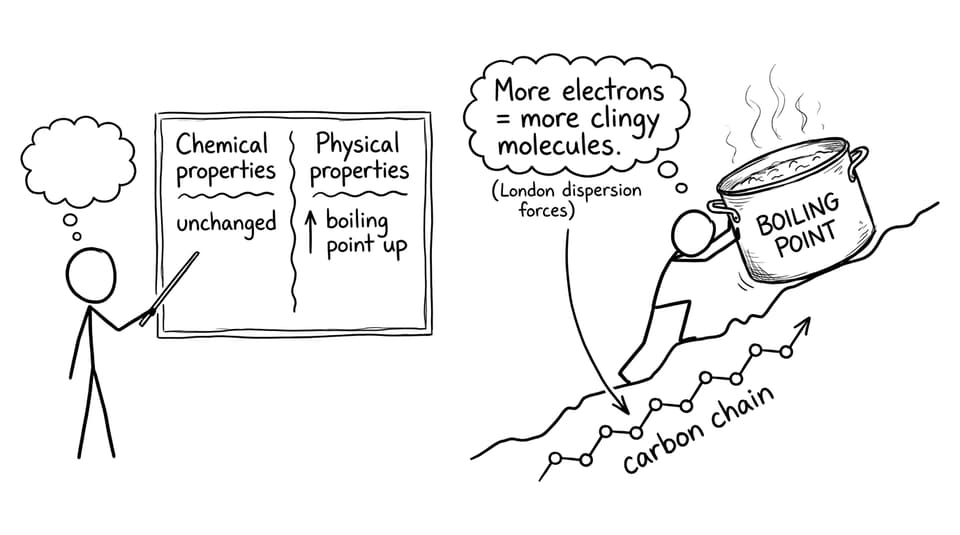
increases London dispersion forces (more electrons, larger surface area)
-
tends to raise boiling point and often melting point
-
often decreases water solubility (especially for mostly nonpolar chains)
What it usually does not change:
-
the functional group
-
the core reaction type (oxidation, addition, esterification, etc.)
If physical trends feel fuzzy, RevisionDojo’s note on S3.2.4 Physical trends in homologous series is a clean, exam-aligned refresher.
Key characteristics (what examiners expect you to say)
Same functional group, similar chemical properties
This is the heart of the definition. In IB Chemistry, “chemical properties” basically means “how it reacts.”
-
Alcohols (–OH) commonly undergo combustion, oxidation, and esterification.
-
Alkenes (C=C) commonly undergo electrophilic addition and polymerisation.
So if two molecules share a functional group, you should immediately expect shared reaction patterns.
To lock in the language, RevisionDojo’s IB Chemistry Key Definitions is useful for precise phrasing.
Same general formula
General formulae act like quick ID checks. Common families you’ll meet in IB Chemistry:
-
Alkanes: CₙH₂ₙ₊₂
-
Alkenes: CₙH₂ₙ
-
Alcohols (simple, monohydric): CₙH₂ₙ₊₁OH
-
Carboxylic acids (simple): CₙH₂ₙ₊₁COOH
Gradual trends in physical properties
Longer chains usually mean stronger intermolecular attractions overall, so properties shift in predictable directions.
A nuance that often earns marks: branching. Branched isomers can have lower boiling points than straight-chain versions because they pack with less surface contact.
Common homologous series you should recognize instantly
In IB Chemistry, these families come up repeatedly:
Alkanes
Low reactivity, nonpolar, burn readily in combustion. Trend questions often focus on boiling points increasing with chain length.
Alkenes
Defined by a C=C double bond, so they’re more reactive than alkanes and show addition chemistry.
Alcohols
The –OH group enables hydrogen bonding, raising boiling points compared with similar-sized alkanes.
Carboxylic acids
Very polar, capable of strong hydrogen bonding, and acidic. They react with alcohols to form esters.
For broader topic navigation (questions, notes, flashcards, and more), start from IB Chemistry Resources.
Homologous series and isomerism: the exam trap
As carbon numbers increase, isomerism becomes more common. Students sometimes assume different structures mean different families. In IB Chemistry, the rule is simpler:
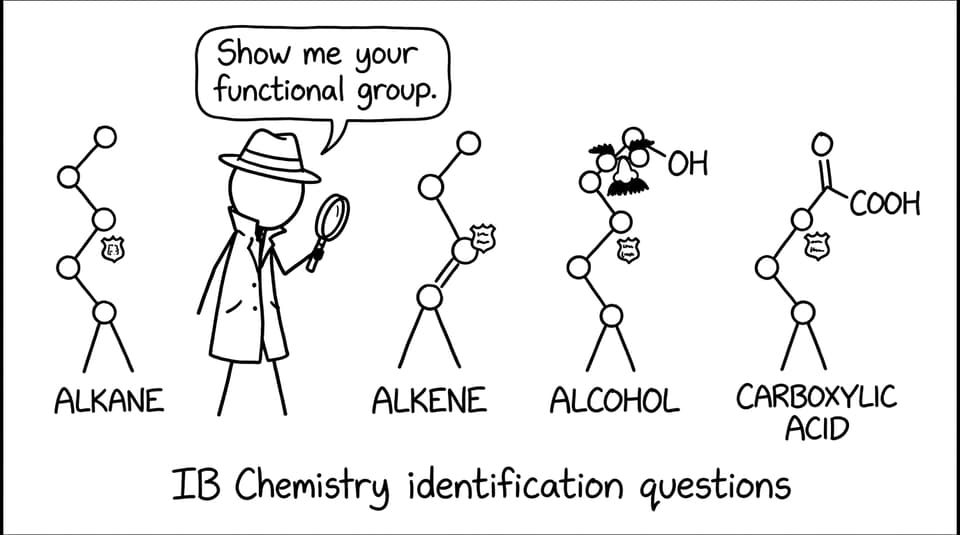
If the functional group is the same, isomers are still in the same homologous series.
Example: C₄H₁₀ has butane and methylpropane. Different shapes, same alkane family.
Closing: make organic chemistry predictable again
A homologous series is one of those IB Chemistry ideas that feels small until it starts saving you time everywhere: identifying compounds, predicting trends, and choosing the right reaction logic under pressure.
If you want to turn the concept into marks, use RevisionDojo as your workflow: read the Study Notes, drill the Questionbank, reinforce with Flashcards, and ask AI Chat to explain any step you missed. Then test yourself with Mock Exams, check your work with Grading tools, and target weak areas with Predicted Papers. When coursework pressure hits, the Coursework Library and Tutors make sure you don’t get stuck alone.
Keep IB Chemistry systematic: family first, functional group second, trends last. The subject gets calmer when the patterns lead.