
Galvanic cells are one of those IB Chemistry ideas that feel oddly poetic: two beakers, a wire, and suddenly a quiet chemical reaction turns into a number on a voltmeter. The first time you see it, it looks like a lab trick. Then exam season hits, and you realize it’s a language: oxidation, reduction, anode, cathode, ions, electrons. If you can read that language, you can answer a huge slice of IB Chemistry electrochemistry questions with calm confidence.
Galvanic cell meaning (in one clean sentence)
A galvanic cell (also called a voltaic cell) converts chemical energy into electrical energy using a spontaneous redox reaction.
This is core IB Chemistry: spontaneity (energy), redox (electron transfer), and electric current (measurable output).
If you want a broader foundation first, review Redox Reactions Explained for IB Chemistry or Oxidation and Reduction Explained for IB Chemistry.
Quick exam checklist for IB Chemistry galvanic cells
Use this checklist when a diagram shows up:
-
Identify the anode and cathode
-
Write the two half-equations
-
State electron flow direction in the wire
-
State ion flow direction in the salt bridge
-
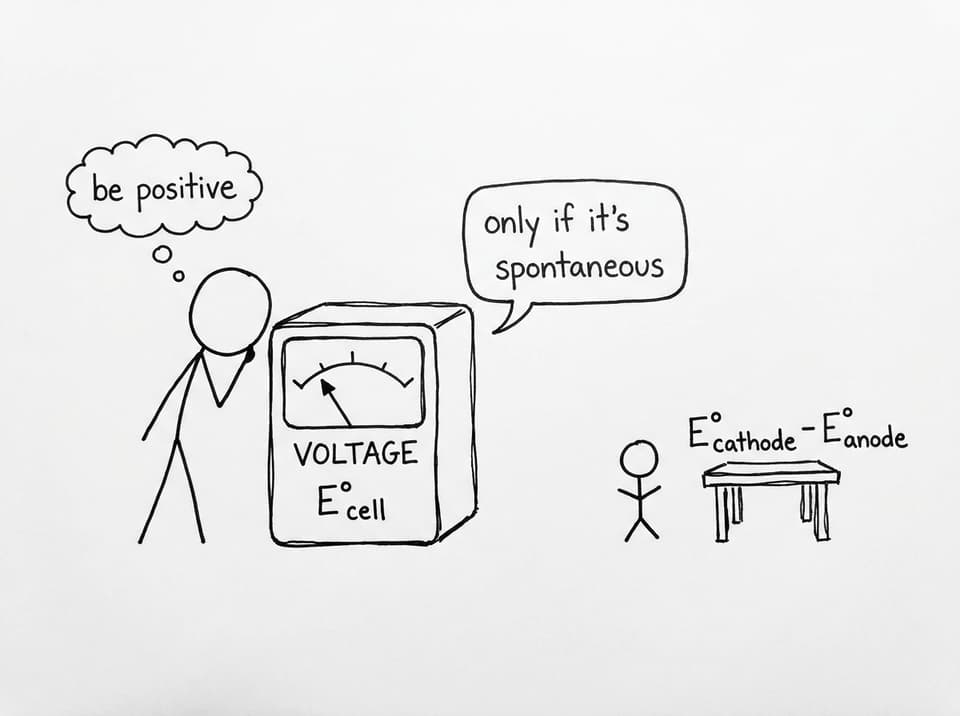
Use E°cell = E°cathode - E°anode
-
Confirm E°cell is positive for a galvanic cell
For targeted practice, use the Electrochemical Cells (HL) Questionbank and the 9.2 Electrochemical Cells Questionbank.
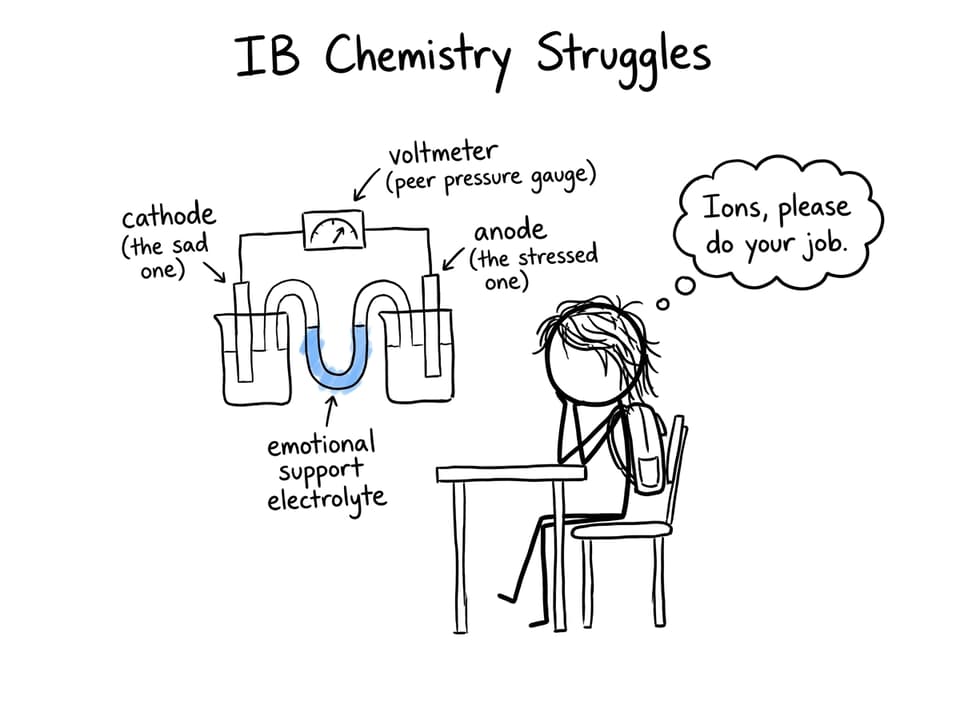
The structure of a galvanic cell (what each part actually does)
A classic IB Chemistry setup has two half-cells:
Two half-cells
Each half-cell contains a metal electrode in a solution of its ions (for example Zn(s) in Zn²⁺(aq), Cu(s) in Cu²⁺(aq)). This separation matters because it forces electrons to travel through a wire instead of jumping directly in solution.
Anode and cathode
-
Anode = oxidation happens here
-
Cathode = reduction happens here
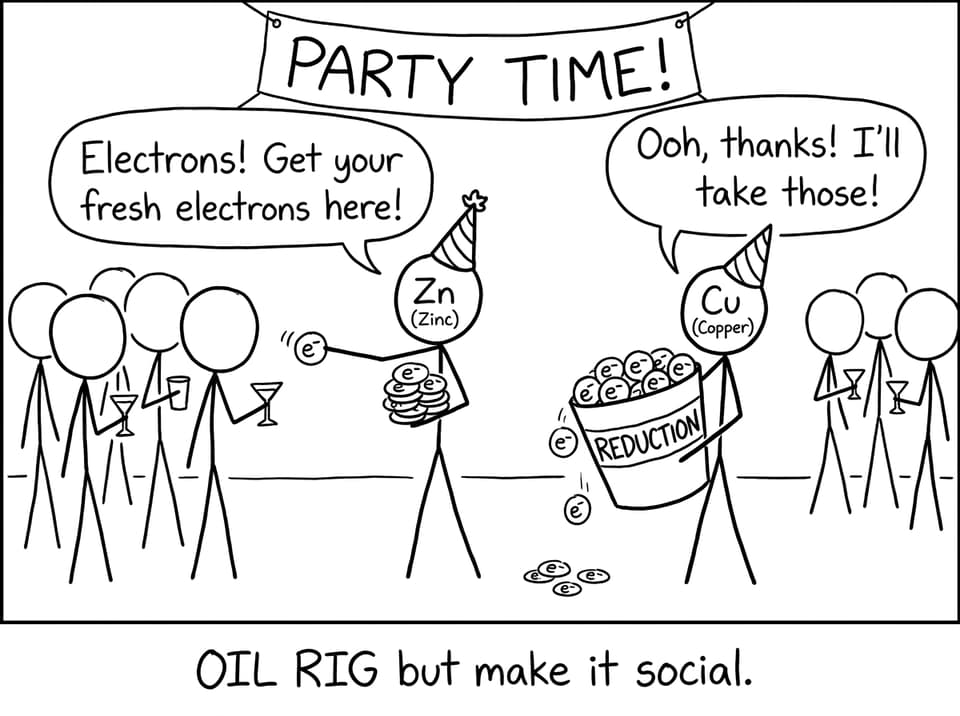
Mnemonic you already know from IB Chemistry: OIL RIG (Oxidation Is Loss, Reduction Is Gain).
If this is still fuzzy, the syllabus-aligned note R3.2.5 Electrochemical cells: Oxidation and reduction Notes is a fast reset.
External circuit (wire)
Electrons move through the wire from anode to cathode. That moving charge is the current your voltmeter detects.
Salt bridge
The salt bridge allows ions to move to prevent charge build-up. Without it, one half-cell becomes too positive and the other too negative, and the reaction effectively chokes itself.
How a galvanic cell works (step-by-step, Daniell cell style)
The Daniell cell (Zn/Cu) is the standard story in IB Chemistry, because every detail is testable.
Oxidation at the anode (zinc)
Zinc atoms become ions and release electrons into the metal.
Electrons travel through the wire
Those electrons can’t enter the Cu²⁺ solution directly (different compartment), so they take the only available path: the wire.
Reduction at the cathode (copper)
Copper ions gain electrons and plate onto the copper electrode.
The salt bridge keeps things neutral
-
Anions move toward the anode compartment (to balance the growing positive charge from Zn²⁺)
-
Cations move toward the cathode compartment (to replace Cu²⁺ being removed)
To reinforce this with syllabus language, see Notes for R3.2.6 Primary (voltaic) cells or the full hub R3.2.6 Primary (voltaic) cells.
Cell potential in IB Chemistry: the one formula that pays rent
In IB Chemistry, voltage questions are usually “quietly mechanical” once you commit to the rule:
E^\\circ\_{\\text{cell}} = E^\\circ\_{\\text{cathode}} - E^\\circ\_{\\text{anode}}
-
If E°cell > 0, the reaction is spontaneous (galvanic)
-
Bigger E°cell usually means a stronger push for electron flow
For a deeper explanation (and common sign mistakes), use Standard Cell Potential Explained.
Common mistakes IB Chemistry students make
-
“Electrons go through the salt bridge.” No: ions go through the salt bridge; electrons go through the wire.
-
“Oxidation happens at the cathode.” Never. Oxidation is always at the anode.
-
“Cathode is always positive.” True for galvanic cells, not for electrolytic cells. Compare with Electrolysis Explained for IB Chemistry (Fast + Clear).
Closing: learn the story, then drill it
A galvanic cell is just a spontaneous redox reaction that’s been forced to “walk around” through a wire so you can measure it. In IB Chemistry, that simple story turns into marks when you can label anode/cathode, track electron flow, explain the salt bridge, and calculate E°cell without hesitation.
If you want to turn understanding into speed, RevisionDojo is built for that final stretch: use the Questionbank for exam-style electrochemistry, Study Notes to tighten definitions, Flashcards for OIL RIG and cell conventions, and AI Chat when a diagram doesn’t click. When you’re ready to simulate the pressure, build a timed set with Mock Exams and use the Grading tools to see exactly where method marks are leaking. That’s how IB Chemistry revision becomes less about panic, and more about pattern recognition.