

Starting DP1 can feel manageable. Your first assignments have clear due dates, larger projects seem distant, and two years sounds generous. Then deadlines begin to overlap.
This free IB planner helps you collect subject assessments, Internal Assessment milestones, Extended Essay tasks, TOK work, CAS commitments, and school events in one deadline table. You do not need to predict everything on day one. You need somewhere reliable to record what comes next.
Many DP deadlines are set internally by schools and teachers. Treat your coordinator's calendar and teacher instructions as authoritative, then use the template to turn those dates into a workable plan.
What the free DP1 planner contains
The downloadable IB template uses one master table. Each row records:
- the official school deadline
- the subject or DP component
- the task or milestone
- its current status
- a personal start date
- a personal target date
- the next concrete action
- teacher or coordinator notes
Print it or complete it digitally. Every important commitment should have a date, an earlier target, and an immediate next step.
[DOWNLOAD BUTTON]
The file will be attached here as a free IB download. Create a free RevisionDojo account to download it and connect your planning with revision resources.
Your DP1 deadline checklist
Gather dates from reliable sources:
- subject calendars and course outlines
- your school's DP calendar and coordinator announcements
- teacher instructions
- Extended Essay meetings
- TOK deadlines
- CAS check-ins and planned experiences
- tests, mock exams, holidays, and school events
Do not record guessed dates as confirmed. If a deadline is unannounced, write TBC and add a date when you will ask about it. Visible uncertainty is easier to manage.
How to fill in your IB planner
Begin with fixed school deadlines
Enter major assessments and DP components first, then smaller tasks requiring several preparation sessions. Use your school's dates, not another school's online calendar.
Schools commonly set earlier internal submission dates to allow time for permitted guidance and administrative processes. If instructions conflict, ask your teacher or coordinator before planning around either date.
Label the task clearly
Avoid “essay” or “science work.” Write English A oral outline, Biology investigation proposal, or Extended Essay research question.
Specific labels reduce the effort needed to understand a row weeks later. They also help you choose relevant RevisionDojo learning resources without reconstructing what the assignment involved.
Set a personal target and start date
Put your personal target before the official deadline. This buffer protects against illness, technical problems, and work that takes longer than expected.
A small task might need 1-2 days; a substantial draft might need 5-7 days. Adjust for complexity and your teacher's feedback arrangements.
Then work backward. Suppose a history essay needs five sessions: interpreting the question, finding evidence, outlining, drafting, and editing. With a personal target of 18 October, a realistic start might be 7 October rather than 17 October. Check that those sessions actually fit around your other commitments.
Write the next visible action
“Do EE” describes a responsibility, not an action. “Find three academic sources for the research question” tells you where to begin.
Other useful actions include emailing a supervisor with two topic ideas, entering trial results into a spreadsheet, or revising an introduction using teacher comments.
When practice is next, RevisionDojo's Questionbank and grading tools can support focused work. Study Notes, Flashcards, and AI Chat can help with the review before you attempt questions.
Update the status weekly
Use four labels: Not started, In progress, Waiting for feedback, and Complete. Review each row weekly.
Change dates when teachers revise them, split tasks that have grown, and identify the next action for unfinished work. A useful planner reflects reality rather than remaining perfectly tidy.
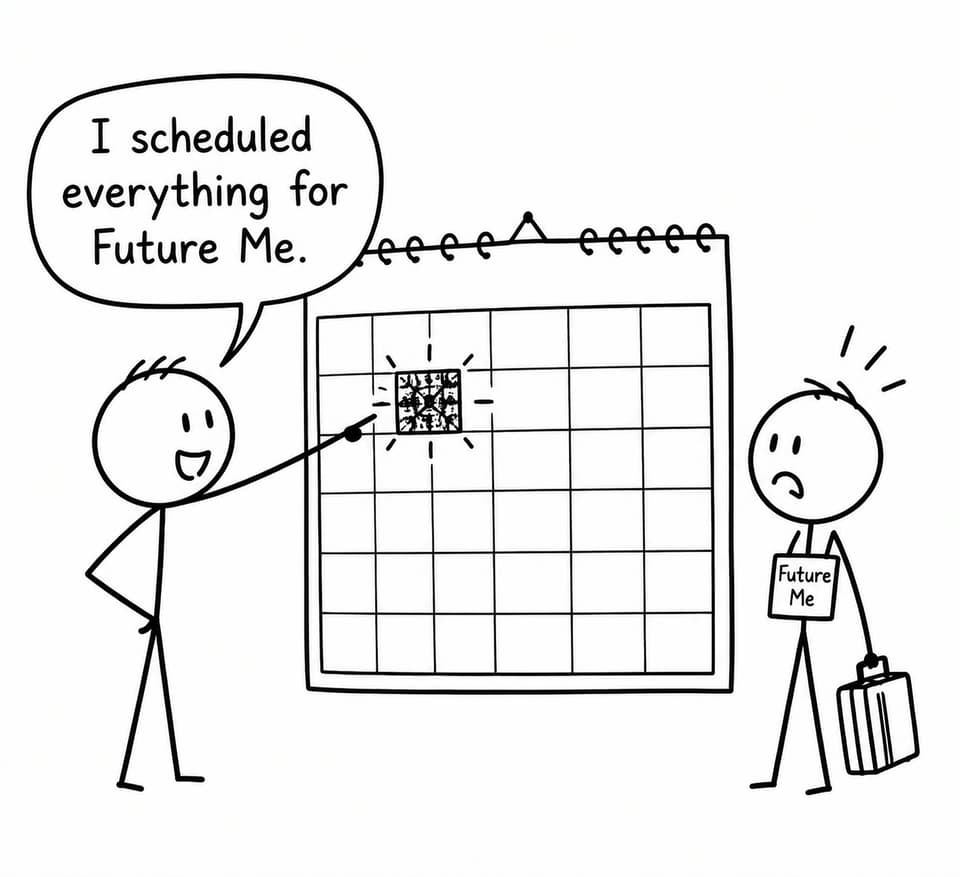
One student has assigned every task to a visibly concerned future self.
A completed DP1 planner example
These dates are illustrative, not universal IB deadlines. Replace them with dates confirmed by your school.
| School deadline | Subject or component | Task or milestone | Start date | Personal target | Next action | Status |
|---|---|---|---|---|---|---|
| 18 September | Biology | Topic test | 8 September | 16 September | Complete 15 cell biology questions | In progress |
| 3 October | English A | Comparative response | 22 September | 1 October | Select evidence from both texts | Not started |
| 24 October | Mathematics AA | Functions assessment | 10 October | 22 October | Review transformations and log errors | Not started |
| 14 November | Extended Essay | Submit two topic proposals | 27 October | 10 November | Check subject suitability with teacher | Not started |
| 5 December | TOK | Exhibition planning checkpoint | 17 November | 2 December | Draft links between object and prompt | Not started |
| 12 December | CAS | Adviser check-in | 1 December | 9 December | Update evidence and reflections | Not started |
The Biology test has a start date, an earlier target, and a precise practice task. The Extended Essay entry remains at the proposal stage, so its next action is appropriately small. Planning should match the stage you have reached, not make every project feel immediately due.
Keep the planner useful throughout DP1
Connect weekly reviews to study sessions
Review the table at a consistent time, such as Sunday evening. Check the next 2-3 weeks for collisions. If mathematics and English deadlines share a week, move their preparation sessions apart.
The deadline table tells you what matters; your weekly calendar tells you when it happens. Schedule a specific session, such as “Tuesday, 4:30-5:15, functions practice.”
Use Study Notes, Flashcards, and AI Chat for focused review. Later, Predicted Papers and Mock Exams can support timed rehearsal, while the Coursework Library and Tutors can offer guidance with longer assignments.
Check capacity, not just empty spaces
An empty evening is not automatically an available study session. Travel, meals, activities, family responsibilities, and rest all occupy time, even when they do not appear beside an assessment deadline. Add those commitments before deciding how much work a week can hold.
For example, suppose you have three realistic study sessions before a draft is due, but your task list requires six. The solution is not to squeeze six labels into three boxes. Start earlier, break the assignment into smaller deliverables, or ask your teacher which requirement needs clarification. Keep the school deadline unchanged unless your teacher explicitly confirms an adjustment.
After completing a task, compare your estimate with the time it actually took. If selecting evidence needed two sessions rather than one, use that information when planning the next essay. Over time, the planner becomes more accurate because it reflects your working pace, not an ideal version of your week.
Protect gradually developing work
CAS, TOK, and the Extended Essay should not disappear behind tomorrow's homework. Record school checkpoints, then create earlier personal milestones.
For Internal Assessments, separate proposals, research, data collection, drafts, feedback windows, and final submissions where applicable. One distant deadline cannot show the work required along the way.
Make decisions before the week becomes crowded
When commitments overlap, ask what must begin sooner, which session can be shortened, and where clarification is needed. Use RevisionDojo's IB study platform to focus available study time rather than simply extending it.
Build a calmer first year
An IB planner makes uncertain commitments visible. Enter confirmed dates, set earlier targets, name the next action, and review weekly. You do not need a perfect two-year plan to make a useful start.
Create a free RevisionDojo account and download the DP1 planner to organize your first year alongside resources that support the work behind each deadline.