




There is a particular kind of frustration that comes from studying for three hours and having nothing measurable to show for it. Your notes look cleaner. Your folders look organized. Yet the next exam-style question still feels unfamiliar.
If you are asking, “does RevisionDojo work?”, the honest answer is yes, it can improve your IB performance when you use it for active practice, feedback, and timed preparation. RevisionDojo reports meaningful gains in subject scores, exam technique, markscheme understanding, and confidence among its users. Individual students have also reported moving from grades of 4 or 5 to 6 or 7.
But the important word is can. No platform automatically produces a higher grade. The strongest results come when RevisionDojo replaces passive revision with a repeatable cycle: understand, retrieve, apply, review, and try again.
That distinction matters because a subscription is not a study method. RevisionDojo works when you turn its tools into one.
The short answer: does RevisionDojo work?
RevisionDojo appears to work best for students who need structure, realistic IB practice, and fast feedback. Its main advantage is not any single feature. It is the connection between IB Study Notes, questions, and revision tools, allowing students to move from learning a concept to applying it without constructing a fragmented system across several platforms.
A productive workflow looks like this:
- Learn one narrow concept with Study Notes.
- Retrieve definitions, formulas, or examples using Flashcards.
- Apply the concept through the Questionbank.
- Review why marks were lost, not merely which answers were wrong.
- Use AI Chat or Grading tools for targeted feedback.
- Build timing through Predicted Papers and Mock Exams.
- Use the Coursework Library and Tutors when a problem needs deeper support.
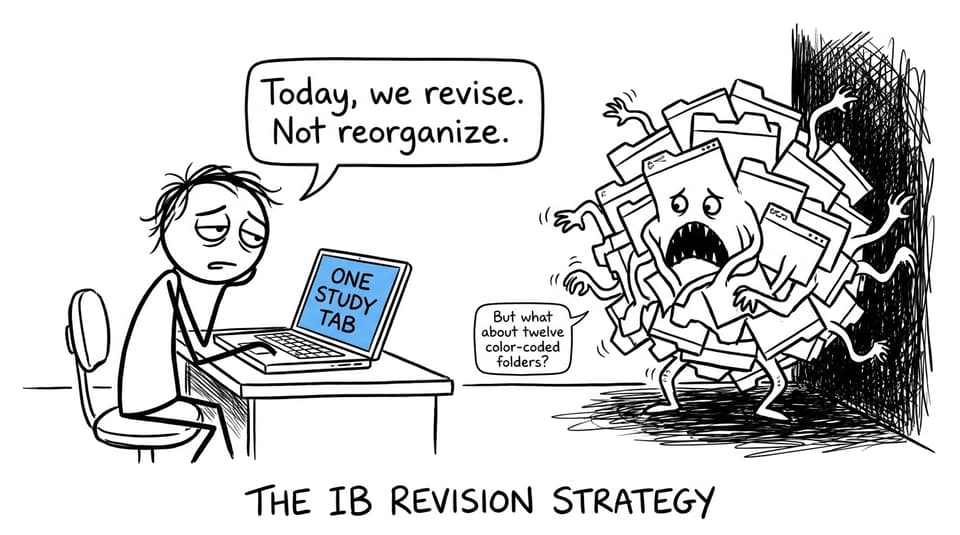
The platform is therefore most useful when your question changes from “How long did I study?” to “What can I now do that I could not do yesterday?”
What the RevisionDojo results actually show
Claims about academic improvement should be read carefully. There are three different kinds of evidence available: platform survey data, reported score changes, and individual testimonials. Each tells us something useful, but none should be confused with an independent randomized trial.
Survey findings from RevisionDojo users
RevisionDojo’s Annual State of Learning Survey reports responses from 2,000 students in 2025. Among the reported findings:
| Reported outcome | Result published by RevisionDojo |
|---|---|
| Understanding complex concepts | 42% improvement among more than 80% of users |
| Markscheme understanding | 48% improvement among more than 75% of users |
| Exam technique | 45% improvement among more than 73% of users |
| Exam-related stress | Approximately 39% reduction among more than 92% of users |
These figures are relevant because exam technique and markscheme awareness often determine whether knowledge becomes marks. The IB’s assessment process uses subject-specific criteria and markschemes, while final grades are determined after marks are combined, weighted, and converted using grade boundaries.
Still, the survey findings are self-reported. They show how users perceived their improvement, not a controlled comparison proving that RevisionDojo alone caused each change. Motivation, teaching, prior attainment, study time, and access to other support may also contribute.
Reported IB score changes
RevisionDojo’s plans and results page reports that users gained more than half a subject-grade point across every IB subject group, with the average improvement described as close to one grade. The largest gains were reported among students starting from lower scores, particularly in the sciences.
The same page publishes measurable student testimonials, including:
- A Biology student who reported moving from a 4 to a 6.
- A student who reported improving Computer Science HL from 5 to 7, Mathematics AA HL from 4 to 7, and Business Management SL from 5 to 7.
- A Chemistry student who reported moving from a predicted 6 to a final 7.
- A student who reported achieving a total IB score of 43.
- Another student, Erik, who reported achieving 45 points while using RevisionDojo.
These are encouraging RevisionDojo IB scores, but they should be interpreted as testimonials rather than independently audited case studies. They demonstrate what some students achieved while using the platform. They do not guarantee that every student will experience the same increase.
That is not a weakness unique to RevisionDojo. Educational outcomes are difficult to isolate because students do not learn in laboratories. They learn amid teachers, deadlines, sleep, stress, coursework, and hundreds of small decisions.
Why the platform can improve IB grades
The strongest argument for RevisionDojo is not simply that successful students have used it. It is that its core workflow reflects well-supported learning principles.
Systematic reviews of classroom research have found that retrieval practice generally improves learning compared with passive review. Research also supports distributed practice, where learning is spread across multiple sessions rather than concentrated into one large session. RevisionDojo can facilitate both approaches through short Flashcard reviews, repeated question sets, and scheduled retesting.
The Questionbank turns understanding into performance
Reading an explanation can create a feeling of fluency. Answering a question reveals whether that fluency is real.
The RevisionDojo Questionbank lets students practise by topic and track questions that need review. This matters because broad instructions such as “revise Chemistry” are difficult to act on. A focused target such as “complete ten equilibrium questions and classify every error” creates visible evidence.
A useful progression is:
- Begin untimed while learning the method.
- Move to short timed sets once accuracy is stable.
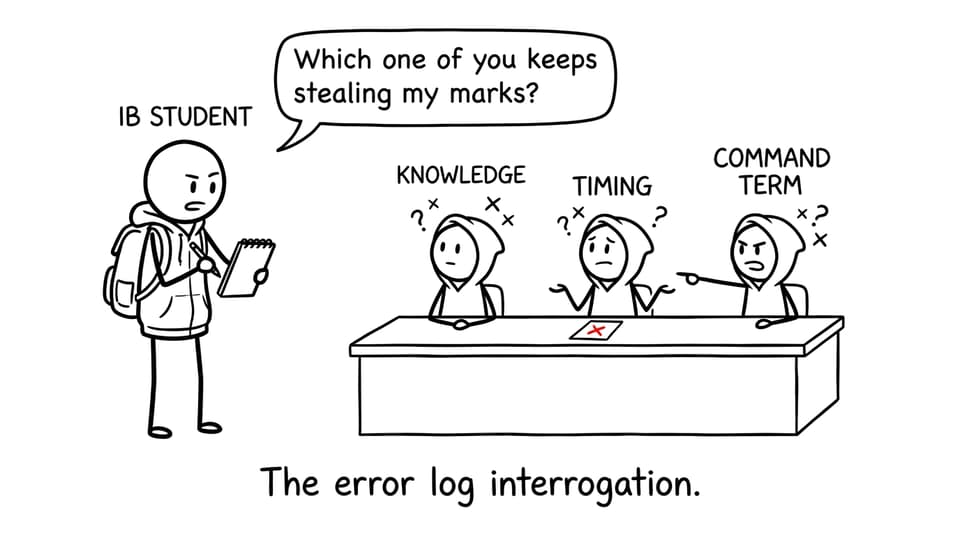
- Record whether each error came from knowledge, interpretation, method, or timing.
- Repeat missed question types after a delay.
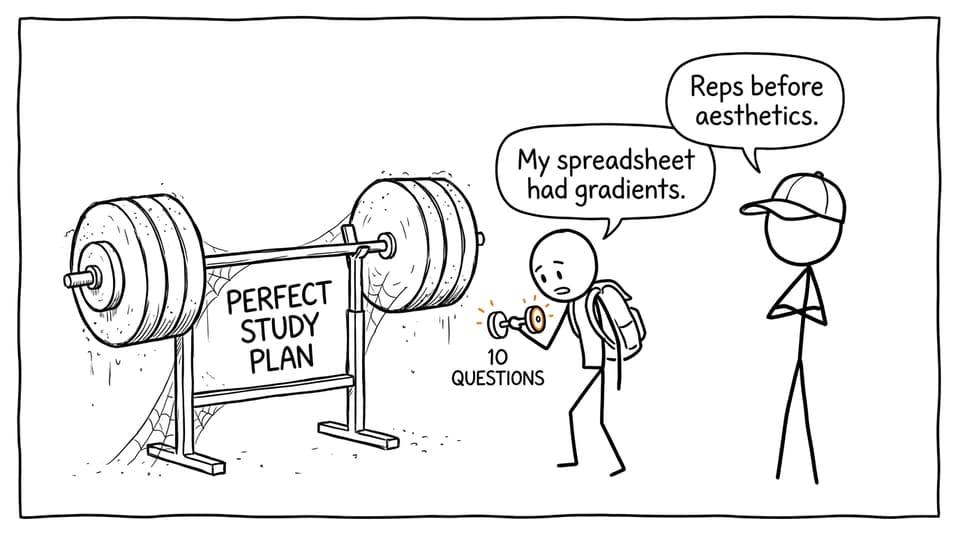
The question is not how many problems you complete. It is how many mistakes you prevent from recurring.
Feedback closes the gap between effort and marks
Students often know that an answer is weak without knowing why. RevisionDojo’s AI Chat and Grading tools are designed to shorten that diagnostic delay by providing markscheme-oriented feedback.
This is especially valuable for extended responses, where knowing the content is only part of the task. You must also respond to the command term, select relevant evidence, build analysis, and make your reasoning visible. The guide to using IB command terms effectively explains how words such as outline, explain, discuss, and evaluate require different forms of response.
AI feedback should still be treated as support rather than unquestionable authority. Compare important advice with your subject guide, teacher feedback, and official course requirements. For high-stakes coursework decisions, a qualified teacher or RevisionDojo Tutor can provide human judgment and context.
Timed practice makes the exam less surprising
Knowledge can disappear under pressure when it has never been practised under constraints. RevisionDojo addresses this through full-length IB mock exam preparation and examiner-written Predicted Papers.
Timed work helps expose problems that ordinary revision conceals:
- Spending too long on low-mark questions.
- Misreading command terms when rushed.
- Failing to plan extended responses.
- Leaving insufficient time to check calculations.
- Losing concentration during longer papers.
The simulation itself is only half the exercise. The review creates improvement. A completed Mock Exam should produce a short list of specific actions for the next week.
Who is most likely to see better RevisionDojo IB scores?
RevisionDojo is likely to provide the greatest value when you:
- struggle to identify your weakest topics;
- need more exam-style application;
- receive teacher feedback too slowly for frequent practice;
- use several disconnected resources and lose time switching between them;
- understand content but repeatedly lose marks through technique;
- need a structured routine across multiple IB subjects.
It may be less transformative if you only read Study Notes, copy solutions, or ask AI Chat for complete answers without attempting the work yourself. Watching someone else exercise does not make you stronger. Academic practice follows the same rule.
RevisionDojo also cannot replace your teacher, official subject documentation, or careful attention to school deadlines. Its IB exam-preparation app workflow is best viewed as an integrated training environment rather than an automatic grade generator.
A four-week plan to test whether RevisionDojo works for you
Instead of deciding from testimonials alone, run a small personal experiment. Use one subject and measure the outcome.
Establish a baseline
Complete a timed set before changing your routine. Record your percentage, completion time, and error categories. Keep the conditions consistent enough to make later comparison meaningful.
Run the daily improvement loop
For four or five sessions each week:
- Spend 10 minutes reviewing Flashcards.
- Use Study Notes for one specific gap, limited to 10 or 15 minutes.
- Complete 25 to 40 minutes of Questionbank practice.
- Review every lost mark.
- Write one to three error rules for your next attempt.
An error rule might be: “For an evaluate question, include evidence, limitations, and an explicit judgment.” This is more reusable than recording that question seven was wrong.
Add one timed session each week
Use a Mock Exam section or Predicted Paper under realistic conditions. Review it for longer than feels comfortable. If the same error appears twice, make it the first target of the following week.
Students with limited time can adapt the structure in RevisionDojo’s guide to preparing for IB exams in one month. The goal is not to touch every resource. It is to create a loop you can sustain.
Retest and compare
At the end of four weeks, complete another set of comparable length and difficulty. Compare:
- marks earned;
- time used;
- unanswered questions;
- repeated error types;
- confidence before and after marking.
One improved result can be noise. A pattern across several timed sets is more persuasive. Continue what works and change what does not.
The verdict: RevisionDojo works when practice becomes a system
The available evidence is promising but should be read with proportion. RevisionDojo reports average subject-score gains, substantial improvements in exam technique and markscheme understanding, and individual students moving from middle grades to 6s and 7s. These outcomes are largely based on company survey data and testimonials, so they demonstrate reported results rather than guaranteed causation.
The more durable reason to use RevisionDojo is structural. Its Questionbank, Study Notes, Flashcards, AI Chat, Grading tools, Predicted Papers, Mock Exams, Coursework Library, and Tutors connect the stages of effective IB preparation in one place.
A grade rarely changes because of one dramatic evening. It changes through dozens of small feedback loops, each one showing you where marks disappeared and what to do next. RevisionDojo is the ultimate IB resource for building those loops, but you must still run them.
Start with one subject, establish a baseline, and follow a focused routine for four weeks. If you need a broader framework, use RevisionDojo’s calm, repeatable system for earning an IB 7. Your results will give you a better answer than any advertisement can.